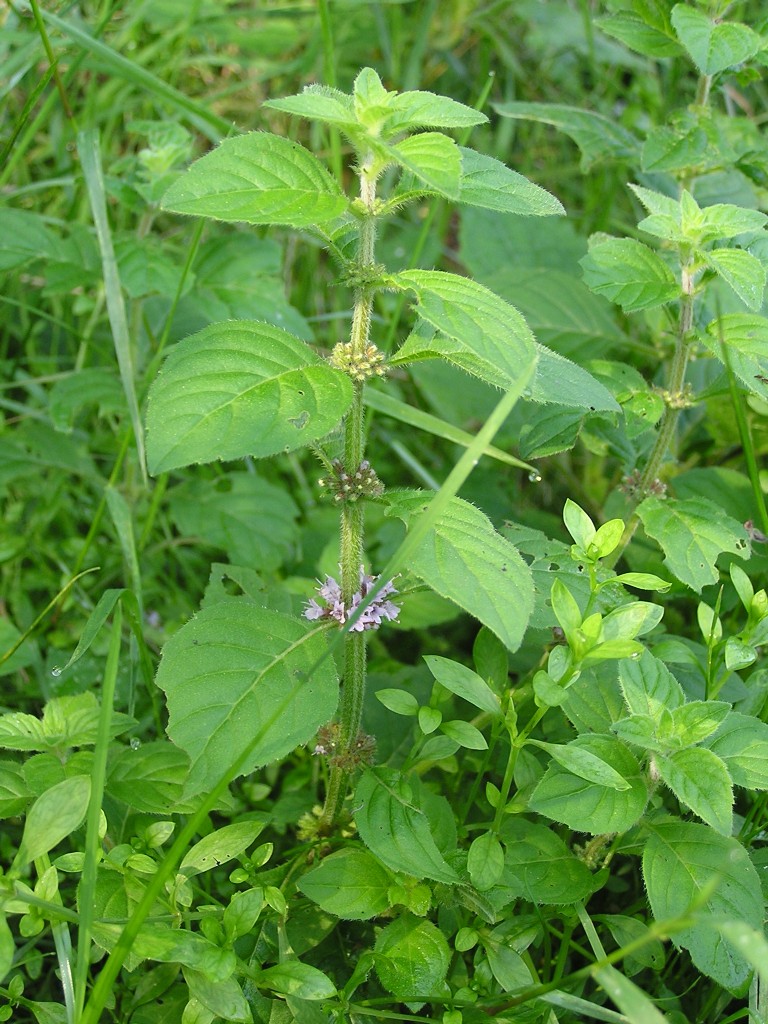
Photo: Michael Becker, CC BY-SA 3.0 · source

Herbaceous plant · Mint family (Lamiaceae)
Corn mint
Mentha arvensis
In other languages: Akkermunt (Nederlands) · Menthe des champs (Français)
Grows wild in Belgium.
Corn mint is a low, creeping mint with hairy, oval leaves and whorls of small lilac flowers in the leaf axils, spread along the whole stem. Unlike water mint, the stem does not end in a flower head but in a pair of leaves. It grows in damp arable fields and stubbles, wet grassland, and along ditches, ponds and woodland paths; in Belgium it is fairly common. The scent is minty but rather musty, less fresh than peppermint or water mint. From July to October it is a welcome nectar source for bees, hoverflies and butterflies.
Light
Sun or partial shade
preferably some sun
Moisture
Normal to wet
must not dry out
Hardiness
Fully hardy
down to -30 °C
Size
0.3 m
tall, 0.5 m wide
Flowering
July–October
| Pruning months | March and June |
|---|---|
| Height | 0.3 m |
| Native to Belgium | Yes |
| Flowering | July–October |
Identify
How to recognise it
- Growth habit
- Perennial with sprawling to ascending, often branched stems of 10–50 cm and creeping rhizomes.
- Leaf
- Opposite, oval to elliptic, 2–6 cm, scalloped to toothed, short-stalked and hairy. Smells of mint when crushed, but rather musty.
- Flower
- Small lilac, sometimes white, two-lipped flowers of 3–5 mm in dense, rounded whorls in the leaf axils, spread along the stem. The stem ends in a pair of leaves, not in a flower head. From July to October.
- Stem
- Square, hairy and often tinged red.
- Fruit/Seed
- Four small, smooth nutlets per flower, inside the hairy, bell-shaped calyx with short, triangular teeth.
- Confusion with
- Water mint has a rounded flower head at the top of the stem and a stronger scent. Whorled mint, a hybrid of corn mint and water mint, has a calyx with long, pointed teeth. Gypsywort also has flower whorls in the leaf axils, but tiny white flowers, deeply cut leaves and no mint scent.
Flowering: July–October · Pruning: March and June
In your garden
Why grow it?
- Flowers late, from July to October, when many other wild flowers are over.
- Bees, bumblebees, hoverflies and butterflies visit the flower whorls.
- A food plant for the caterpillars of the mint moth, a small purple-and-gold moth that flies by day.
- A natural ground cover for a damp spot: beside a pond, by a wildlife pool or in a wet corner of the garden.
- You can use the leaves in the kitchen like other mints, although the flavour is less fine.
Corn mint: where does it grow best?
- In the wild: damp arable fields and stubbles, wet grassland, the banks of ditches and ponds, wheel ruts and damp woodland paths.
- Sun to part shade.
- Moist to wet, fertile soil: loam, clay or sand; tolerates temporary flooding.
- In the garden: beside a pond or pool, in a wet corner, at the edge of a small bog garden or in a large pot.
Goes well with
- Ragged-robin: Pink flowers in spring, on the same wet ground.
- Water forget-me-not: Small pale blue flowers at the water’s edge.
- Purple-loosestrife: Tall purple spikes above it, in the same damp zone.
- Meadowsweet: Creamy plumes in summer, for a damp wild patch.
Maintenance
Corn mint: when and how to plant it?
- Buy plants from a nursery for native or pond plants, and ask for true corn mint, not a hybrid.
- Plant in April–May or September, 30–40 cm apart, in moist soil.
- To keep it in check, plant it in a bottomless bucket or large pot sunk into the ground up to the rim.
- Water regularly for the first few weeks, until it is well rooted.
- You can also sow it: scatter the fine seed in spring on moist seed compost in a pot and do not cover it, as it needs light to germinate.
- Never dig up plants from the wild; a nursery plant or a cutting from someone nearby is a better start.
Care
- Watering
- Keep the soil moist. Water in dry summer spells, or the leaves dry out.
- Feeding
- Not needed; on soil that is too rich it goes floppy and is more prone to rust.
- Spreading
- It spreads by underground runners. Chop off the edges with a spade every spring or keep it in a sunken pot.
- Mowing
- In a damp hay meadow it copes well with mowing. Mow the part where it grows only after flowering, or leave a strip uncut.
- Harvesting
- Pick young tips from May to September; this also keeps the plant compact.
Tip: Plant corn mint in a large bottomless pot sunk into the ground up to the rim: it stays in its place, and you can easily keep the soil around it moist.
Pruning and mowing
Pruning months: March and June.
When: In March, cut away the dead stems; in June, cut back by half for fresh leaves if you wish.
How:
- Leave the faded stems standing over winter: small insects overwinter in them.
- In March, cut them to just above the ground, before the new shoots appear.
- For fresh leaves, cut the plant back by half in June; it soon regrows and flowers afterwards.
- Cut stems with rust down to the ground straight away.
Propagation
- Cuttings
- From May to August, put shoot tips of 8–10 cm in a glass of water or moist cutting compost; they root within a few weeks.
- Division
- In March–April or September, chop off a piece of rhizome with shoots and replant it elsewhere.
- Seed
- Sow in spring on moist compost, uncovered. Cuttings are quicker and guarantee true corn mint.
Corn mint: how does it get through the winter?
Hardy to −30 °C.
- The stems die back in autumn; the plant overwinters as rhizomes in the soil.
- The dry stems give shelter to small insects in winter.
- Fully hardy; new shoots appear early in spring.
Diseases and pests
- Mint rust: Orange to brown pustules on leaves and stems, sometimes with distorted shoots in spring. Cut off affected parts straight away and put them in the household waste.
- Spreading: The rhizomes run far. Use a sunken pot or chop off the edges every year.
- Powdery mildew: White powder on the leaves in dry summers. Water at the base and cut back affected stems.
- Hybrids: Next to water mint, hybrids form easily. Propagate by cuttings if you want pure plants.
Through the year
- March: Cut down old stems. Chop off the edges.
- April: Plant or divide. New shoots.
- May: Pick tips. Take cuttings.
- June: Cut back by half for fresh leaves if you wish. Water in dry spells.
- July: First flower whorls. Bees and hoverflies.
- August: Full flower. Watch for rust.
- September: Flowering. Plant or divide.
- October: Last flowers. Leave the stems standing.
- December: Dormant underground.
You and this species
Did you know?
- In Greek mythology, Minthe was a nymph turned into a plant by a jealous Persephone; the name Mentha is said to come from her.
- In Asia, a closely related mint, sometimes treated as a form of corn mint, is grown on a large scale as a source of natural menthol.
- Where corn mint and water mint grow together, their hybrid, whorled mint, often appears, with features of both parents.