Photo: Michael Becker, CC BY-SA 3.0 · source

Herbaceous plant · Spurge family (Euphorbiaceae)
Annual mercury
Mercurialis annua
In other languages: Tuinbingelkruid (Nederlands) · Mercuriale annuelle (Français)
Grows wild in Belgium.
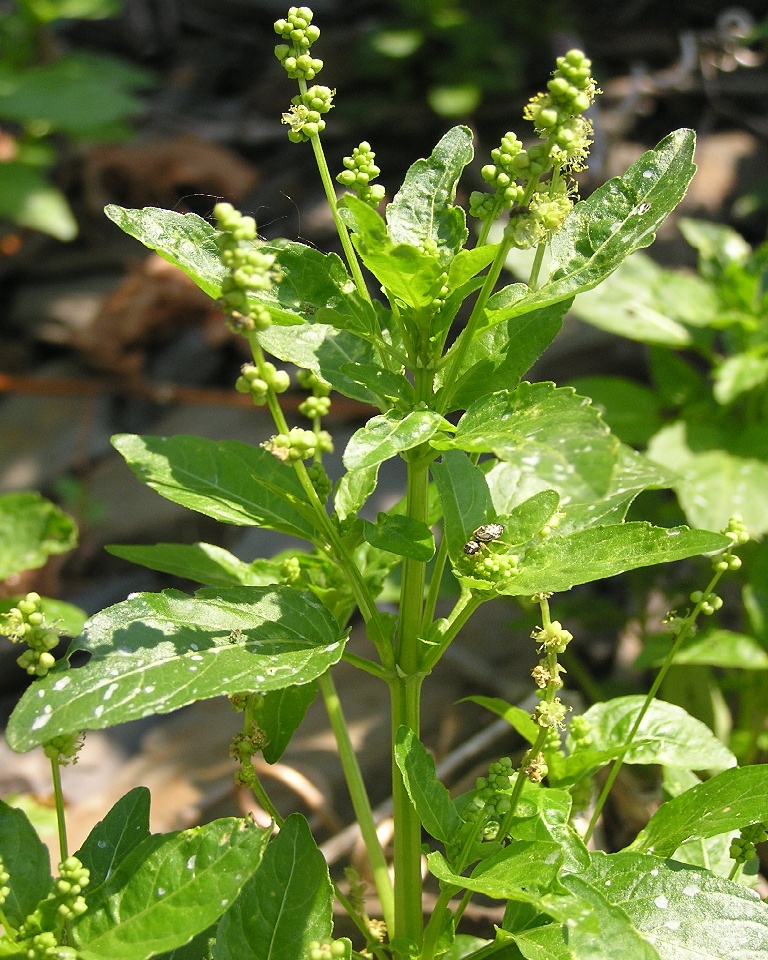
Annual mercury is an annual, hairless, light green plant of the spurge family, but without the white milky sap of the spurges. It is a well-known weed of vegetable gardens, borders, fields, nurseries and vineyards, and also grows between paving stones and at the foot of walls in villages and towns. In Belgium it is common, especially on loose, fertile soil that is regularly worked. You recognise it by its opposite, glossy, round-toothed leaves and by its separate male and female plants: the males carry long, upright spikes of green flowers, the females almost stalkless, bristly, two-lobed fruits in the leaf axils. It is poisonous, flowers from spring until the first frost and has little value for pollinators, because it is pollinated by the wind.
Caution: Annual mercury is poisonous to people and animals. Eating it can cause stomach and gut upsets. Children must not eat it, and chickens, rabbits, guinea pigs, horses and other livestock are also at risk. In the vegetable patch, don’t confuse it with edible plants such as orache or goosefoot. Wear gloves if you do a lot of weeding and wash your hands afterwards. If swallowed, call a doctor or the Poison Centre.
Light
Sun or partial shade
preferably some sun
Moisture
Normal
no wet feet
Hardiness
down to -10 °C
protect in harsh winters
Size
0.4 m
tall, 0.3 m wide
Flowering
May–November
| Height | 0.4 m |
|---|---|
| Native to Belgium | Yes |
| Flowering | May–November |
Identify
How to recognise it
- Growth habit
- Annual, hairless, much-branched plant of 10–50 cm, with a square, slightly glossy stem.
- Leaf
- Opposite, oval to lance-shaped, 2–5 cm, light green, glossy and round-toothed, with a short stalk.
- Flower
- Male and female on separate plants. Male plants: small clusters of green flowers on long, upright, stalked spikes. Female plants: 1–3 almost stalkless flowers in the leaf axils. From May until the first frost.
- Fruit/Seed
- A two-lobed, bristly capsule of 3–4 mm with two seeds, which bursts open and flings the seeds away.
- Roots
- A short taproot with fine side roots: the plant is easy to pull up.
- Confused with
- Dog’s mercury is perennial, hairy and unbranched and grows in woods. In the vegetable patch, young plants of orache or goosefoot sometimes look similar, but they have alternate, often mealy leaves. Spurges have white milky sap; annual mercury does not.
Flowering: May–November
In your garden
Why grow it?
- To be honest, it is mainly a weed: it is wind-pollinated and has little to offer bees and butterflies.
- The seeds carry a small, fatty appendage; ants carry them off to their nests.
- A clear indicator: where there is plenty of annual mercury, the soil is loose, fertile and often cultivated.
- An instructive plant for learning to tell male and female plants apart: such a strict separation is fairly rare among herbaceous plants.
- It keeps growing in late autumn, when almost everything else has finished flowering, and keeps bare soil covered.
Annual mercury: where does it grow best?
- In the wild as a weed in vegetable gardens, borders, fields, nurseries, vineyards, on building land and in cracks between paving stones and at the foot of walls.
- Sun to partial shade.
- Loose, fertile, often cultivated soil, from sand to loam; moderately moist.
- In the garden mainly on dug beds and bare soil; in a dense, permanent planting or under mulch it has little chance.
Goes well with
- Ground ivy: A dense native ground cover that takes up bare soil, so annual mercury gets less of a chance.
- Phacelia: A green manure that quickly covers bare vegetable beds and is loved by bees.
- Wild strawberry: Covers the ground in a partly shaded edge and gives you fruit as well.
- Herb Robert: Self-seeds in the same corners, but is a good plant for small bees.
Maintenance
Annual mercury: when and how to plant it?
- Sowing or planting is neither necessary nor advisable: annual mercury is poisonous and arrives by itself, with compost, imported soil or potted plants.
- If you still want it in a wild corner, leave a few self-sown plants in a spot where children, pets and chickens don’t go.
- If you want to get rid of it, hoe or weed every 2–3 weeks from April to October, before the female plants have ripe fruits.
- Wear gloves if you are doing a lot of weeding, and wash your hands afterwards.
- Keep the soil covered with mulch, a green manure or dense planting: on covered soil far fewer seeds germinate.
- Never take plants or soil from the wild to plant elsewhere: this also stops you bringing in weeds and their seeds.
Care
- Weeding
- Pull or hoe young plants before they set seed. Only the female plants make seed: those are the most important ones to remove in time.
- Mulching
- A layer of compost, leaves or wood chips on bare soil strongly reduces germination.
- Compost
- Plants with ripe fruits don’t belong on a cold compost heap, because the seed survives there. Put them in the green waste bin or a hot compost.
- Feeding
- Not needed. Rich, bare soil is exactly what annual mercury loves.
- Don’t dig the soil
- Every time you dig, you bring seed up from the soil. Disturb the ground as little as possible.
Tip: Weed out the female plants above all, with the bristly little balls in the leaf axils, before they ripen: the male plants don’t make seed.
Pruning and mowing
When: Pruning doesn’t apply. Weed or hoe from April to October, before the fruits are ripe.
How:
- Pull plants up with the root, ideally when the soil is moist.
- Hoe in dry weather: the seedlings then shrivel at once.
- Don’t wait until the female plants have bristly fruits: these burst open and scatter the seed.
- Don’t leave the last plants standing in autumn: in a mild winter they simply keep flowering.
Caution: Wear gloves and wash your hands after weeding; keep pulled plants away from children and animals.
Propagation
- Seed (how it spreads)
- It spreads only by seed. The ripe fruits burst and fling the seeds away, and ants carry them further.
- Seed bank
- The seed stays viable in the soil for a few years and germinates from spring to autumn whenever the soil is worked.
Annual mercury: how does it get through the winter?
Hardy to −10 °C: protect in harsh winters.
- Annual mercury is annual: frost kills the plants.
- In mild winters some plants survive and keep flowering.
- The seed overwinters in the soil and germinates from spring onwards.
Diseases and pests
- Too many seedlings: On loose, rich soil it comes up in masses. Weed early and often, and cover the soil.
- Seed bank: After a year with lots of seed it keeps coming back for years. Stop it setting seed and persevere: the store in the soil will then shrink.
- Confusion with edible plants: Young plants of orache and goosefoot sometimes look similar. In the vegetable patch, only pick what you recognise for sure.
- Poisonous to animals: Chickens, rabbits and guinea pigs must not eat it. Don’t feed pulled weeds to animals.
Through the year
- March: First seedlings on bare soil.
- April: Hoe in dry weather. Apply mulch.
- May: First flowers. Weed before seed is set.
- June: Male and female plants are easy to tell apart. Weed.
- July: Weed; the female plants first.
- August: Weed. Cover bare soil with a green manure.
- September: Weed. New seedlings after harvesting.
- October: Remove the last plants.
- November: Frost kills the plants; in mild winters they keep flowering.
You and this species
Did you know?
- The name Mercurialis refers to the Roman god Mercury, who according to the Roman writer Pliny is said to have discovered the plant.
- Male and female plants are separate, and the pollen is carried from one to the other by the wind. Scientists therefore use the plant to study how plants become male or female.
- Although it belongs to the spurge family, annual mercury has no white milky sap.