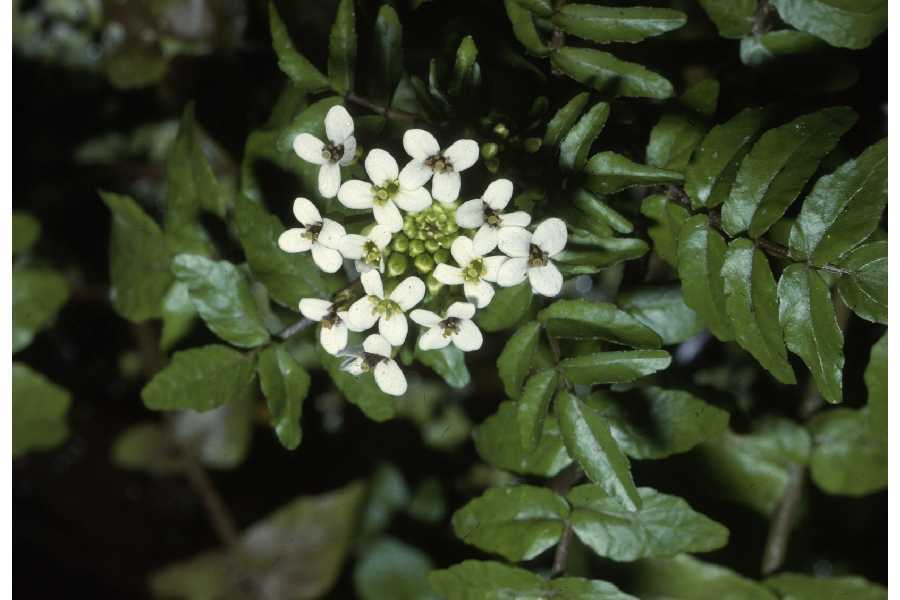
Photo: Wikimedia Commons, Public domain · source

Herbaceous plant · Cabbage family (Brassicaceae)
Water-cress
Nasturtium officinale
In other languages: Witte waterkers (Nederlands) · Cresson de fontaine (Français)
Grows wild in Belgium.
Water-cress is a perennial water plant with hollow, creeping or floating stems, glossy dark green, pinnate leaves and small clusters of white, four-petalled flowers. It grows in clear, flowing or spring-fed water: springs, streams, ditches fed by seepage and wet banks, often on chalky ground. In Belgium it is fairly common, especially along streams and spring-fed ditches. You can recognise it by the peppery, mustard-like taste of the leaves and by the stems that root at the nodes in the water. It is the wild ancestor of the cultivated watercress sold in shops, and its dense mats give shelter to small water creatures in streams and ditches.
Caution: Never eat raw water-cress picked in the wild. Water that flows through pastures with sheep or cattle can carry larvae of the liver fluke, which attach themselves to the leaves. Grow your own in clean water. Do not confuse it with poisonous members of the carrot family that grow in the same water, such as fine-leaved water-dropwort and cowbane.
Light
Sun or partial shade
preferably some sun
Moisture
Moist to wet
must not dry out
Hardiness
Fully hardy
down to -20 °C
Size
0.3 m
tall, 0.6 m wide
Flowering
May–September
| Pruning months | June and September |
|---|---|
| Height | 0.3 m |
| Native to Belgium | Yes |
| Flowering | May–September |
Identify
How to recognise it
- Growth habit
- Perennial plant of marshes and water, with sprawling to floating, hollow stems of 30–100 cm that root at the nodes; the tips rise 10–40 cm above the water.
- Leaf
- Pinnate with 3–9 oval to round leaflets, the end leaflet the largest; glossy dark green and hairless, with a peppery mustard taste.
- Flower
- Small white flowers of 4–6 mm with four petals and yellow anthers, in short clusters at the stem tips. From May to September.
- Fruit/Seed
- Slightly curved pods of 1–2 cm on spreading stalks, with the seeds in two rows in each half.
- Stem
- Hollow, juicy and often tinged purple, with fine white roots at the nodes.
- Confusion with
- Narrow-fruited water-cress has its seeds in one row and longer, slimmer pods. Large bitter-cress has violet anthers and a solid stem. Fool’s-water-cress and lesser water-parsnip grow in the same places and also have pinnate leaves, but flower in umbels; be extra careful with poisonous members of the carrot family such as fine-leaved water-dropwort and cowbane.
Flowering: May–September · Pruning: June and September
In your garden
Why grow it?
- Flowers from May to September; hoverflies, small bees and flies visit the little white flowers.
- A food plant for the caterpillars of the green-veined white, a butterfly that lives on wild members of the cabbage family.
- Dense mats in streams and ditches give shelter to water creatures such as freshwater shrimps, insect larvae and young fish.
- In spring water it often stays green all winter: one of the few fresh green plants in the cold season.
- A classic edible plant with a peppery taste, grown for centuries; grow it yourself in clean water rather than picking it in the wild.
Water-cress: where does it grow best?
- In the wild: springs, streams, seepage-fed ditches, wet banks and boggy spots in stream valleys.
- Clear, well-oxygenated, preferably flowing water, shallow (up to about 30 cm), often chalky.
- Sun to part shade; in cool spring water it stays fresh even in summer.
- In the garden: in the shallow margin of a pond with clean water, in a small stream or rill, or in a pot standing in a saucer of water.
Goes well with
- Brooklime: Small blue flowers in the same shallow, flowing water.
- Water forget-me-not: Pale blue flowers at the water’s edge.
- Water mint: Scented lilac flower heads in the wet margin.
- Marsh-marigold: Golden-yellow flowers in spring at the pond edge.
Maintenance
Water-cress: when and how to plant it?
- Buy plants from a nursery for water and marginal plants, or seed from a seed supplier.
- Plant in April–June in the shallow margin, with the roots in the mud and 5–10 cm of water above, or in a planting basket with heavy soil.
- You can sow from March to May: scatter the fine seed on wet compost in a pot and stand it in a saucer of water.
- After 4–6 weeks, set the young plants 15–20 cm apart in shallow water.
- Without a pond: keep a large pot of clay soil permanently in a saucer of water in a cool, part-shaded spot, and change the water regularly.
- Never pick or dig up water-cress in the wild: the plant belongs there, and wild water may be contaminated (see ‘Take care’).
Care
- Watering
- Always keep it wet. In a pot or saucer, change the water regularly, especially in summer: still, warm water soon goes stale.
- Feeding
- Not needed in a pond; extra nutrients mainly feed algae. In a pot, a little compost in spring is enough.
- Harvesting
- Cut young shoot tips from April to October; this keeps the plant compact and bushy.
- Spreading
- In a small pond it spreads quickly. Pull out overlong stems; broken pieces easily root elsewhere.
- Flowering stems
- Cut off flowering tips if you mainly want leaves, but leave a few for the insects.
Tip: A bunch of shop-bought watercress often roots in a glass of water. Then put the rooted stems in a pot standing in a saucer of water in a cool spot, and you can harvest your own cress for weeks.
Pruning and mowing
Pruning months: June and September.
When: In June, cut back the old flowering stems; in September, thin the mats.
How:
- In June, cut stems that have run to flower back to a few nodes above the water; tender new shoots soon follow.
- In September, thin the mats by pulling out old stems, so the water stays open.
- Leave some of the flowers for hoverflies and small bees.
- Leave the removed material on the bank for a day so water creatures can crawl back, then compost it.
Propagation
- Cuttings
- From April to September, put 10 cm pieces of stem with a few nodes in a glass of water: roots appear within a week.
- Seed
- Sow from March to May on wet compost, in a saucer of water.
- Rooted stems
- In spring, detach rooted pieces of stem and replant them elsewhere in shallow water.
Water-cress: how does it get through the winter?
Hardy to −20 °C.
- In spring water or flowing water it often stays green all winter.
- In hard frost the stems above the water freeze; the plant regrows in spring from the nodes under water.
- In a pot: in hard frost, move it against a wall or into a cool shed, so the root ball does not freeze solid.
Diseases and pests
- Aphids: On young tips in summer. Rinse them off with water; ladybirds and hoverfly larvae help.
- Flea beetles: Small jumping beetles pepper the leaves with holes. Keep the plant really wet: they like dry conditions.
- Caterpillars: Caterpillars of white butterflies sometimes eat the leaves. Damage usually stays limited; let them be.
- Rotting stems: In warm, still water the stems rot. Change the water or move the plant to a cooler spot.
Through the year
- March: Sow in a saucer of water.
- April: Plant in the pond margin. Harvest the first tips.
- May: First flowers. Root cuttings in water.
- June: Cut back flowering stems for new shoots.
- July: Flowering. Change the water in hot weather.
- August: Flowering. Watch for aphids and caterpillars.
- September: Last flowers. Thin the mats.
- October: Last harvest of young tips.
- December: Often green in spring water; protect pots from hard frost.
You and this species
Did you know?
- Nasturtium comes from the Latin nasus tortus, ‘twisted nose’: the peppery taste makes you wrinkle your nose.
- The garden nasturtium shares the name because it tastes just as peppery, but it is not related to water-cress at all.
- In England and France, watercress was grown on a large scale from the 19th century onwards in shallow beds fed by clear spring water.