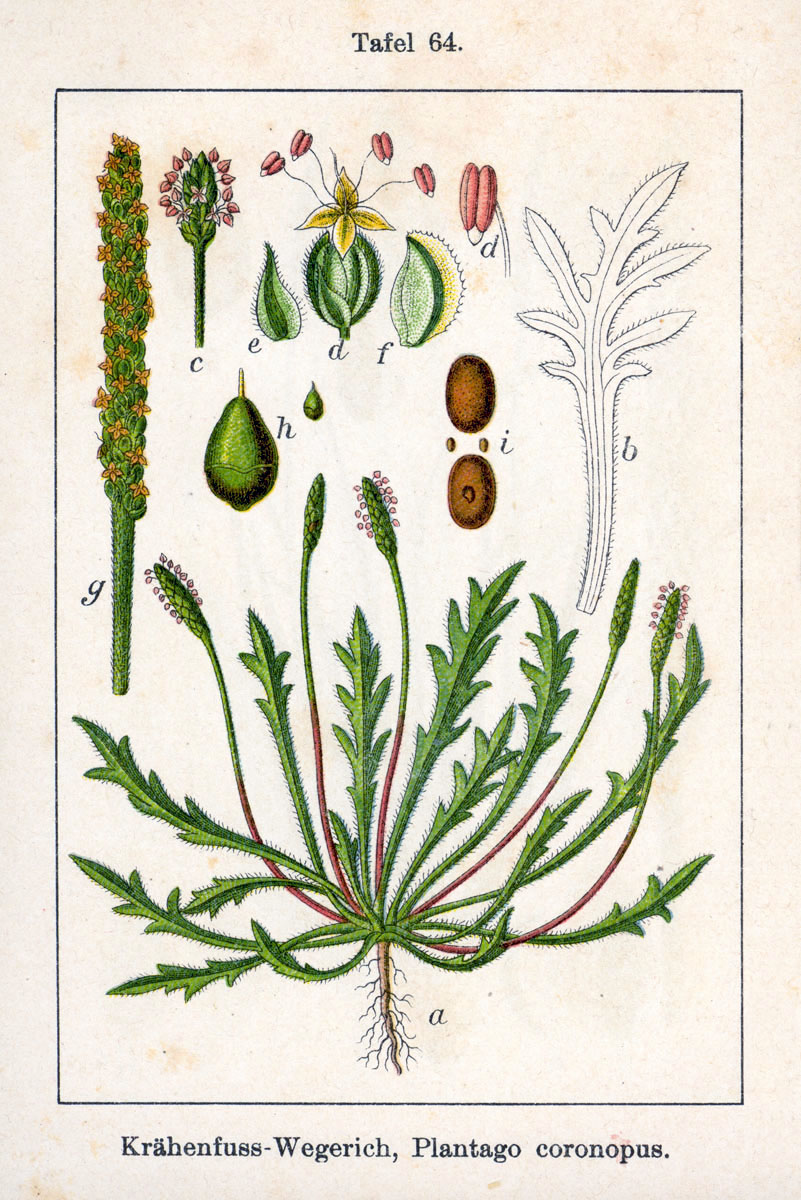
Photo: Johann Georg Sturm (Painter: Jacob Sturm), Public domain · source

Herbaceous plant · Plantain family (Plantaginaceae)
Buck’s-horn plantain
Plantago coronopus
In other languages: Hertshoornweegbree (Nederlands) · Plantain corne-de-cerf (Français)
Grows wild in Belgium.
Buck’s-horn plantain is a low annual to biennial plantain, sometimes living a few years, with a flat, star-shaped rosette of narrow, deeply cut leaves that look like a deer’s antlers. It grows naturally on the coast: in dunes, on dykes, along sandy paths and at the edges of salt marshes. Inland you see it more and more along roads that are salted in winter, on central reservations, in car parks and between paving stones. You can recognise it by its hairy, slightly fleshy leaves with narrow side lobes and the many short, brownish flower spikes on curved stalks. It is not a major plant for insects, as it is mainly wind-pollinated, but the young leaves make a crunchy, slightly salty leaf vegetable that is easy to sow yourself.
Light
Full sun
warm and bright
Moisture
Dry to normal
no wet feet
Hardiness
Fully hardy
down to -20 °C
Size
0.15 m
tall, 0.2 m wide
Flowering
May–September
| Pruning months | June–August |
|---|---|
| Height | 0.15 m |
| Native to Belgium | Yes |
| Flowering | May–September |
Identify
How to recognise it
- Growth habit
- Flat, star-shaped leaf rosette 5–20 cm across, with many flower stalks of 5–20 cm that first curve along the ground and then rise.
- Leaf
- Narrow, 2–15 cm long, usually pinnately lobed with a few narrow side lobes like antlers; sometimes almost untoothed. Hairy and slightly fleshy, especially in salty places.
- Flower
- Dense, cylindrical spikes 2–6 cm long on hairy, leafless stalks, with tiny brownish flowers and pale yellow anthers, from May to September.
- Fruit/Seed
- Small capsules that open with a lid, containing a few seeds that turn sticky when wet.
- Roots
- A taproot, which helps it cope well with drought.
- Confusion with
- Sea plantain has fleshy, linear, untoothed and usually hairless leaves without side lobes. Ribwort plantain has broader, lance-shaped leaves with clear veins and short, blackish-brown spikes on long, furrowed stalks. Buck’s-horn plantain: hairy, narrow leaves with antler-like lobes in a flat star.
Flowering: May–September · Pruning: June–August
In your garden
Why grow it?
- A true pioneer of salty, dry and trampled places: dunes, dykes, coastal paths and motorway verges, where few other plants survive.
- An edible plant: the young leaves are crunchy and slightly salty, and are grown as a salad in Italy under the names minutina or erba stella.
- Seed-eating birds such as finches and sparrows pick up the seeds; the flowers give some pollen, but are mainly wind-pollinated.
- A tough plant for the gaps between paving slabs and bricks, a gravel path or a salt-sprayed coastal garden.
- Low, with flat rosettes: ideal for a dry, sunny spot where taller plants do not fit.
Buck’s-horn plantain: where does it grow best?
- In the wild on the coast: in dunes, on dykes and sea defences, along sandy paths and at the edges of salt marshes. Inland, increasingly along salted roads, on central reservations and in car parks.
- Full sun.
- Dry to moderately moist, sandy or gravelly soil. It tolerates salt, trampling and poor soil, but is crowded out by more vigorous plants on rich soil.
- In the garden, in the joints of a patio, a gravel path, a dry rock garden, a coastal garden or in the vegetable plot as a leaf crop.
Goes well with
- Thrift: Pink pompoms above a low tuft; together they give a seaside feel on dry soil.
- Biting stonecrop: A small yellow succulent for the same paving joints and gravel paths.
- Sea kale: A bold coastal plant with blue-grey leaves, handsome in a sandy coastal garden.
- Rocket: In the vegetable plot: together a peppery, slightly salty salad, and also sown in late summer.
Maintenance
Buck’s-horn plantain: when and how to plant it?
- Buy seed from a seed merchant, where it is often sold as minutina or erba stella, or seed of native origin from a nursery that specialises in native plants.
- As a leaf crop, sow in March–May or August–September, in rows 20–25 cm apart, barely covering the seed.
- Thin the seedlings to 10–15 cm apart in the row.
- Keep the soil moist until the seed has germinated. After that, water only in dry spells; a little more often in the vegetable plot, so the leaves stay tender.
- For gaps between paving or on gravel: scatter the seed into the joints in September–October or March–April and let nature take its course.
- Never take plants or seed from dunes or other nature areas.
Care
- Watering
- In the vegetable plot, water in dry weather to keep the leaves tender. In paving joints and gravel it is not needed.
- Feeding
- Not needed. In the vegetable plot, ordinary soil that is not too rich is enough; on poor soil it stays compact.
- Harvesting
- From 6–8 weeks after sowing, pick the outer leaves, or cut the whole rosette just above the heart: it will grow back.
- Flower stalks
- Cut off flower stalks if you want to harvest leaves: once the plant flowers, the leaves become tougher.
- Self-seeding
- Let a few plants set seed: it seeds itself into joints and onto bare patches.
Tip: Sow buck’s-horn plantain in late summer: you will then have fresh, crunchy leaves all winter and in early spring, when there is little else to harvest in the vegetable plot.
Pruning and mowing
Pruning months: June–August.
When: From June to August, cut off the flower stalks of plants grown for the kitchen. Plants in paving joints or a wild corner need nothing.
How:
- Cut the spikes off with their stalks at the rosette as soon as they appear.
- Between paving or in a wild corner, leave the spikes, so that birds can eat the seeds and the plant can self-seed.
- In autumn, pull out spent, dried-up plants and put them on the compost heap.
Propagation
- Seed
- Sow in spring or late summer. The seed germinates readily and you can pick young leaves after a few weeks.
- Self-seeding
- Let seed ripen: the seeds turn sticky when wet and can cling to shoes and tyres. That is how it spreads along paths and roads.
Buck’s-horn plantain: how does it get through the winter?
Hardy to −20 °C.
- Rosettes from a late-summer sowing usually overwinter well and give leaves early in spring.
- After flowering and setting seed most plants die; some live for a few years.
- Hardy to about −20 °C, especially on dry, free-draining soil.
Diseases and pests
- Tough leaves: After flowering or in drought the leaves turn tough. Cut off flower stalks, water and sow again every couple of months.
- Slugs: Young seedlings in the vegetable plot are sometimes eaten. Sow a little more thickly and keep the edges open and dry.
- Crowded out: In a lawn or border it is smothered by more vigorous plants. It needs open, bare ground.
- Sand in the leaves: The rosettes lie flat on the ground. Rinse the leaves well before use.
Through the year
- March: First sowing as a leaf crop. Overwintered rosettes give leaves.
- April: Sow and thin. Harvest overwintered plants.
- May: Harvest. Flowering begins.
- June: Flowering. Cut off flower stalks on plants for the kitchen.
- July: Flowering in paving and verges. Remove flower stalks in the vegetable plot, water in dry spells.
- August: Sow for autumn and winter. Cut off the last flower stalks.
- September: Last sowing. Harvest.
- October: Clear spent plants. Sow into paving joints.
- December: Rosettes overwinter.
You and this species
Did you know?
- The name coronopus comes from the Greek korōnē, ‘crow’, and pous, ‘foot’: the cut leaf resembles a crow’s foot.
- It is moving inland along motorways: road salt makes the verges salty, and this coastal plant copes with that better than most other plants.
- In Italy it is called erba stella, ‘star herb’, after its star-shaped rosette.