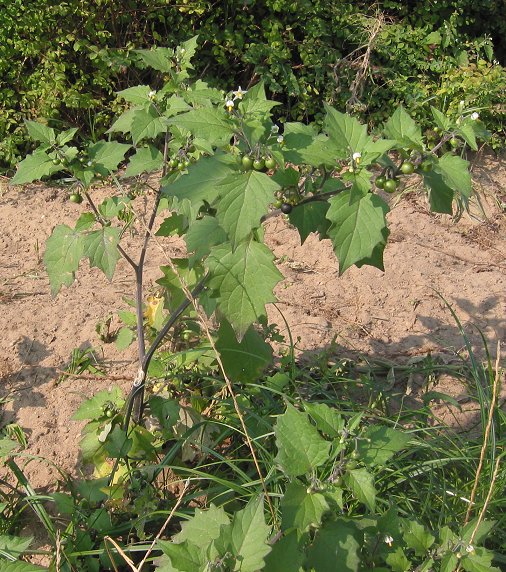
Photo: Wikimedia Commons, CC BY-SA 3.0 · source

Herbaceous plant · Nightshade family (Solanaceae)
Black nightshade
Solanum nigrum
In other languages: Zwarte nachtschade (Nederlands) · Morelle noire (Français)
Grows wild in Belgium.
Black nightshade is an annual of the nightshade family, related to potato and tomato. It grows in fields, vegetable gardens and borders, on waste ground and compost heaps, and it is common throughout Belgium, especially on rich soil. From June to October it carries small, white, star-shaped flowers with a yellow cone of stamens, followed by small clusters of green berries that turn black. The plant is poisonous, especially the unripe green berries and the leaves, and to children the black berries look like bilberries. Birds eat the ripe berries and spread the seeds, so it often turns up in unexpected places.
Caution: Black nightshade is poisonous because of glycoalkaloids such as solanine, especially in the unripe green berries and the leaves. Young children are most at risk, because the black berries look like bilberries; dogs, cats, rabbits, horses and other livestock can also become ill. Do not eat any part of the plant, do not let children pick the berries and clear away plants with berries in gardens where children or animals play. If swallowed: call the Belgian Poison Centre straight away (070 245 245).
Light
Sun or partial shade
preferably some sun
Moisture
Normal
no wet feet
Hardiness
down to 0 °C
protect in harsh winters
Size
0.4 m
tall, 0.4 m wide
Flowering
June–October
| Height | 0.4 m |
|---|---|
| Native to Belgium | Yes |
| Flowering | June–October |
Identify
How to recognise it
- Habit
- Annual, upright to spreading, branched plant of 10–60 cm.
- Leaf
- Oval to diamond-shaped, 3–7 cm, with an untoothed or coarsely wavy-toothed edge; dark green, hairless to slightly hairy.
- Flower
- White, about 1 cm, star-shaped with five swept-back petals and a yellow cone of stamens; in small drooping clusters of 3–8, from June to October.
- Fruit/Seed
- Round berry of 6–10 mm, green at first, dull to glossy black when ripe, with many small seeds. The calyx stays small around the berry.
- Stem
- Green or tinged purple, somewhat angular, often with small bumps along the ridges.
- Confusion with
- Bittersweet is a woody climber with purple flowers and red berries. Deadly nightshade is much larger, with brownish purple bell flowers and large, glossy black berries in a star-shaped calyx, and is highly poisonous. Children confuse the berries with bilberries or blackcurrants.
Flowering: June–October
In your garden
Why grow it?
- Flowers for a long time, until the first frost; hoverflies and small bees sometimes take its pollen, although the plant often pollinates itself.
- The ripe berries are eaten by birds, which spread the seeds.
- An interesting plant for getting to know the nightshade family: its flower looks very much like that of potato and tomato.
- To be honest: in the vegetable garden it is mainly a weed to keep in check, especially where children play.
- An indicator of rich, cultivated soil.
Black nightshade: where does it grow best?
- In the wild: fields, especially of maize, potatoes, beet and vegetables, vegetable gardens, compost heaps and waste ground.
- Sun to half shade.
- Rich, loose, cultivated soil, especially where a lot of manure or compost has been used.
- In the garden it turns up by itself in vegetable plots and borders; keep it out of play areas and pastures.
Goes well with
- Common poppy: Choose a cornfield flower border with poppies instead of weeds: the same bare soil, more for bees.
- Cornflower: Blue flowers for bees on the same open, cultivated soil.
- Pot marigold: An edible ornamental that fills gaps in the vegetable garden.
- Phacelia: A green manure that covers the soil after harvest and so slows germination; much loved by bees.
Maintenance
Black nightshade: when and how to plant it?
- Do not sow or plant it: black nightshade arrives by itself, via birds, compost, manure and imported soil.
- Learn to recognise the young plants by their oval, dark green leaves so that you can weed them out early.
- Weed out young plants with a hoe or by hand before they flower: they pull up easily.
- In a garden with children or pets, do not let a single plant produce berries.
- Do not put plants with berries on a cold compost heap: the seeds survive there.
- Never dig plants up from the wild and do not spread it on purpose: there are better choices for birds and insects.
Care
- Weeding
- Weed every few weeks from June to September; it grows fast in warm weather.
- Berries
- Remove plants before the berries ripen and wash your hands afterwards.
- Mulching
- A mulch or green manure keeps the soil covered and slows germination.
- Waste
- Plants with berries go in the green waste bin, not on a cold compost heap.
- Feeding
- It thrives mainly on heavily manured soil, so do not overfeed your vegetable garden.
Tip: Weed out black nightshade at the latest when you see the first green berries: that way children cannot eat them and hundreds of new seeds do not end up in your vegetable garden.
Pruning and mowing
When: No pruning: weed the plants out before they flower, or at the latest before the berries ripen, from June to September.
How:
- Pull up the whole plant with its root; cut stems regrow.
- Take away plants with berries in a bag.
- Mowing helps little: it branches low down and flowers again.
Caution: Never let children pick or taste the berries, not even when they are ripe and black.
Propagation
- Seed
- Each berry contains many seeds. Birds eat the berries and spread the seed, which stays viable in the soil for years and germinates from May, once the soil is warm.
- Compost and manure
- The seed survives in cold compost and in manure, and so reaches your vegetable garden. Do not spread compost containing berries on your beds.
Black nightshade: how does it get through the winter?
Hardy to 0 °C: protect in harsh winters.
- The plant dies at the first night frost.
- The seed overwinters in the soil and only germinates in late spring, when the soil is warm.
- Clear away dead plants with berries before winter.
Diseases and pests
- Poisonous berries: Children find the black berries attractive. Weed the plant out before the berries ripen.
- Late blight: Like potato and tomato, it can be infected by late blight and so help keep the disease going. Weed it out near potatoes and tomatoes.
- Rapid fruiting: One plant produces many berries. Do not let any reach ripeness.
- Confusion with edible berries: Teach children that black berries on a low plant in the vegetable garden are not bilberries.
Through the year
- May: First seedlings as the soil warms up. Hoe.
- June: Flowering begins. Pull up young plants.
- July: Flowers and first green berries. Weed.
- August: The berries turn black. Clear away plants with berries.
- September: Last round of weeding, especially after harvesting potatoes and vegetables.
- October: Last flowers; the first frost kills the plant.
- November: Clear away dead plants with berries.
You and this species
Did you know?
- Black nightshade is related to potato, tomato and aubergine; its flowers look very much like potato flowers.
- ‘Nightshade’ is an old name for poisonous plants of this family; exactly where the name comes from is uncertain.
- The seed can survive in the soil for years and only germinates once the soil is warm; that is why the plant appears late in the season.