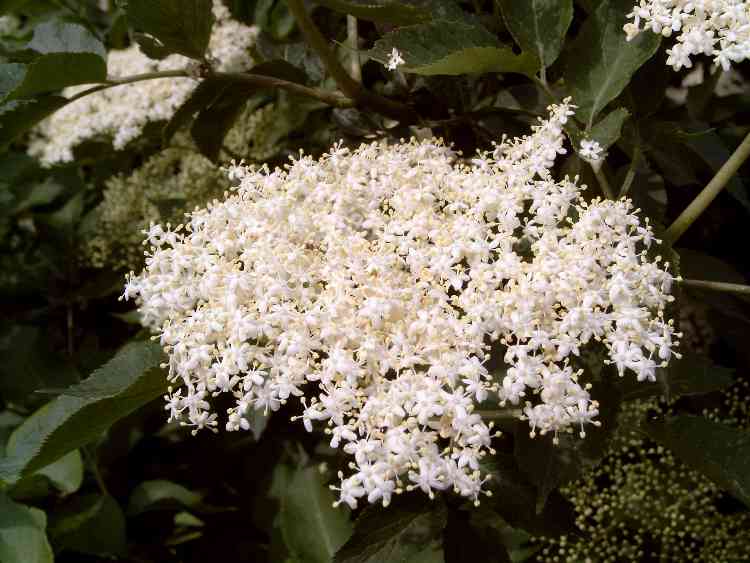
Photo: Kku, Public domain · source

Shrub · Moschatel family (Adoxaceae)
Elder
Sambucus nigra · also: Elderberry, Black elder
Elder is a fast-growing native shrub or small tree of 3–10 m. In May–June it carries large, flat heads of creamy, fragrant flowers, which you can turn into cordial, tea or fritters. In August–September it hangs with purple-black berries, delicious cooked in jam or syrup and a feast for dozens of bird species. It grows almost anywhere, tolerates partial shade and soon grows back after hard pruning. Raw berries, leaves and stems are mildly poisonous: only eat the berries cooked.
Caution: Raw berries, leaves and stems are mildly poisonous (nausea, vomiting): only eat the berries cooked and remove the green stalks.
Light
Sun to shade
not fussy
Moisture
Normal
no wet feet
Legal basis
Any garden soil
any pH
Hardiness
Throughout Belgium
no protection needed
Size
3–10 m, shrub or small tree
tall
Flowering
May–June
| Pruning months | November–March |
|---|---|
| Height | 3–10 m, shrub or small tree |
| Native to Belgium | Yes |
| Good for bees, butterflies and birds | Yes, for birds |
| Poisonous to people and pets | In part: see Caution above |
| Flowering | May–June |
Identify
Elder: how do you recognise it?
- Habit
- Shrub or small tree of 3–10 m, often multi-stemmed, with arching, overhanging branches.
- Leaf
- Opposite, pinnate with 5–7 toothed, pointed leaflets. Crushed, the leaf smells unpleasant.
- Bark
- Grey-brown, corky and furrowed; young twigs with conspicuous warts (lenticels) and soft white pith.
- Flower
- Large flat heads of creamy, fragrant flowers in May–June.
- Fruit
- Hanging heads of purple-black berries (August–September).
Flowering: May–June · Harvest and fruit: May–June and August–September · Pruning: November–March
Identify by feature: Pinnate leaves · Opposite leaves · Black berries
Looks like it, but isn’t
- Ash Fraxinus excelsior: grows into a large tree, has more leaflets and black buds. Difference from ash
In your garden
Why grow it?
- Fragrant flowers in May–June for cordial, tea and fritters.
- Berries in August–September for jam, and for blackbirds, thrushes and blackcaps.
- Grows fast and almost anywhere, even in partial shade.
- After hard pruning it simply grows back.
Elder: where does it grow best?
- Sun to partial shade; it flowers best in the sun.
- Rich, moist soil; on poor sandy soil it stays smaller.
- Allow 3–4 m width; it self-seeds easily via birds.
- Lovely at the edge of the garden, in a hedgerow or near the compost heap.
- Light
- Sun to shade
- Legal basis
- Any garden soil
- Moisture
- Normal
- Size
- 8 m tall, 4 m wide
- Hardiness
- Throughout Belgium, no protection needed
Goes well with
- Dog rose: Flowers in June and hips in autumn: together a thicket full of food for birds.
- Hazel: A native shrub for the same rich edge.
- Common honeysuckle: Climbs through the elder and is fragrant in the evening.
Good and bad companions
Goes well with
- Together a mixed native hedge, good for birds and insects: hawthorn, blackthorn, hazel, dog rose, common dogwood, guelder rose, wild privet, field maple
Maintenance
Elder: when and how to plant it?
- Plant from November to March, bare-root or root-balled.
- Dig a wide planting hole and mix in some compost.
- Plant at the same depth as before and firm the soil.
- Water generously after planting and during dry spells in the first year.
Care
- Watering
- In dry spells during the first year; otherwise flowers and berries drop in dry summers.
- Feeding
- A little compost in spring; no more is needed.
- Seedlings
- Birds sow it everywhere: pull out unwanted seedlings while they are young.
- Harvest
- Pick the flowers when they have just opened, and the berries when the whole head is purple-black.
Tip: Pick elderflowers on a dry, sunny morning and use them straight away: that is when their scent is strongest.
Elder: when to prune it?
Pruning months: November–March.
When: During winter dormancy (November–March).
How:
- Every year, cut a few of the oldest stems down to the ground; young stems carry the most flowers.
- Remove dead branches and those growing inwards.
- An old elder can be cut right back: it will regrow.
Caution: Don’t prune during the nesting season if birds are nesting in the shrub.
Propagation
- Hardwood cuttings
- In winter, cut 20–30 cm lengths from young stems and push two-thirds of each into the ground; they root easily.
- Sowing
- Sow the seeds from ripe berries outdoors in autumn; they germinate in spring.
Elder: how does it get through the winter?
Hardy throughout Belgium: no protection needed.
- Fully hardy.
- Birds eat the last berries well into winter: feel free to leave some on.
Diseases and pests
- Black aphid: Colonies of black aphids on the young shoot tips in spring. Ladybirds and tits usually clear them; spray with water if needed.
- Jelly ear: Brown, ear-shaped fungi on dead elder wood. Harmless to the shrub; remove dead branches if you don’t want them.
- Drought: Flowers and berries drop and the leaves wilt. Water and cover the soil.
Through the year
- January: Winter pruning: remove the oldest stems.
- March: Last month for pruning and planting.
- April: Aphids on young shoots: let natural enemies do their work.
- May: Flowering: pick flowers for cordial.
- June: Flowering ends; flowers for tea and fritters.
- August: Berries turn purple-black.
- September: Harvest the berries and cook them into jam or syrup.
- November: Planting and hardwood cuttings.
- December: Winter pruning.
Use
What can you use it for?
- Food and drink
- Elderflowers for cordial, tea and fritters; the berries, cooked, for jam, syrup or wine.
- For wildlife
- Flowers for insects, berries for dozens of bird species.
- Also used for
- The hollow stems were once made into whistles and pea-shooters.
Caution: Raw berries, leaves and stems are mildly poisonous: only eat the berries cooked.
Edible and useful
- Blossom (May–June)
- Pick the flower heads on a dry, sunny morning, when most of the florets have just opened and smell sweet. Shake them to remove insects and preferably do not rinse them: the fragrant pollen carries the flavour. Use them the same day, for cordial, ‘champagne’, tea or fritters. Leave plenty of heads for the berries and the birds.
- Berries (August–September)
- Only pick fully ripe, purple-black clusters; if there are still green or red berries among them, wait. Strip the berries from the stalks with a fork and never eat them raw: always cook them, for syrup, jelly, jam or soup.
- Storing
- The flowers can be dried: lay the heads on a rack or hang them upside down somewhere airy and shady, then keep the dried florets in a closed jar. The berries can be frozen on their stalks; once frozen, they come off easily. Cordial and jelly keep for a year in sterilised bottles and jars.
- Fermenting
- Elderflower ‘champagne’: a lightly sparkling drink fermented by the wild yeasts on the flowers. Elderberry wine is an old tradition too.
Caution: Raw and unripe berries, leaves, stems and bark of elder are mildly poisonous and can cause nausea and vomiting: remove all stalks and always cook the berries. Do not confuse elder with dwarf elder (Sambucus ebulus), a poisonous herbaceous plant 1–2 m tall with upright flower heads and an unpleasant smell, or with red-berried elder (red berries in small clusters). Never pick white flower heads from herbaceous plants such as cow parsley, hemlock or hogweed: elder is a woody shrub. Pick well away from busy roads and sprayed fields, and never eat anything you have not identified with certainty.
Eating and using is at your own risk: see the terms of use.
Recipes
- Elderflower cordial (Syrup · ± 1.5 litres · 30 min + 24 hrs steeping)
- Elderflower champagne (Fermentation · ± 4 litres · 30 min + 1–2 weeks)
- Elderberry jelly (Jelly · ± 4 jars of 250 ml · 1 hr)
- Elderflower fritters (Dish · 4 servings · 20 min + 30 min resting)
- Warm elderberry soup with apple (Dish · 4 servings · 20 min + 30 min cooking)
Good for wildlife
- Birds
- Berries, seeds or insects as food, or a place to nest.
- Hoverflies
- Open flowers for hoverflies; many of their larvae eat aphids.
- Ladybirds
- Aphids on the plant are food for ladybirds and their larvae.
You and this species
Did you know?
- Elderflowers make a delicious cordial; birds spread the berries everywhere.
- With the soft pith removed, the hollow stems were once used to make whistles and peashooters.
- Jelly ear, a fungus on old elder wood, is edible and used in Asian cooking.
- Elder branches often carry jelly ear (Judas’s ear), a fungus whose name refers to the legend that Judas hanged himself on an elder.
- Biologists used to clamp plant parts in the light, white elder pith so they could cut thin slices with a razor for the microscope.