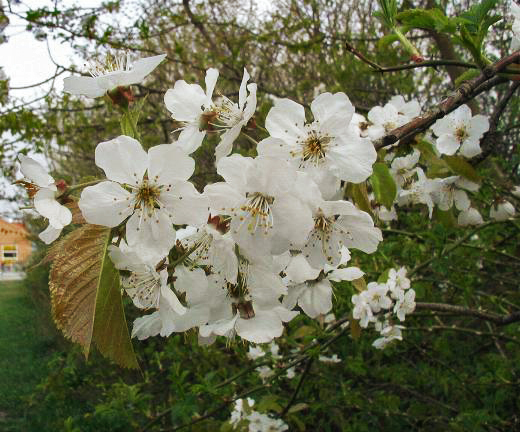
Photo: Sten Porse, CC BY-SA 3.0 · source

Pruning guide · Fruit tree
Cherry tree: when and how to prune
Prunus avium
Prune a cherry tree in summer, in June–August, straight after picking and in dry weather.
A cherry does not take pruning well: prune little, especially while it is young, and never in autumn or winter, when saw cuts let in gummosis and silver leaf.
| Pruning months | June–August |
|---|---|
| Nesting season (15 March–15 August) | Take care in June–August |
| Flowering | April |
| Good for bees, butterflies and birds | Yes, for bees, butterflies and birds |
| Native to Belgium | Yes |
Cherry tree: when to prune it?
Prune straight after picking, in June or July: the tree is still growing and closes its wounds before autumn. Shape a young tree without fruit in June–July.
In autumn and winter the spores of silver leaf and the bacteria of bacterial canker get in easily, and the tree responds with gum: don’t prune then.
Choose a dry spell: in rainy weather wounds stay wet for a long time.
Cherry tree: how to prune it?
- Over its first three or four years, train a young tree into an open crown with a strong trunk and a few well-spaced main branches.
- After that, only remove dead, diseased, crossing or overcrowded branches.
- Cut just outside the branch collar and leave no stubs; saw a heavy branch off in three cuts.
- If the tree gets too big for your garden, don’t cut it back hard every year but thin it out: shortening it spurs it into even stronger growth.
- Disinfect your saw and secateurs after cutting out a diseased branch.
How much to cut, and how often?
- As little as possible: a cherry left in peace stays healthier.
- Never remove more than about a quarter of the crown at once; better a little every year.
- For a small garden, choose a cherry on a dwarfing rootstock rather than a wild cherry you have to cut back every year: a seedling soon reaches fifteen metres.
What does it mean for wildlife?
- Wild cherry is a native tree; its blossom in April is early food for bees and bumblebees.
- Blackbirds, starlings and thrushes love the cherries in June–July: if you want to share, leave them the ones at the top.
- Pruning after picking still falls in the nesting season (15 March–15 August): check first for an active nest in the tree, as disturbing it is against the law. Prune after mid-August and you are outside it.
- The leaves feed the caterpillars of moths. Leave fallen leaves where they lie, but not in a field: wilted cherry leaves are poisonous to horses and livestock.
Common mistakes
- Pruning in autumn or winter, which brings gummosis and silver leaf.
- Cutting an oversized tree back hard every year: it only grows more vigorously.
- Leaving large saw cuts or stubs, which a cherry heals poorly.
- Pruning in wet weather, so wounds stay damp for a long time.
Caution: Don’t prune in autumn or winter: saw cuts then invite silver leaf and gummosis.
Nearby: related pruning guides
Similar to: Difference from Japanese cherry · Difference from sour cherry · Difference from plum · Difference from bird cherry · Difference from St Lucie cherry
Plant profile: Cherry tree · Pruning calendar and basic rules