Side by side
Wild cherry or Japanese cherry? How to tell them apart
Prunus avium · Prunus serrulata
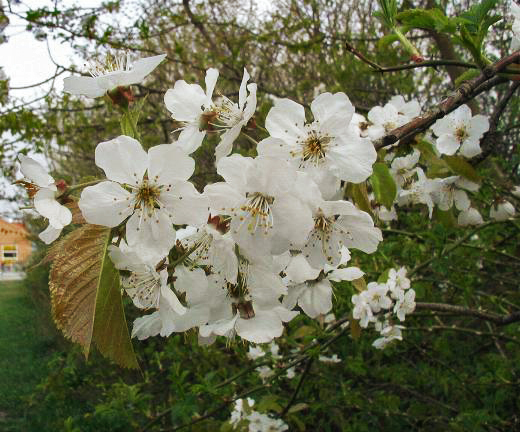
You can tell a wild cherry by its coarsely toothed leaves without bristle tips, its single white flowers and its cherries; a Japanese cherry has leaves whose teeth end in fine bristles and usually pink, double flowers without fruit.
In April the blossom decides it: single white flowers in clusters on the wild cherry, full pink or white, often double flowers on the Japanese cherry. Both have glossy reddish-brown bark with horizontal stripes.


| Wild cherry | Japanese cherry | |
|---|---|---|
| Leaves | Alternate, obovate with a pointed tip, 6–15 cm, coarsely toothed, slightly drooping. Two small red glands at the top of the leaf stalk. | Alternate, oval with a long pointed tip, 8–15 cm; the teeth end in fine bristle tips. Glands on the leaf stalk; young leaves often bronze. |
| Flowering | White flowers in clusters, in April, just before or with the leaves (April). | Pink or white, often double flowers in April (e.g. ‘Kanzan’) (April–May). |
| Fruit | Small, dark red, sweet cherries in June–July; loved by birds. | Usually no fruit. |
| Bark | Glossy red-brown, peeling in horizontal bands, with horizontal lines of lenticels. | Glossy red-brown with horizontal lenticels; often a swelling where the tree was grafted. |
| Shape and height | Fruit tree, 15–25 m | Broadleaf tree, 5–10 m |
| Site | Full sun, any garden soil, normal | Full sun, any garden soil, normal |
| Native to Belgium | Yes | No, planted |
| Good for bees, butterflies and birds | Yes, for bees, butterflies and birds | Little |
| Poisonous to people and pets | Not known to be poisonous | Not known to be poisonous |
| Pruning months | June–August | May–July |
The best feature in each season
- Spring
- The wild cherry flowers white in April, just before or with the leaves; the Japanese cherry flowers in April–May, often with bronze young leaves.
- Summer
- In June–July the wild cherry carries small, dark red cherries that birds love; the Japanese cherry usually bears no fruit. Look at the leaf teeth too: bristle-tipped on the Japanese cherry.
- Autumn
- Both colour beautifully: the wild cherry a glorious orange-red, the Japanese cherry yellow to orange.
- Winter
- The bark looks very similar. A Japanese cherry often has a bulge on the trunk where it was grafted and a broad, vase-shaped crown; a wild cherry grows into a tall tree with a single straight trunk.
Where do they grow?
The wild cherry is native and grows in broadleaved woods, woodland edges and hedgerows. The Japanese cherry is a group of old Japanese cultivars that grows only in gardens, streets and parks.
Which one for your garden?
- For bees and birds the wild cherry is the better choice: it offers nectar, pollen and cherries. As a wild tree it reaches 15–25 m; a cherry grafted onto a dwarfing rootstock also fits a smaller garden.
- The Japanese cherry stays smaller at 5–10 m and is a superb flowering tree, but double flowers offer hardly any nectar or pollen. If you want an ornamental cherry for bees, choose a single-flowered form.
Did you know? In Japan cherry blossom time, hanami, is celebrated with great enthusiasm: the weather forecast even tracks where the blossom is opening.
Read on
- Plant profile: Wild cherry
- Plant profile: Japanese cherry
- Wild cherry: when and how to prune
- Japanese cherry: when and how to prune
- Identification key: the question that separates them
Also looks like
- Wild cherry or sour cherry
- Plum or wild cherry
- Bird cherry or wild cherry
- St Lucie cherry or wild cherry