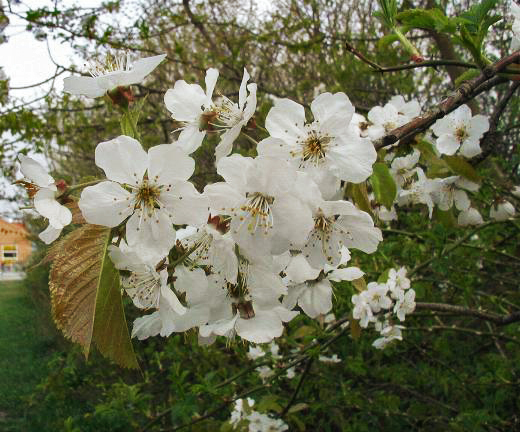
Photo: Sten Porse, CC BY-SA 3.0 · source

Fruit tree · Rose family (Rosaceae)
Wild cherry
Prunus avium · also: Sweet cherry, Gean
The wild cherry is a native tree of 15–25 m with glossy red-brown bark in horizontal bands. In April it flowers white, just before or with the leaves, and in June–July it carries small, dark red cherries that birds love. In autumn the leaves turn a beautiful orange-red. It is the wild ancestor of our cultivated cherries: a garden cherry tree is the same species, grafted onto a rootstock. As a wild tree it gets too big for an ordinary garden, but in a large garden, a woodland edge or a park it is a magnificent blossom tree. A grafted cherry on a dwarfing rootstock also fits in a smaller garden.
Caution: The cherries are edible, but don’t crunch the stones: like those of all Prunus species, they contain a substance that releases hydrogen cyanide. Wilted leaves, after pruning or a storm, are also poisonous to horses and livestock: don’t leave them in a field.
Light
Full sun
warm and bright
Moisture
Normal
no wet feet
Legal basis
Any garden soil
any pH
Hardiness
Throughout Belgium
no protection needed
Size
15–25 m
tall
Flowering
April
| Pruning months | June–August |
|---|---|
| Height | 15–25 m |
| Native to Belgium | Yes |
| Good for bees, butterflies and birds | Yes, for bees, butterflies and birds |
| Poisonous to people and pets | In part: see Caution above |
| Flowering | April |
Identify
Wild cherry: how do you recognise it?
- Habit
- Tree of 15–25 m with an oval crown about 12 m wide and a straight trunk.
- Leaves
- Alternate, obovate with a pointed tip, 6–15 cm, coarsely toothed, slightly drooping. Two small red glands at the top of the leaf stalk.
- Bark
- Glossy red-brown, peeling in horizontal bands, with horizontal lines of lenticels.
- Flowers
- White flowers in clusters, in April, just before or with the leaves.
- Fruit
- Small, dark red, sweet cherries in June–July; loved by birds.
- Difference from Japanese cherry
- Japanese cherry has leaves with bristle-tipped teeth and usually pink, double flowers.
- Difference from bird cherry
- Bird cherry flowers in long hanging spikes and has dull bark.
Flowering: April · Harvest and fruit: June–July · Pruning: June–August
Identify by feature: White blossom · Peeling bark
Looks like it, but isn’t
- Japanese cherry Prunus serrulata: leaf with bristle-tipped teeth and usually pink, double flowers. Difference from Japanese cherry
- Bird cherry Prunus padus: flowers in long hanging spikes and dull bark. Difference from bird cherry
In your garden
Why grow it?
- White blossom in April: a feast for bees and bumblebees.
- Cherries for you, or for blackbirds, thrushes and starlings.
- Beautiful orange-red autumn colour and a glossy, red-brown trunk.
- Native and fast-growing: suitable for a woodland edge or a wildlife garden.
Wild cherry: where does it grow best?
- Full sun: that is where it flowers best and the cherries ripen best.
- Almost any free-draining soil, ideally deep and not too wet; it doesn’t like waterlogging.
- For a good crop it needs a pollination partner: a second sweet cherry within 50 m, or choose a self-fertile variety.
- A wild cherry grows 15–25 m tall and 12 m wide: only for a large garden, a woodland edge or a park. For a small garden, choose a grafted cherry on a dwarfing rootstock.
- Light
- Full sun
- Legal basis
- Any garden soil
- Moisture
- Normal
- Size
- 20 m tall, 12 m wide
- Hardiness
- Throughout Belgium, no protection needed
Goes well with
- Hawthorn: Flowers in May, just after the cherry, and gives berries in autumn: together a rich woodland edge for birds.
- Hazel: A native shrub for the edge around the cherry, with early pollen and nuts.
- Blackthorn: White blossom in March–April, just before the cherry, on the sunny edge of a copse or hedge.
Good and bad companions
Goes well with
- A second sweet cherry nearby, for pollination: wild cherry
Maintenance
Wild cherry: when and how to plant it?
- Plant from November to March when the ground isn’t frozen; container plants can go in later, but not in drought.
- For a fruit tree: choose a self-fertile variety such as ‘Stella’ or ‘Lapins’, or plant two varieties that pollinate each other.
- Don’t plant deeper than in the nursery: the graft union stays above the soil.
- Stake a young tree and water it after planting and during dry spells in the first year.
Care
- Watering
- In dry spells during the first year; for a fruit tree also in a long drought while the cherries are swelling.
- Feeding
- A layer of compost in spring is enough.
- Birds
- If you want to eat the cherries yourself, put a net over a small tree shortly before harvest.
- Suckers
- Remove shoots that come up from the roots or below the graft union.
Tip: No room for a 20 m wild cherry? Plant a cherry tree on a dwarfing rootstock, or train a self-fertile variety as a fan against a sunny wall.
Wild cherry: when to prune it?
Pruning months: June–August.
When: In summer, straight after picking (June–August), in dry weather.
How:
- Prune little, and mainly while young: shape the crown in the first years, and later only remove dead, diseased, crossing or overcrowded branches.
- Cut branches off just outside the branch collar and don’t leave stubs: a cherry heals large wounds poorly.
Caution: Don’t prune in autumn or winter: saw cuts then invite silver leaf and gummosis.
Propagation
- Sowing
- Take the stones from ripe cherries, rinse them and sow them outdoors in autumn: they need winter cold to germinate. This gives you a wild cherry, not a fruiting variety.
- Grafting
- Fruiting varieties are grafted or budded onto a rootstock; that is a job for the nursery or an experienced amateur.
Wild cherry: how does it get through the winter?
Hardy throughout Belgium: no protection needed.
- Fully hardy; only late frost during flowering can cost you the crop.
- Leave the tree alone in winter: pruning at this time invites silver leaf and gummosis.
Diseases and pests
- Birds: Blackbirds and starlings often eat the cherries before they are fully ripe. A net over the tree, shortly before harvest, helps.
- Cherry fruit fly and spotted wing drosophila: Maggots in the cherries. Pick all the cherries, including rotten ones, and don’t leave fallen fruit lying around; early varieties suffer less.
- Black cherry aphid: Black aphids make the tips of young shoots curl in May–June. A healthy tree grows through it; cut off badly affected tips.
- Silver leaf and gummosis: Silvery leaves, dying branches or oozing gum. Only prune in summer in dry weather, and cut affected branches back into healthy wood.
- Blossom wilt and brown rot: Flowers and twigs wither, or cherries rot on the tree. Cut out affected parts and remove shrivelled fruits that stay on the tree.
Through the year
- January: Planting season in mild weather; don’t prune.
- March: Last month for planting; give compost.
- April: Flowering: white blossom for bees; watch out for night frost.
- May: Black cherry aphid on the tips: usually no action needed.
- June: Harvest of early cherries; prune straight after picking, in dry weather.
- July: Harvest and summer pruning; a net against birds.
- August: Last month for pruning.
- October: Orange-red autumn colour; sow stones outdoors.
- November: Planting season starts.
Use
What can you use it for?
- Food and drink
- Sweet cherries, fresh or in jam.
- Wood
- Warm reddish-brown cherry wood for furniture.
- For wildlife
- Blossom for bees, cherries for blackbirds and starlings.
Edible and useful
- Fruit (June–July)
- Pick the cherries from June to mid-July, when they are dark and sweet, with their stalks on: that way they keep longer. Cherries from wild trees are smaller and slightly more bitter, but delicious in jam. Eat them fresh, in jam, steeped in brandy or in a clafoutis.
- Storing
- Unwashed, a few days in the fridge. Pitted, frozen spread out on a tray and then bagged: a year. Save the stones for a cherry-stone pillow.
Caution: The stones, leaves and bark contain cyanogenic compounds: do not crack or grind the stones. Swallowing a whole stone does no harm. Do not confuse cherries with the fruit of cherry laurel or bird cherry, which grow in long clusters. Brandied cherries are not for children. Pick well away from busy roads and sprayed fields, and never eat anything you have not identified with certainty.
Eating and using is at your own risk: see the terms of use.
Recipes
- Cherry jam (Jam · ± 4 jars of 250 ml · 1 hr)
- Brandied cherries (Liqueur · 1 one-litre jar · 20 min + 2 months)
- Cherry-stone pillow (Skin and body care · 1 pillow · 1 hr + 1 week drying)
- Cherry clafoutis (Dish · serves 4–6 · 20 min + 40 min baking)
- Sweet-and-sour pickled cherries (Vinegar · ± 3 jars of 250 ml · 30 min + 2 weeks maturing)
Good for wildlife
- Bees
- Nectar and pollen for honeybees and wild bees.
- Birds
- Berries, seeds or insects as food, or a place to nest.
- Caterpillars
- Host plant: caterpillars of butterflies or moths eat the leaves.
You and this species
Did you know?
- The wild ancestor of the cultivated cherry; turns a beautiful orange-red in autumn.
- Cherry wood has a warm, reddish-brown colour and is highly prized for furniture.
- Birds eat the cherries and drop the stones elsewhere: that is how young cherries spring up in woodland edges and hedges.
- The scientific name avium means ‘of the birds’: they eat the cherries and so spread the stones.
- With its massive bill, the hawfinch can even crack cherry stones to get at the seed inside.