Side by side
Wild cherry or sour cherry? How to tell them apart
Prunus avium · Prunus cerasus
You can tell a wild cherry as a large tree of 15–25 m with big, slightly drooping leaves and sweet cherries; a sour cherry stays a small fruit tree of 3–6 m with thin, drooping twigs, smaller glossy leaves and sour cherries.
Size says the most: the wild cherry becomes a real tree with a single straight trunk, the sour cherry a shrubby little tree. The wild cherry leaf is 6–15 cm, dull and coarsely toothed, with two red glands on the stalk; the sour cherry leaf is 5–8 cm, firmer and glossy.
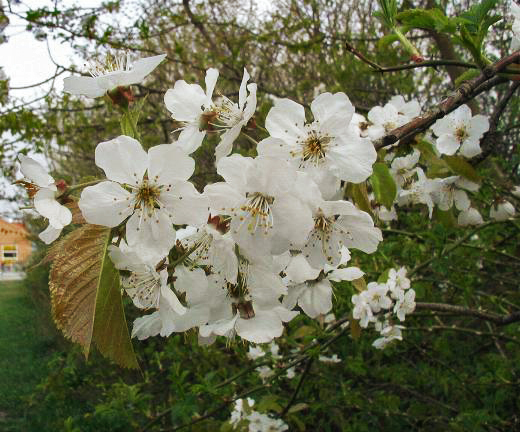


Photo: Franz Eugen Köhler, Köhler's Medizinal-Pflanzen, Public domain · source

Sour cherry Prunus cerasus
| Wild cherry | Sour cherry | |
|---|---|---|
| Leaves | Alternate, obovate with a pointed tip, 6–15 cm, coarsely toothed, slightly drooping. Two small red glands at the top of the leaf stalk. | Alternate, 5–8 cm, glossy and finely toothed; smaller and firmer than in sweet cherry. |
| Flowering | White flowers in clusters, in April, just before or with the leaves (April). | White flowers in small clusters in April (April–May). |
| Fruit | Small, dark red, sweet cherries in June–July; loved by birds. | Sour, dark red cherries (July), ideal for jam and kriek beer. |
| Bark | Glossy red-brown, peeling in horizontal bands, with horizontal lines of lenticels. | Reddish-brown with horizontal lenticels. |
| Shape and height | Fruit tree, 15–25 m | Fruit tree, 3–6 m |
| Site | Full sun, any garden soil, normal | Full sun, any garden soil, normal |
| Native to Belgium | Yes | No, naturalised |
| Good for bees, butterflies and birds | Yes, for bees, butterflies and birds | Yes, for bees and birds |
| Poisonous to people and pets | Not known to be poisonous | Not known to be poisonous |
| Pruning months | June–August | July–August |
The best feature in each season
- Spring
- Both flower white in April. The wild cherry flowers just before or with the leaves, the sour cherry a little later, as the leaves are already opening.
- Summer
- Taste a cherry: sweet and dark red in June–July on the wild cherry, sour and bright to dark red in July on the sour cherry.
- Autumn
- The wild cherry turns a glorious orange-red. The sour cherry turns yellow to orange and then reveals its thin, slightly drooping twigs.
- Winter
- Both have reddish-brown bark with horizontal stripes. The wild cherry has fat, glossy buds, clustered on short side shoots; the sour cherry has thinner, drooping twigs.
Where do they grow?
The wild cherry is native in broadleaved woods, woodland edges and hedgerows, and is the wild ancestor of our cultivated cherries. The sour cherry comes from south-west Asia and has been naturalised for centuries as a fruit tree in orchards and gardens.
Which one for your garden?
- In a small garden the sour cherry is the easiest: it stays small, is self-fertile and crops as an espalier even against a north-facing wall. Prune it in summer, straight after harvest.
- A wild cherry is a superb flowering tree for a large garden; for fruit, choose a cherry grafted onto a dwarfing rootstock. Both are good for bees and birds. Do not crack the stones: as with all cherries, the kernel releases cyanide.
Did you know? The Schaerbeek sour cherry is the classic cherry for Brussels kriek beer: lambic that matures for months on sour cherries.
Read on
- Plant profile: Wild cherry
- Plant profile: Sour cherry
- Wild cherry: when and how to prune
- Sour cherry: when and how to prune
- Identification key: the question that separates them
Also looks like
- Wild cherry or Japanese cherry
- Plum or wild cherry
- Bird cherry or wild cherry
- St Lucie cherry or wild cherry