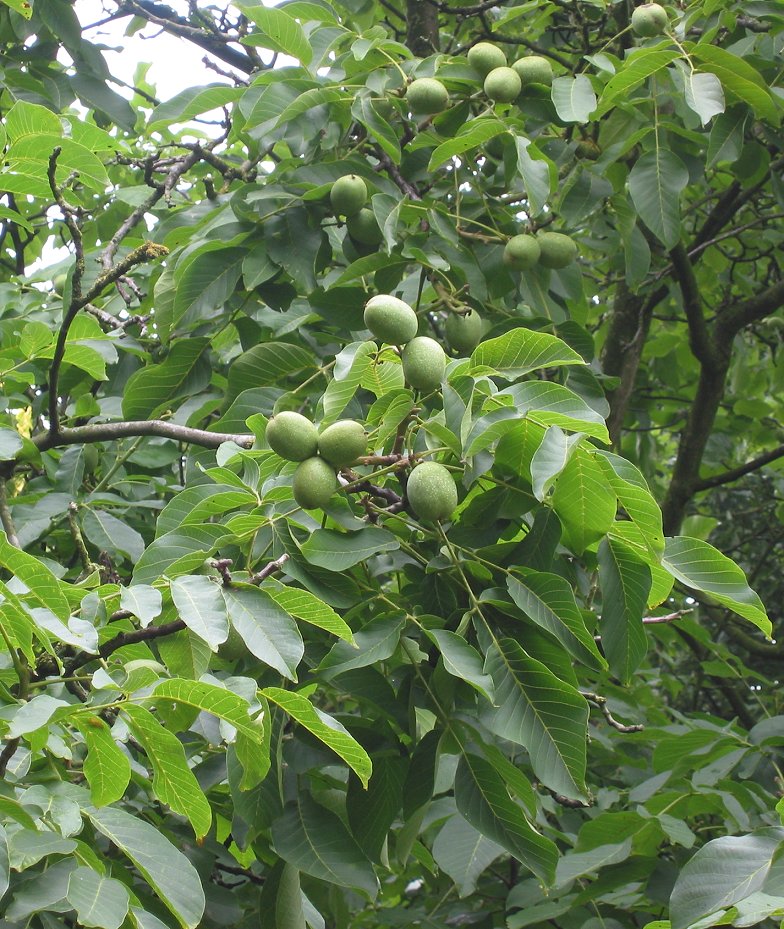
Photo: Wikimedia Commons, CC BY-SA 3.0 · source

Pruning guide · Fruit tree
Walnut tree: when and how to prune
Juglans regia
Prune a walnut only in summer and early autumn, in July–September, when it is in full leaf: in winter and spring it bleeds heavily from every wound.
A walnut needs little pruning and tolerates it poorly: its wounds close slowly, and if you prune at the wrong time, sap drips from the wound for days. So pruning a walnut is mostly about shaping a young tree, and later removing dead wood and branches that are in the way, in summer only. Bear its size in mind too, 15–25 m tall and some 15 m wide: keeping it small is not an option.
| Pruning months | July–September |
|---|---|
| Nesting season (15 March–15 August) | Take care in July–August |
| Flowering | May |
| Good for bees, butterflies and birds | Yes, for birds |
| Native to Belgium | No, naturalised |
Walnut tree: when to prune it?
Prune in July–September, when the tree is in full leaf. It hardly bleeds then, and the wounds start to close before winter.
In July and the first half of August the nesting season is still on. Check first that no birds are nesting in the crown, or wait until after 15 August: September is the best time for wildlife.
Never prune in winter or spring: the wounds then bleed heavily, which weakens the tree.
What else to prune in those months? July · August · September
Walnut tree: how to prune it?
- Shape a young tree in its first years: a central leader with a few strong main branches, well spaced around the trunk. Remove competing leaders and branches that grow too upright while they are still thin.
- If you want to walk or mow under the tree, gradually remove the lowest branches while the tree is young, one or two each summer, until the trunk is about 2–2.5 m tall.
- On a mature tree, only remove dead wood and broken, crossing or rubbing branches. Large saw cuts heal poorly: avoid cutting branches thicker than about 10 cm.
- Saw a heavy branch in three steps: first an undercut, some way out from the trunk; then the branch itself, a little further out; finally the stub, just outside the branch collar. That way the bark does not tear.
- Leave the wound as it is: a clean cut just outside the branch collar closes best on its own. Don’t apply any wound paint.
- Leave work high in the crown or on thick branches to a tree surgeon: a ladder and a saw in a tree are a dangerous combination.
How much to cut, and how often?
- A young tree: a little formative pruning every summer for the first five to ten years. A mature walnut: only when needed, often just every few years.
- Never remove a lot at once: it responds to hard pruning with a mass of water shoots and a weak, unbalanced crown.
- You can’t keep a walnut small by topping it. If there isn’t enough room, choose a smaller tree, or a hazel for nuts of your own.
What does it mean for wildlife?
- If you prune in July or early August, you are still in the nesting season (15 March–15 August). Woodpigeons, crows, magpies and songbirds nest in a large walnut: look carefully first, as disturbing an active nest is against the law. In September you won’t disturb anyone.
- In September–October the nuts fall: food for squirrels, jays, crows and wood mice. Leave some of them for the animals.
- Old walnuts develop hollows where woodpeckers, tits, nuthatches, owls and bats live. A hollow branch that poses no danger can safely stay.
- The flowers are wind-pollinated: for bees, a walnut means little. The fallen leaves contain juglone: don’t use them as a mulch in the vegetable garden, but pile them up in a corner.
Common mistakes
- Pruning in winter or spring, so the tree bleeds for days.
- Topping the tree or cutting it back hard to keep it small: it then sprouts a mass of water shoots and gets an ugly, weak crown.
- Sawing a thick branch off in one go, so it tears and leaves a large wound in the trunk.
- Leaving a stub or sawing flush with the trunk, instead of just outside the branch collar.
- Pruning in July or early August without checking for nests first.
Caution: Never prune in winter or spring: the wounds then bleed heavily and weaken the tree.
Nearby: related pruning guides
Similar to: Difference from tree of heaven
Plant profile: Walnut tree · Pruning calendar and basic rules