Photo: Wikimedia Commons, CC BY-SA 3.0 · source

Fruit tree · Walnut family (Juglandaceae)
Walnut
Juglans regia · also: Common walnut, English walnut
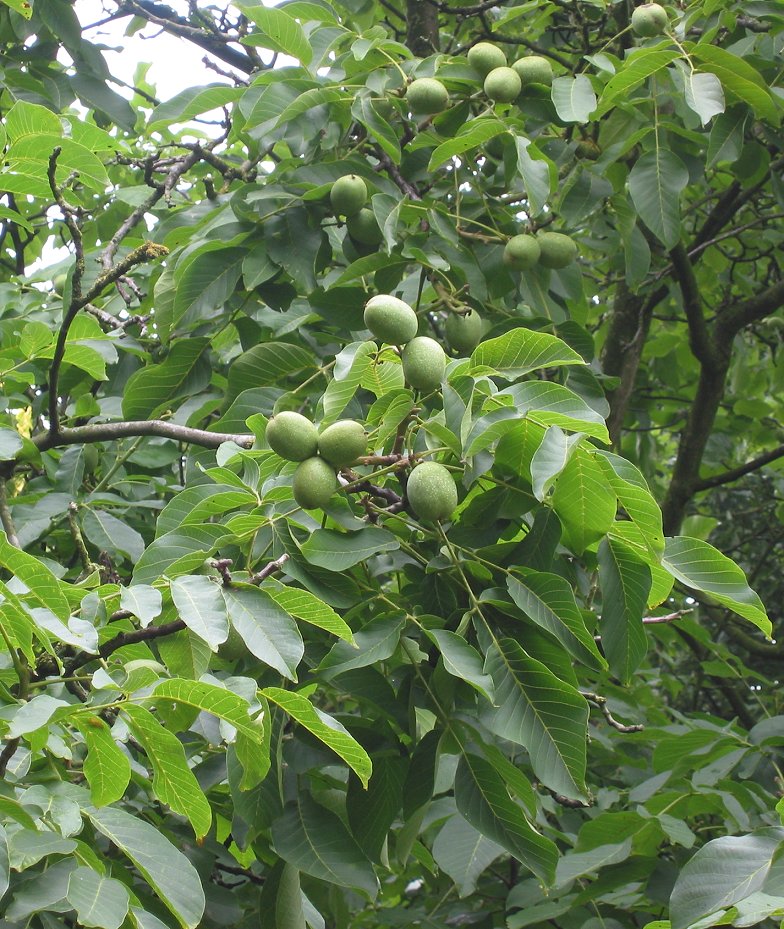
The walnut is the tree that gives us walnuts. It comes from south-eastern Europe and Asia, was spread by the Romans and is naturalised here. It grows 15–25 m tall, with a broad, rounded crown and pinnate leaves with a spicy scent. It comes into leaf late, yet its young shoots and flowers are still sensitive to night frost. In September–October the nuts drop from their green husks. With a crown of about 15 m, it is a tree for a large garden, a meadow or a farmyard, not for a small town garden.
Caution: Leaves and roots release juglone, which holds back the growth of some plants under the crown. The juice of the husk stains skin and clothes brown: wear gloves. Don’t let dogs eat mouldy walnuts: the mould can contain a toxin that causes tremors and seizures.
Light
Full sun
warm and bright
Moisture
Normal
no wet feet
Legal basis
Any garden soil
neutral to chalky
Hardiness
Throughout Belgium
no protection needed
Size
15–25 m
tall
Flowering
May
| Pruning months | July–September |
|---|---|
| Height | 15–25 m |
| Native to Belgium | No, naturalised |
| Good for bees, butterflies and birds | Yes, for birds |
| Poisonous to people and pets | Not known to be poisonous |
| Flowering | May |
Identify
Walnut: how do you recognise it?
- Habit
- Tree of 15–25 m with a broad, rounded, open crown and thick branches.
- Leaf
- Alternate, pinnate with 5–9 large, smooth-edged leaflets; the terminal leaflet is the largest. When crushed it smells aromatic.
- Bark
- Smooth and silver-grey for a long time, later deeply fissured. Twigs cut lengthways show chambered pith.
- Flower
- Hanging green male catkins and small female flowers at the shoot tips, in April–May with the young leaves.
- Fruit
- Walnuts in a smooth green husk that turns black and splits open as it ripens.
- Difference from tree of heaven
- Tree of heaven has many more leaflets (13–41) with a few coarse teeth at the base, and an unpleasant smell.
Flowering: May · Harvest and fruit: June–October · Pruning: July–September
Identify by feature: Pinnate leaves · Nuts, acorns and chestnuts
Looks like it, but isn’t
- Tree of heaven Ailanthus altissima: many more leaflets (13–41) with a few coarse teeth at the base, and an unpleasant smell. Difference from tree of heaven
In your garden
Why grow it?
- Your own walnuts in September–October, and green walnuts in late June for walnut liqueur.
- A stately, broad tree with spicy-scented leaves, handsome in a farmyard or meadow.
- Old walnut trees are valuable: the wood is one of the finest furniture woods.
- Little work: pruning is rarely needed.
Walnut: where does it grow best?
- Full sun, in a spot sheltered from late night frost: not in a hollow where cold air settles.
- Deep, fertile, well-drained soil, preferably chalky; no waterlogging.
- Allow for a crown 15 m wide: only for a large garden, a meadow or a farmyard.
- Not right next to the vegetable garden or a border: leaves and roots hold back the growth of some plants.
- Light
- Full sun
- Legal basis
- Any garden soil
- Moisture
- Normal
- Size
- 25 m tall, 15 m wide
- Hardiness
- Throughout Belgium, no protection needed
Goes well with
- Hazel: A small nut shrub for the edge of the garden, outside the walnut’s crown: together a nut corner.
- Daffodil: Flowers in spring, well before the walnut comes into leaf.
- Wildflower meadow: Walnuts have always stood in a meadow or orchard; grass grows well under the open crown.
Good and bad companions
Best kept away from
- Sensitive to the juglone that walnut releases: heather, rhododendron, common lilac, highbush blueberry, apple, pear, japanese pieris, cross-leaved heath
Maintenance
Walnut: when and how to plant it?
- Plant from November to March when the ground isn’t frozen.
- Choose a grafted variety: it bears after a few years, a seedling only after 10–15 years or more.
- It forms a deep taproot: plant a young tree and dig a deep hole, without bending the root.
- Keep the graft union above the soil, put a stake on the windward side and water generously after planting.
Care
- Watering
- In dry spells during the first and second year; after that its deep roots cope.
- Feeding
- Rarely needed; a little compost in spring for a young tree on poor soil.
- Leaves
- Don’t use the fallen leaves as mulch in the vegetable garden or a border: they contain juglone.
- Harvest
- Gather the nuts every few days, remove the husk (wearing gloves) and dry them in an airy place.
Tip: Choose a late-leafing variety such as ‘Franquette’: the flowers escape the night frost more often and you harvest more.
Walnut: when to prune it?
Pruning months: July–September.
When: Only in summer (July–September): in winter and spring a walnut bleeds heavily.
How:
- Prune little, and while the tree is young. Large saw cuts heal poorly.
- Train a young tree on a central leader with a few strong main branches; remove dead and crossing branches.
- Cut a branch in three steps, just outside the branch collar.
Caution: Never prune in winter or spring: the wounds then bleed heavily and weaken the tree.
Propagation
- Sowing
- Sow fresh, ripe nuts outdoors in autumn, about 5 cm deep, and protect them from mice and squirrels. Seedlings give variable nuts and only bear after many years.
- Grafting
- Varieties are grafted onto a seedling; that is tricky and a job for the nursery.
Walnut: how does it get through the winter?
Hardy throughout Belgium: no protection needed.
- The tree itself is hardy.
- Young shoots and flowers are killed by night frost in April–May, and the crop that year is disappointing. So choose a late-leafing variety.
Diseases and pests
- Late night frost: Frozen, blackened young shoots and flowers in spring, and few or no nuts. Plant in a sheltered spot and choose a late-leafing variety.
- Walnut blight: Black spots on leaves, shoots and young nuts, which turn black and drop; especially after a wet spring. Clear up fallen leaves and nuts.
- Leaf blotch: Brown spots on the leaves and early leaf drop in wet summers. Rake up the leaves and remove them.
- Crows and squirrels: They often take the nuts before you do. During the harvest, gather every day.
Through the year
- March: Last month for planting.
- April: Leaves open: watch out for night frost.
- May: Flowering: catkins and small female flowers.
- June: In late June, pick green walnuts for walnut liqueur.
- July: Summer pruning: the only good time, as the tree doesn’t bleed now.
- August: Summer pruning still possible; water young trees in dry spells.
- September: Last month for pruning; the first nuts fall.
- October: Gather, husk and dry the nuts; clear up the leaves.
- November: Planting season starts.
Use
What can you use it for?
- Food and drink
- Walnuts, fresh or dried; green walnuts (late June) for walnut liqueur.
- Wood
- One of the finest furniture woods.
- Also used for
- The juice of the green husk is a brown dye.
Caution: Leaves and roots release juglone, which holds back the growth of some plants beneath it.
Edible and useful
- Fruit (June–July)
- The green, unripe nuts from late June to mid-July, while the shell inside has not yet hardened: a knitting needle or knife should pass through easily. Traditionally picked around Midsummer (24 June), for walnut liqueur or for pickling.
- Nuts (September–October)
- Gather ripe walnuts in September and October, as soon as the husks split and the nuts fall. Collect them every day: on the ground they soon go mouldy, and squirrels and crows are after them too. Remove the husks straight away.
- Leaves (June–August)
- Leaves in summer, for a hair rinse that gives dark hair a warm sheen.
- Storing
- Do not wash fresh nuts; dry them in a single layer on a rack or in an open crate somewhere dry and airy for 2 to 3 weeks, until the kernel snaps rather than bends. In their shells they then keep for a year somewhere cool and dry. Shelled nuts soon go rancid: keep them in a closed jar in the fridge or freezer.
Caution: Green walnuts, husks and leaves stain hands, clothes and grout brown for days: wear gloves. Throw away nuts that are mouldy, bitter or rancid. Walnuts are a common cause of nut allergy. Do not use the leaf rinse on blonde, grey or bleached hair, and keep it out of your eyes. Pick well away from busy roads and sprayed fields, and never eat anything you have not identified with certainty.
Eating and using is at your own risk: see the terms of use.
Recipes
- Green-walnut liqueur (nocino) (Liqueur · ± 1 litre · 30 min + 6 weeks steeping + maturing)
- Pickled green walnuts (Vinegar · 2 jars of 500 ml · 2 weeks brining + 1 month maturing)
- Walnut-leaf hair rinse (Skin and body care · 1 rinse · 30 min)
- Walnut and parsley pesto (Dish · ± 250 ml (enough for 4 portions of pasta) · 20 min)
- Caramelised walnuts with rosemary (Other · ± 250 g · 20 min + 30 min cooling)
Good for wildlife
- Birds
- Berries, seeds or insects as food, or a place to nest.
You and this species
Did you know?
- The juice from the husk stains your fingers brown; it was once used as a dye.
- The name walnut comes from an Old English word meaning ‘foreign nut’: the nut from the Romance-speaking lands to the south.
- Walnut liqueur is traditionally made from green walnuts picked around Midsummer (24 June), while the inside is still soft.
- The genus name Juglans comes from the Latin Jovis glans, ‘Jupiter’s acorn’; regia means ‘royal’.
- The word walnut (Dutch walnoot) really means ‘foreign nut’: wal- referred to the Romance-speaking lands to the south, where the nut came from.