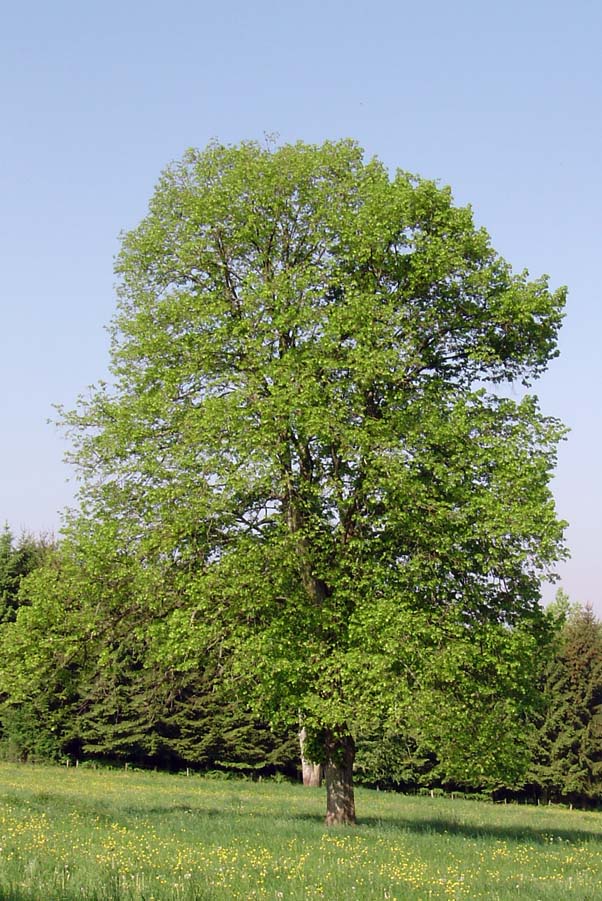
Photo: Toubib at Dutch Wikipedia, CC BY-SA 3.0 · source

Pruning guide · Broadleaf tree
Small-leaved lime: when and how to prune
Tilia cordata
Prune a lime tree during winter dormancy (November–March): a free-standing tree only while it is young, and a hedge, pleached tree or pollard every year or every few years, as a lime copes well with hard pruning.
The small-leaved lime is a native tree of 20–30 m with a dense crown about 14 m wide: as a free-standing tree, too big for an ordinary garden. But few trees can be shaped so well. As a pleached tree in front of a wall or a terrace, as a pollard or as a hedge, it fits anywhere. The secret is to start early: a young lime can be trained, but a mature free-standing lime can no longer be kept small.
| Pruning months | November–March |
|---|---|
| Nesting season (15 March–15 August) | Take care in March |
| Flowering | July |
| Good for bees, butterflies and birds | Yes, for bees and butterflies |
| Native to Belgium | Yes |
Small-leaved lime: when to prune it?
Prune during winter dormancy, November–March, while the tree is bare. You can see its structure clearly then, and the tree loses the least sap.
Ideally finish before mid-March, when the nesting season starts and the leaves are about to break.
Don’t prune in spring as the leaves unfold: the tree has just used up its reserves.
What else to prune in those months? January · February · March · November · December
Small-leaved lime: how to prune it?
- A young free-standing tree: give it a single leader, remove crossing branches and raise the crown gradually. After that it needs little.
- A pleached tree: tie the young branches horizontally along the frame, and every winter cut all the new shoots back to the framework, to one or two buds.
- A pollard: cut it at the height you want while it is young, then every 3–6 years saw off all the branches on the head, just above the swelling.
- A hedge: trim it into shape, slightly narrower at the top than at the bottom, so the base gets light.
- At every pruning, also cut off the shoots on the trunk and the suckers at the base: limes produce a lot of them.
- Saw large branches of a free-standing tree off in three steps, just outside the branch collar, and leave work at height to a tree surgeon.
How much to cut, and how often?
- A mature free-standing tree: almost nothing, apart from dead wood and suckers. Never remove more than a quarter of the crown in one year.
- A pleached tree or hedge: every winter, all the new shoots.
- A pollard: every 3–6 years, everything on the head.
What does it mean for wildlife?
- Prune in winter, outside the nesting season (15 March–15 August). If you are still at it in March, first check that no birds are nesting in the crown or the pollard head.
- In early July the lime flowers in fragrant clusters: one of the most important nectar trees for honeybees and bumblebees. A pleached lime pruned in winter still flowers on its new shoots.
- Old pollarded limes develop hollows where little owls, tits and bats live: leave such a hollow in place.
- The caterpillars of the lime hawk-moth and other moths live on the leaves, food for young birds. The aphids produce honeydew, which attracts ladybirds and tits.
Common mistakes
- Heavily reducing or topping a mature free-standing lime: it regrows in a mass of weak branches and never looks good again.
- Only starting a pleached tree or pollard when the tree is already big.
- Leaving a pollard uncut for too long, so the heavy branches split the head.
- Leaving the suckers for years, until there is a thicket around the base.
Caution: Start pleaching or pollarding while the tree is young: a mature free-standing lime can’t be forced into shape later on.
Nearby: related pruning guides
Similar to: Difference from large-leaved lime · Difference from common lime · Difference from katsura tree · Difference from Caucasian lime
Plant profile: Small-leaved lime · Pruning calendar and basic rules