Side by side
Katsura tree or small-leaved lime? How to tell them apart
Cercidiphyllum japonicum · Tilia cordata
How to tell them apart – katsura tree: round, heart-shaped leaves in opposite pairs; small-leaved lime: alternate, lopsided heart-shaped leaves with a pointed tip.

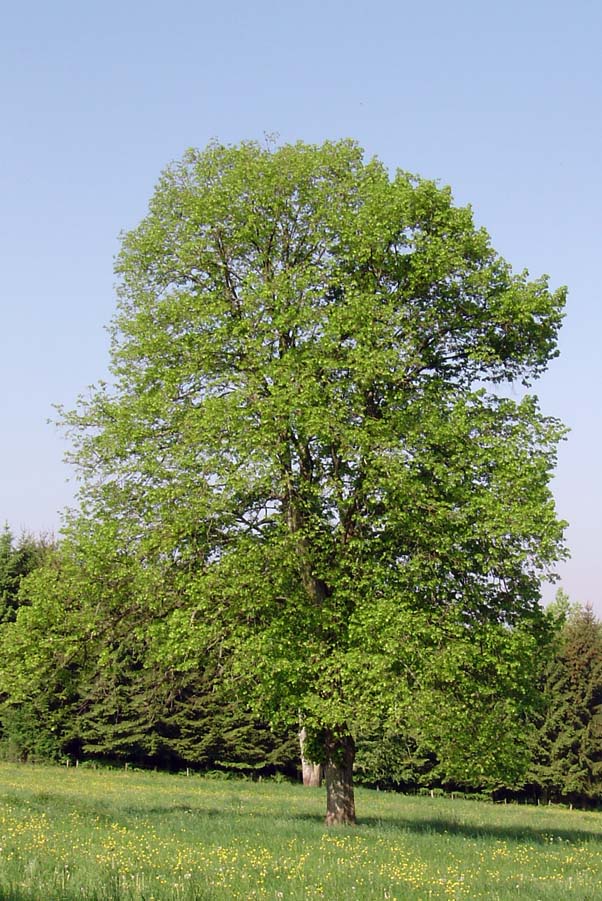


How do you recognise them?
- Katsura tree
- Round, heart-shaped leaves in opposite pairs. In autumn they turn yellow to pink and smell of caramel.
- Small-leaved lime
- Small, lopsided heart-shaped leaf with a hairless, blue-green underside and rusty-brown tufts of hair.
- Compared with katsura tree: alternate, lopsided heart-shaped leaves with a pointed tip.
| Katsura tree | Small-leaved lime | |
|---|---|---|
| Leaves | Opposite, 5–10 cm, round to heart-shaped with a scalloped edge and palmate veins; young leaves reddish. | Alternate, lopsided heart-shaped, 3–8 cm, finely toothed. Underside blue-green and hairless, with rusty-brown tufts of hair in the vein axils. |
| Flowering | Inconspicuous reddish flowers before the leaves (March–April). | Clusters of 5–10 flowers on a tongue-shaped bract, in early July (July). |
| Fruit | Small, pod-like fruits in clusters. | Thin-walled nutlets without distinct ribs, easily crushed between your fingers. |
| Bark | Greyish-brown, peeling in strips on older trees; often multi-stemmed. | Grey and finely fissured. |
| Shape and height | Broadleaf tree, 10–20 m | Broadleaf tree, 20–30 m |
| Site | Sun or partial shade, any garden soil, moist to wet | Sun or partial shade, any garden soil, normal |
| Native to Belgium | No, planted | Yes |
| Good for bees, butterflies and birds | Little | Yes, for bees and butterflies |
| Poisonous to people and pets | Not known to be poisonous | Not known to be poisonous |
| Pruning months | July–August and November–February | November–March |
What does it mean for your garden?
- Small-leaved lime is native: it feeds more insects and birds than a non-native species. If in doubt, choose this one.
- Katsura tree (10–20 m) and small-leaved lime (20–30 m) both grow into large trees: too big for an ordinary garden, but fine in a large garden, a park or a meadow.
Read on
- Plant profile: Katsura tree
- Plant profile: Small-leaved lime
- Katsura tree: when and how to prune
- Small-leaved lime: when and how to prune
- Identification key: the question that separates them
Also looks like
- Large-leaved lime or small-leaved lime
- Judas tree or katsura tree
- Katsura tree or handkerchief tree
- Common lime or small-leaved lime
- Caucasian lime or small-leaved lime
Identify by feature
This comparison is compiled from the Bladwijzer species pages.