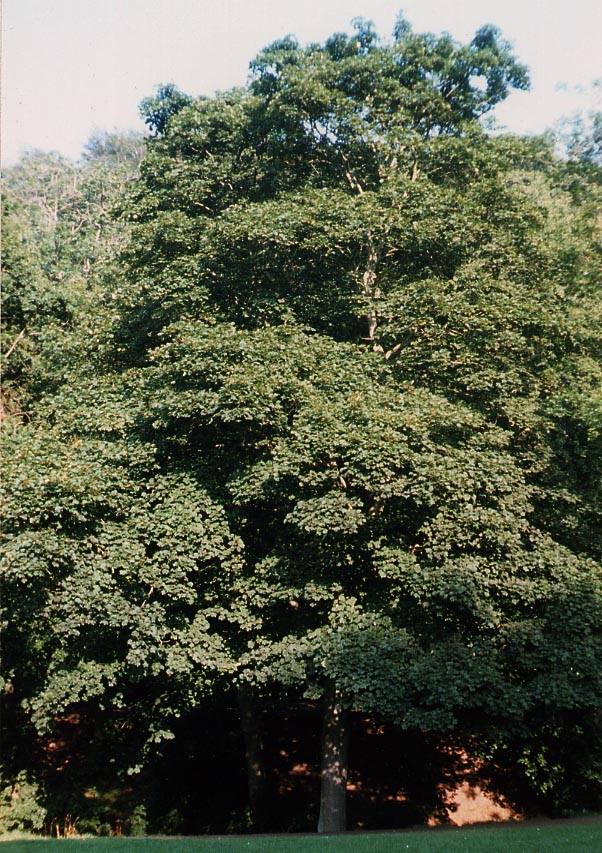
Photo: MPF, CC BY-SA 3.0 · source

Pruning guide · Broadleaf tree
Sycamore: when and how to prune
Acer pseudoplatanus
Prune a sycamore lightly, in summer or early autumn (July–October): give a young tree a single leading stem, and saw large branches off in three steps, just outside the branch collar.
The sycamore is one of the commonest trees in our region, tough and fast-growing. It reaches 25–35 m with a crown up to 18 m wide: too big for an ordinary garden. Its place is in a park, a field hedge or a windbreak. A tree that is allowed to grow freely needs little pruning. Most of the work comes in the first years, when you shape the tree, and in pulling up seedlings, which pop up everywhere.
| Pruning months | July–October |
|---|---|
| Nesting season (15 March–15 August) | Take care in July–August |
| Flowering | May |
| Good for bees, butterflies and birds | Yes, for bees and birds |
| Native to Belgium | No, naturalised |
Sycamore: when to prune it?
Prune in summer or early autumn, July–October, while the tree is in leaf. Wounds close fastest then.
Don’t prune in late winter or spring: the sap is rising and a sycamore bleeds heavily from every wound.
Pull up small seedlings all year round, ideally in spring when the soil is moist and they are still small.
What else to prune in those months? July · August · September · October
Sycamore: how to prune it?
- Give a young tree a single leading stem: remove a second, competing leader, and branches that cross.
- Raise the crown gradually: each year remove at most one or two of the lowest branches, until you have the clearance you want.
- Saw a large branch off in three steps: first an undercut a little way from the trunk, then the branch itself slightly further out, and finally the stub just outside the branch collar, the swelling at the base of the branch. Never saw flush with the trunk.
- Leave branches thicker than 10 cm and work at height to a tree surgeon.
- In a field hedge, a sycamore can be coppiced to a low stump every 8–15 years: it regrows readily.
- If you see a black, sooty layer under loose bark, that is sooty bark disease. Don’t saw it yourself: the spores are harmful to the lungs. Have a professional with protective equipment fell the tree.
How much to cut, and how often?
- A mature tree: as little as possible. Never remove more than a quarter of the crown in one year.
- A young tree: a little formative pruning each year, until it has a good trunk and crown.
- Seedlings: all of them, except the one you deliberately keep.
What does it mean for wildlife?
- July and early August are still in the nesting season (until 15 August): before pruning, check that no birds are nesting in the crown, and otherwise wait until later in August.
- In April–May the hanging flower clusters are an important source of nectar and pollen for honeybees, bumblebees and wild bees.
- The aphids in summer feed ladybirds, hoverfly larvae and tits. Old sycamores with hollows are nesting places for woodpeckers, tits and bats: leave such a hollow alone if it poses no danger.
- The seeds and seedlings are poisonous to horses (atypical myopathy): don’t plant it next to a horse paddock, and keep horses away from fallen seed.
Common mistakes
- Pruning in late winter or spring, so the tree bleeds heavily.
- Topping or heavily reducing a mature tree because it is too big: it regrows in a mass of weak branches. Choose a smaller tree instead.
- Sawing a large branch off in one go or flush with the trunk, so the bark tears or the wound doesn’t close.
- Sawing into a tree with sooty bark disease yourself.
Caution: Don’t prune in late winter or spring: it bleeds heavily then. Do you see a black, sooty layer under loose bark (sooty bark disease)? Don’t saw it yourself: the spores are harmful to the lungs.
Nearby: related pruning guides
Similar to: Difference from Norway maple · Difference from silver maple · Difference from London plane · Difference from sweetgum