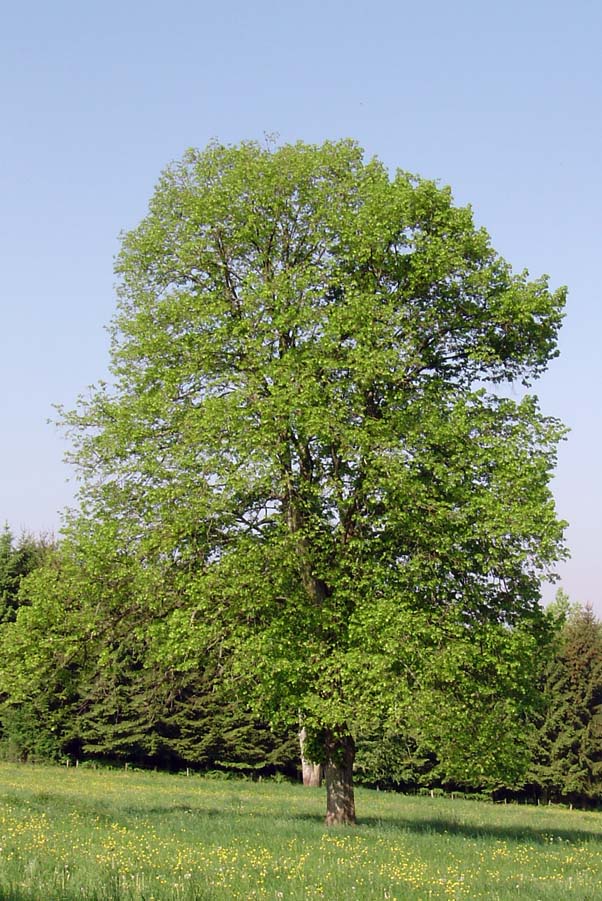
Photo: Toubib at Dutch Wikipedia, CC BY-SA 3.0 · source

Broadleaf tree · Mallow family (Malvaceae)
Small-leaved lime
Tilia cordata
The small-leaved lime is our other native lime, with smaller leaves than the large-leaved lime: lopsided and heart-shaped, with a hairless, blue-green underside and rusty-brown tufts of hair in the vein axils. In early July it flowers in clusters of 5–10 fragrant blooms that bees and bumblebees flock to. It grows 20–30 m tall with a dense crown of about 14 m and is less fussy than its relative: it grows on sand, loam and clay. Limes have long been village trees and court trees. As a free-standing tree it is too big for an ordinary garden, but as a hedge, a pleached tree or a pollard it fits anywhere.
Caution: As with large-leaved lime, aphids can drip sticky honeydew in summer: not over a patio or drive.
Light
Sun or partial shade
preferably some sun
Moisture
Normal
no wet feet
Legal basis
Any garden soil
any pH
Hardiness
Throughout Belgium
no protection needed
Size
20–30 m
tall
Flowering
July
| Pruning months | November–March |
|---|---|
| Height | 20–30 m |
| Native to Belgium | Yes |
| Good for bees, butterflies and birds | Yes, for bees and butterflies |
| Poisonous to people and pets | Not known to be poisonous |
| Flowering | July |
Identify
Small-leaved lime: how do you recognise it?
- Habit
- Tree of 20–30 m with a dense, oval to domed crown about 14 m across.
- Leaves
- Alternate, lopsided heart-shaped, 3–8 cm, finely toothed. Underside blue-green and hairless, with rusty-brown tufts of hair in the vein axils.
- Bark
- Grey and finely fissured.
- Flowers
- Clusters of 5–10 flowers on a tongue-shaped bract, in early July.
- Fruit
- Thin-walled nutlets without distinct ribs, easily crushed between your fingers.
- Difference from large-leaved lime
- Large-leaved lime has a larger leaf with a softly hairy underside and white hair tufts, and hard nutlets with 5 ribs.
Flowering: July · Harvest and fruit: April–July · Pruning: November–March
Identify by feature: Heart-shaped leaves · Lopsided leaf base
Looks like it, but isn’t
- Large-leaved lime Tilia platyphyllos: larger leaf with a softly hairy underside and white hair tufts. Difference from large-leaved lime
In your garden
Why grow it?
- In early July a feast for bees and bumblebees, when many other flowers are over.
- Less fussy than large-leaved lime: grows on almost any soil.
- Takes clipping well: suitable as a hedge, a pleached tree or a pollard.
- Long-lived, with a dense, cool crown.
- The blossom makes lime-flower tea.
Small-leaved lime: where does it grow best?
- Sun to partial shade.
- Almost any soil, from sand to loam and clay, acid or chalky; ideally moisture-retentive, but not permanently wet.
- Allow for 20–30 m in height and a crown of about 14 m: as a free-standing tree for a park, a farmyard, a hedgerow or a large garden.
- In a smaller garden: as a hedge, a pleached tree or a pollard that you keep short every winter.
- Light
- Sun or partial shade
- Legal basis
- Any garden soil
- Moisture
- Normal
- Size
- 25 m tall, 14 m wide
- Hardiness
- Throughout Belgium, no protection needed
Goes well with
- Large-leaved lime: Flowers two weeks earlier: together they give bees lime blossom for weeks longer.
- Hazel: A native shrub for the edge or understorey, which can be coppiced just like the lime.
- Holly: Evergreen and shade-tolerant: a dark green understorey beneath the lime.
- English oak: Together a native copse or hedgerow full of life.
Good and bad companions
Goes well with
- Tolerate the shade under this tree: oregon grape, rhododendron, oleaster, japanese skimmia, garden privet, camellia, laurustinus, box-leaved honeysuckle
Best kept away from
- Sun-loving plants get too little light under the dense crown: english lavender, heather, butterfly bush, blackthorn, highbush blueberry, sea buckthorn, japanese rose, broom
Maintenance
Small-leaved lime: when and how to plant it?
- Plant from November to March when the ground isn’t frozen.
- For a tree: a young root-balled or bare-root tree, secured to a stake.
- For a hedge: young whips (forestry transplants of 60–80 cm), about 3 per metre.
- Don’t let bare roots dry out: plant straight away or heel the plants into moist soil.
- Water after planting and during dry spells in the first few summers.
Care
- Watering
- In dry spells during the first few years; rarely needed after that.
- Feeding
- Not needed.
- Hedge
- Clip a lime hedge into shape every winter; that keeps it dense and narrow.
- Suckers
- Remove shoots at the base during the winter prune.
- Aphids
- Aphids and honeydew are common, but harmless to the tree.
Tip: Want a lime but a tree is too big? Plant a lime hedge: small-leaved lime takes clipping well, thickens up quickly and gives you a green wall that also benefits the bees.
Small-leaved lime: when to prune it?
Pruning months: November–March.
When: During winter dormancy (November–March).
How:
- Prune as for large-leaved lime: it tolerates hard pruning well and is also suitable for pleaching, pollarding and hedging.
- On a pleached tree, cut the new shoots back to the framework every winter; clip a hedge into shape, slightly narrower at the top than at the bottom.
- A free-standing tree only needs formative pruning while young: a single leader, crossing branches removed, the crown lifted gradually.
Caution: Start pleaching or pollarding while the tree is young: a mature free-standing lime can’t be forced into shape later on.
Propagation
- Sowing
- Sow the nutlets outdoors in a seed tray in autumn; they germinate slowly, often only in the second spring.
- Layering
- A low branch or base shoot pegged into the ground in winter roots within a year.
Small-leaved lime: how does it get through the winter?
Hardy throughout Belgium: no protection needed.
- Fully hardy.
- In winter you can recognise limes by their zigzag twigs with oval, often reddish buds.
Diseases and pests
- Aphids and sooty mould: Honeydew makes whatever is underneath sticky and turns black with sooty mould. Harmless to the tree.
- Spider mites: In hot, dry summers the leaves turn bronze and drop early. Water young trees.
- Lime hawk-moth: A large green caterpillar with a little horn at the rear, which eats a few leaves. Harmless: leave it alone.
- Suckers: Lots of shoots at the base: remove them during the winter prune.
Through the year
- January: Pruning: shape the hedge, pleached tree or pollard.
- February: Pruning; planting season when there is no frost.
- March: Last month for pruning and planting.
- May: Leaves emerge.
- July: Flowering in early July, full of bees and bumblebees; pick blossom for tea.
- August: Water young trees in dry spells.
- October: Yellow autumn colour; sow the nutlets.
- November: Planting season; pruning can start again.
- December: Prune hedges and pleached trees.
Use
What can you use it for?
- Food and drink
- Lime-flower tea.
- For wildlife
- Bees and bumblebees flock to the flowers in July.
- Wood
- Carving wood, and the inner bark was once plaited into rope.
Edible and useful
- Blossom (June–July)
- Pick the blossom together with its pale bract on a dry day, when most of the flowers have just opened and smell strongly: in June for large-leaved lime, from late June to mid-July for small-leaved lime. For tea, cordial or a fragrant bath. Leave plenty for the bees.
- Leaves (April–May)
- The young, soft leaves of April and May can be eaten raw; they taste mild and slightly mucilaginous, and are good in a salad or a sandwich.
- Storing
- Dry the blossom in a thin layer on a rack or in a paper bag, somewhere airy and out of the sun, until it rustles. Keep it in a tightly closed jar in the dark for up to a year. Old, browned blossom has lost its scent.
Caution: Do not pick from trees along busy streets or from trees sprayed against aphids. Throw away blossom that smells musty or has gone mouldy. Do not pick more than you need: lime trees are an important food source for bees. Never eat anything you have not identified with certainty.
Eating and using is at your own risk: see the terms of use.
Recipes
- Lime-blossom tea (Tea · 1 cup · 10 min)
- Lime-blossom cordial (Syrup · ± 1 litre · 30 min + 24 hrs steeping)
- Lime-blossom bath (Skin and body care · 1 bath · 20 min)
- Lime-flower and apple jelly (Jelly · ± 4 jars of 250 ml · 45 min + 12 hrs steeping)
- Stuffed lime leaves with rice (Dish · 4 portions (± 20 rolls) · 1 hr 15)
Good for wildlife
- Bees
- Nectar and pollen for honeybees and wild bees.
- Bumblebees
- Nectar and pollen for bumblebees, also from deep flowers and early in spring.
- Ladybirds
- Aphids on the plant are food for ladybirds and their larvae.
- Caterpillars
- Host plant: caterpillars of butterflies or moths eat the leaves.
You and this species
Did you know?
- Limes have long been village trees and court trees: justice was administered beneath the lime.
- The inner bark was once plaited into rope, and the wood is prized by carvers.
- The scientific name cordata means ‘heart-shaped’, after the shape of the leaf.
- The lime hawk-moth, a large moth, is named after the tree: its green caterpillar lives mainly on lime leaves.
- The German city of Leipzig takes its name from the Slavic word for lime tree, lipa: Lipsk meant ‘place where lime trees stand’.