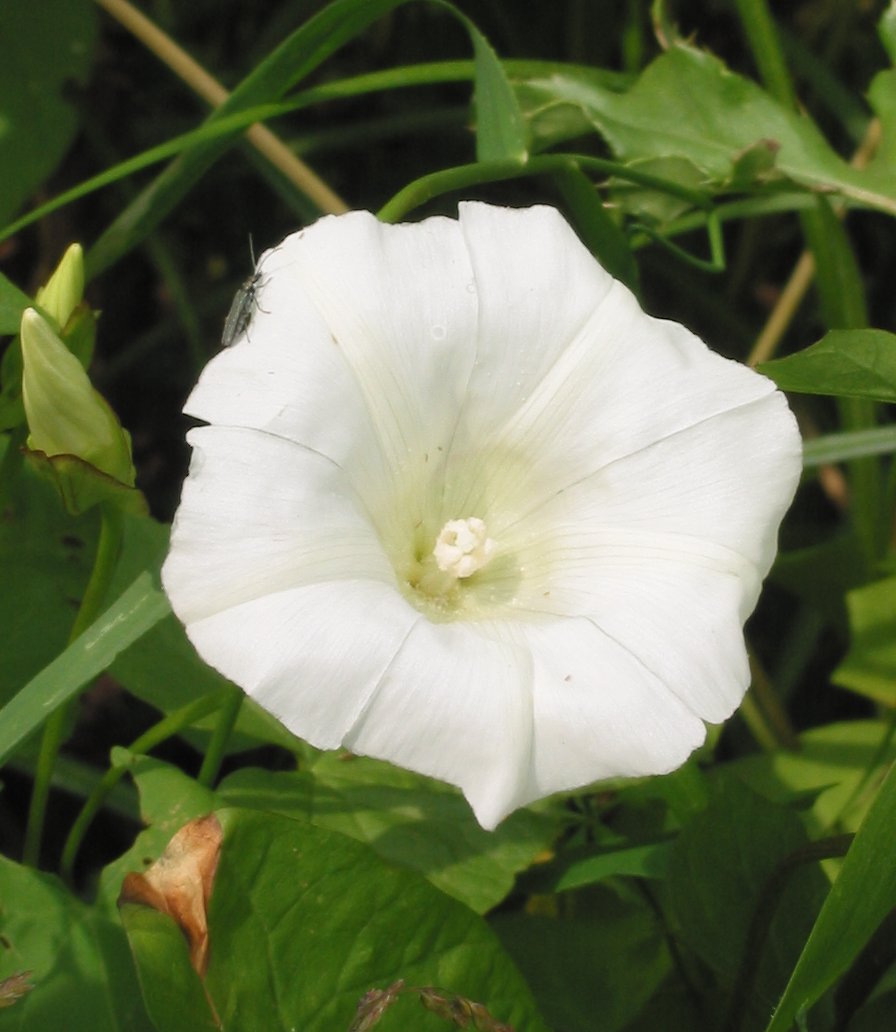
Photo: Rasbak at Dutch Wikipedia, CC BY-SA 3.0 · source

Climber · Bindweed family (Convolvulaceae)
Hedge bindweed
Calystegia sepium · also: Bellbind, Larger bindweed
Hedge bindweed is a native twining climber that turns up uninvited in almost every garden. It twines up to 2–3 m through hedges, shrubs and fences, with arrow-shaped leaves and, from June to September, large pure white funnel-shaped flowers. Underground it spreads by white, brittle rhizomes: every scrap left behind becomes a new plant. In borders and hedges this makes it a persistent weed that you can only keep in check with patience. In a wild corner, along a ditch or in rough ground it can stay: there bumblebees and hoverflies visit the flowers.
Caution: Persistent weed: the rhizomes spread underground and the stems smother shrubs and hedges. Never plant hedge bindweed deliberately in a border or hedge.
Light
Sun or partial shade
preferably some sun
Moisture
Dry to wet
not fussy
Legal basis
Any garden soil
any pH
Hardiness
Throughout Belgium
no protection needed
Size
twines to 2–3 m
tall
Flowering
June–September
| Pruning months | May–September |
|---|---|
| Height | twines to 2–3 m |
| Native to Belgium | Yes |
| Poisonous to people and pets | Not known to be poisonous |
| Flowering | June–September |
Identify
Hedge bindweed: how do you recognise it?
- Habit
- Perennial twining climber that comes back from the ground every year and twines up to 2–3 m.
- Leaf
- Alternate, 5–15 cm, arrow- to heart-shaped with angular lobes at the base, untoothed and hairless, on a long stalk.
- Stems and rhizomes
- Herbaceous, twining stems that die back in winter; white, brittle rhizomes underground.
- Flower
- Pure white (rarely pink) funnels of 3–5 cm; the calyx is hidden behind two large, green bracts; June–September.
- Fruit
- Small round capsules, enclosed by the bracts.
- Difference from field bindweed
- Field bindweed (Convolvulus arvensis) has smaller (1.5–2.5 cm), white-and-pink striped flowers without large bracts around the calyx.
Flowering: June–September · Pruning: May–September
Identify by feature: Twining climbers
Looks like it, but isn’t
- Field bindweed (Convolvulus arvensis): smaller (1.5–2.5 cm), white-and-pink striped flowers without large bracts around the calyx.
In your garden
Why grow it?
- Large, pure white funnel flowers from June to September, attractive in a wild corner or rough ground.
- Bumblebees and hoverflies visit the flowers, and it is a food plant of the convolvulus hawk-moth.
- Native and fully hardy: in a natural corner it needs no care at all.
- Knowing it well lets you tackle it early in borders and hedges, where it does not belong.
Hedge bindweed: where does it grow best?
- Grows in sun and partial shade, on almost any soil, dry or wet.
- Prefers moist, fertile soil: along ditches and riverbanks, in rough ground, hedges and woodland edges, and in gardens.
- It needs support to twine: shrubs, hedges, fences or tall plants. Without support it sprawls over the ground.
- It does not belong in a border, a vegetable garden or a young hedge; in a wild corner or rough ground it does little harm.
- Light
- Sun or partial shade
- Legal basis
- Any garden soil
- Moisture
- Dry to wet
- Size
- 3 m tall, 1 m wide
- Hardiness
- Throughout Belgium, no protection needed
Goes well with
- Hop: Another native twining climber of the same moist, fertile rough ground; together they make a green curtain in a wild corner.
- Elder: Grows in the same fertile spots; in a wild corner, hedge bindweed happily twines through it.
- Common honeysuckle: A native climber you do want in a hedge: fragrant flowers for moths, without spreading underground.
Good and bad companions
Goes well with
- Suits the woodland edge or the light shade of: ginkgo, box elder, ash, honey locust, field maple, silver maple
- Can climb into old, large trees: english oak, scots pine, sycamore, large-leaved lime
Maintenance
Hedge bindweed: when and how to plant it?
- There is never any need to plant it: hedge bindweed arrives by itself, by seed or as bits of rhizome in imported soil or in the root ball of bought plants.
- When planting new shrubs and perennials, check the root ball for small white rhizomes and remove them.
- Don’t plant a new hedge or border on ground infested with bindweed: clear the soil first, because later you will never get the rhizomes out from among the shrub roots.
- If you want a native climber for a fence or hedge, choose common honeysuckle instead: it does not spread underground.
Care
- Removing
- Pull or cut off new shoots as soon as they appear above ground. Without leaves, the rhizomes become exhausted after a few seasons.
- Digging out
- Lift the white rhizomes with a garden fork, not a spade: a spade chops them into pieces, and every piece regrows.
- Unwinding
- Gently unwind stems from hedges and shrubs instead of pulling them: that way they don’t snap and you can find the base.
- Covering
- On bare ground, cover the soil for a whole growing season with cardboard or black membrane: without light the plant is badly weakened.
Tip: If you are planting a new hedge on ground with bindweed, wait a season: keep the soil bare or covered and remove every shoot. Only plant the hedge once nothing more comes up.
Hedge bindweed: when to prune it?
Pruning months: May–September.
When: From May to September, as soon as you see new stems.
How:
- Gently pull the stems free and dig out the white rhizomes as completely as possible.
- Repeat every year, each time new shoots appear: this gradually weakens the plant.
- In any case, remove the stems before they set seed in late summer.
Caution: Don’t put the rhizomes on the compost heap: they will regrow there.
Propagation
- By itself
- Propagation is never needed: every scrap of rhizome grows into a new plant, and seed can germinate too. The real work is the opposite: keeping it in check.
Hedge bindweed: how does it get through the winter?
Hardy throughout Belgium: no protection needed.
- Fully hardy. In autumn the stems die back; the rhizomes overwinter in the soil and reshoot in spring.
- If you make a new border in autumn or winter, sift all the rhizomes out of the soil straight away: it is easiest before any plants go in.
- Clear the dead stems out of the hedge, so you spot the new shoots quickly in spring.
Diseases and pests
- Smothered hedges and shrubs: The stems twine over hedges and shrubs and take their light. Unwind them as soon as you see them, ideally in May–June.
- Keeps coming back: After weeding it regrows from scraps of rhizome left behind. Keep removing the shoots: expect to persevere for a few years.
- Rhizomes among perennials: Hard to dig out without damaging the perennial. Lift the perennial, pick the rhizomes out of the root ball and replant it.
- Brought in with plants: It often arrives in the root ball of a bought plant or in imported soil. Check root balls when planting.
Through the year
- April: The first shoots appear above ground: keep an eye on them.
- May: Pull new stems free and dig out rhizomes.
- June: Unwind stems from hedges and shrubs; flowering begins.
- July: Flowering; keep removing new shoots in the border.
- August: Keep removing stems and shoots.
- September: Final round: remove stems before they set seed.
- October: The stems die back; clear new borders.
Use
What can you use it for?
- For wildlife
- Food plant of the convolvulus hawk-moth; bumblebees and hoverflies visit the flowers.
Caution: Persistent weed: the rhizomes spread underground and the stems smother shrubs and hedges.
You and this species
Did you know?
- Every scrap of rhizome left in the soil when weeding grows into a new plant: that is why hedge bindweed is so hard to get rid of.
- The convolvulus hawk-moth, a large migrant moth from the south, lays its eggs on bindweeds; the caterpillars eat the leaves.
- A twining plant always turns the same way: hedge bindweed in one direction, hop and honeysuckle in the other.