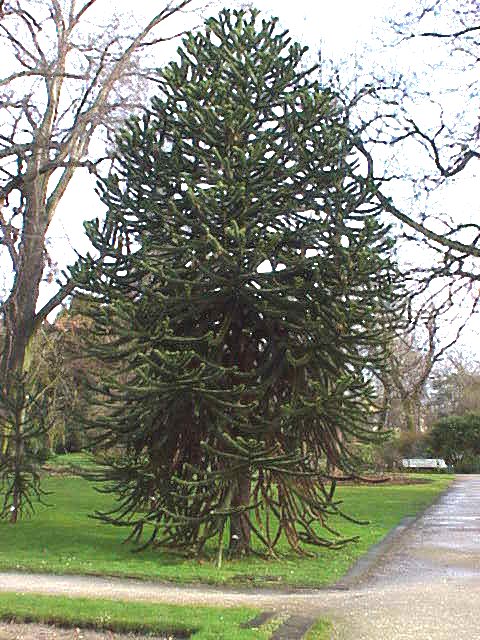
Photo: Wikimedia Commons, CC BY-SA 3.0 · source

Conifer · Monkey puzzle family (Araucariaceae)
Monkey puzzle
Araucaria araucana · also: Chilean pine, Monkey puzzle tree
The monkey puzzle comes from the Andes of Chile and Argentina and is unmistakable: thick, snake-like branches completely covered in broad, triangular, razor-sharp leaves. It grows slowly into a tree of 10–25 m with a candelabra-shaped crown; older trees lose their lower branches. In the 19th and early 20th centuries it was a fashionable tree for villa gardens and parks, and you still often see it in old front gardens. A striking specimen tree, but don’t plant it next to a path or a play area.
Caution: The leaves are razor-sharp: don’t plant it next to a path, a patio or a play area, and wear gloves when clearing up fallen branches.
Light
Full sun
warm and bright
Moisture
Normal
no wet feet
Legal basis
Any garden soil
any pH
Hardiness
Throughout Belgium
no protection needed
Size
10–25 m
tall
| Pruning months | April–May |
|---|---|
| Height | 10–25 m |
| Native to Belgium | No, planted |
| Good for bees, butterflies and birds | Little |
| Poisonous to people and pets | Not known to be poisonous |
Identify
Monkey puzzle: how do you recognise it?
- Habit
- Evergreen tree of 10–25 m, broadly conical when young, later with a tall, open, candelabra-shaped crown; the branches grow in whorls around the trunk.
- Leaf
- Leathery, triangular leaves of 3–5 cm with a spiny tip, spiralled and overlapping all round the branches; they stay on for 10–15 years.
- Bark
- Grey, with ring-shaped scars left by old branches.
- Cone
- Large, round cones (10–15 cm) that take years to ripen; in Chile the seeds are eaten. Male and female cones usually grow on separate trees.
- Difference from Norfolk Island pine
- Norfolk Island pine (Araucaria heterophylla) has soft, small needles and is a houseplant that cannot live outdoors.
Pruning: April–May
Identify by feature: Prickly needles
Looks like it, but isn’t
- Norfolk Island pine (Araucaria heterophylla): soft, small needles; a houseplant that cannot live outdoors.
In your garden
Why grow it?
- A silhouette like no other: an eye-catcher for a large front garden or a park.
- Evergreen and just as striking all year round, winter included.
- Little work: it grows slowly and hardly ever needs pruning.
- Fully hardy and wind-resistant.
Monkey puzzle: where does it grow best?
- Full sun; that is where it grows best.
- Any well-drained soil, acid or chalky, that neither dries out nor stays wet for long.
- Copes well with wind, even on the coast.
- Allow for a crown about 8 m across and 15 m or more tall: not a tree for a small garden, but for a large front garden, a big garden or a park. Keep it well away from paths, patios and play areas.
- Light
- Full sun
- Legal basis
- Any garden soil
- Moisture
- Normal
- Size
- 15 m tall, 8 m wide
- Hardiness
- Throughout Belgium, no protection needed
Goes well with
- Atlas cedar: In a park or large garden: another evergreen showpiece from the age of the great landscape parks.
- Giant redwood: Two exotics often seen together in old country-house parks; only if you have a great deal of space.
- Ornamental juniper: A low, creeping juniper around the base covers the ground, needs little care and keeps people away from the prickly branches.
Good and bad companions
Goes well with
- Tolerate the shade under this tree: oregon grape, rhododendron, oleaster, japanese skimmia, garden privet, camellia, laurustinus, box-leaved honeysuckle
Maintenance
Monkey puzzle: when and how to plant it?
- Plant in April or September, container-grown or root-balled. A young plant establishes best.
- Choose the final spot straight away, far enough from the house, paths and play areas: it grows wide and the leaves are prickly.
- Dig a generous planting hole, loosen the soil and set the plant at the same depth as it was in the pot.
- Water during dry spells for the first two years; after that it fends for itself.
- If you ever want seeds, you need a male and a female tree. You can only tell a tree’s sex after many years, once it produces cones.
Care
- Watering
- During dry spells in the first few years; an older tree needs no watering.
- Feeding
- Not needed; a little compost at planting is enough.
- Lower branches
- Older trees lose their branches from the bottom up. That is normal: remove the dead branches in spring.
- Fallen branches
- Dead branches drop off leaves and all and stay sharp for a long time: clear them up wearing sturdy gloves.
Tip: Don’t plant a young monkey puzzle too close to the house or the path: today’s one-metre plant will become a tree with a crown 8 m across and leaves like blades.
Monkey puzzle: when to prune it?
Pruning months: April–May.
When: In spring, remove the lowest dead branches.
How:
- Saw dead branches off close to the trunk, without cutting into the trunk.
- Don’t cut healthy branches to make it smaller: a branch that is sawn off won’t grow back, and a cut leader is never neatly replaced.
- On a large tree, use a long-handled pruning saw, and stand beside the branch, not underneath it.
Caution: Wear sturdy gloves and long sleeves: the leaves are razor-sharp, even on dead branches.
Propagation
- Sowing
- Fresh seeds from a fertilised female cone germinate readily; don’t let them dry out. Sow them in a deep pot of sandy compost. Seedlings grow slowly.
- Cuttings
- Rarely successful: a cutting from a side branch keeps growing sideways and never becomes a shapely tree.
Monkey puzzle: how does it get through the winter?
Hardy throughout Belgium: no protection needed.
- Fully hardy in Belgium and the Netherlands.
- In severe frost with a cold, dry east wind, young trees can get brown leaves; they usually recover in spring.
- After a winter storm, check for broken branches and clear them up wearing gloves.
Diseases and pests
- Dying lower branches: Normal on older trees. If it happens quickly, or higher branches die too, suspect drought, compacted soil, road salt or root rot.
- Root rot: Brown, dying branches on wet, poorly drained soil. Plant it in a well-drained spot; a sick tree is hard to save.
- Brown leaves: After a harsh winter with cold winds, especially on young trees. Be patient: the tree grows back in spring.
Through the year
- January: After a storm: clear up broken branches wearing gloves.
- April: Saw off the lowest dead branches; plant container-grown trees.
- May: Finish removing dead branches.
- July: Water young trees during dry spells.
- August: Water during prolonged drought, in the first few years.
- September: Plant container-grown or root-balled trees.
- November: Clear up fallen branches; mulch around a young tree.
Use
What can you use it for?
- Garden and landscape
- Striking specimen tree with a candelabra-shaped crown; slow-growing.
- Food and drink
- In Chile the large seeds (piñones) are eaten boiled or roasted.
Caution: The leaves are razor-sharp: don’t plant it next to a path or play area.
You and this species
Did you know?
- The name ‘monkey puzzle’ comes from the remark that even a monkey would struggle to climb it.
- A living fossil: its family was already around when dinosaurs roamed the earth.
- The Pehuenche people of the Andes take their name from the tree (pehuén), and its seeds (piñones) are an important food there. It is protected in Chile, as it is endangered in the wild.
- In Chile, the Scottish naval surgeon Archibald Menzies was served the seeds for dessert. He pocketed a few, raised them on board and so brought the first monkey puzzles to Britain.
- The monkey puzzle family already existed in the age of the dinosaurs: fossil araucarias are known from the Jurassic.