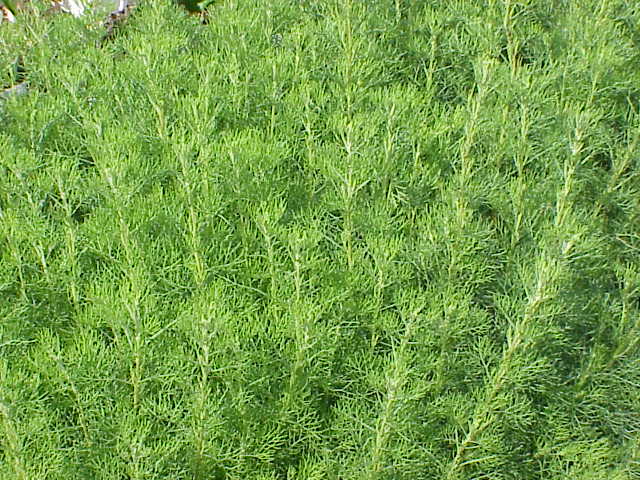
Photo: Kurt Stüber [1], CC BY-SA 3.0 · source

Herb · Asteraceae
Southernwood
Artemisia abrotanum
In other languages: Citroenkruid (Nederlands) · Aurone (Français)
Southernwood is a small, semi-woody shrub that originally comes from south-eastern Europe and western Asia. It forms a loose, upright clump 60–90 cm tall with very finely divided, grey-green foliage that gives off a strong lemon scent as soon as you touch it. It has been grown in herb and cottage gardens for centuries, mainly for that fresh fragrance. It is very hardy, copes with drought and poor soil, and asks for little more than a firm prune in April. The small, yellowish flowers in August–September are barely noticeable.
Light
Full sun
warm and bright
Moisture
Dry
tolerates drought
Legal basis
Sand, loam or clay
neutral to chalky
Hardiness
Fully hardy
down to -25 °C
Size
0.9 m
tall, 0.6 m wide
Flowering
August–September
| Pruning months | April and June |
|---|---|
| Height | 0.9 m |
| Native to Belgium | No, planted |
| Poisonous to people and pets | Not known to be poisonous |
| Flowering | August–September |
Identify
Southernwood: how do you recognise it?
- Habit
- Subshrub with a woody base and many upright stems, 60–90 cm tall and about 60 cm wide.
- Leaves
- Divided into thread-like segments, soft and grey-green; in mild winters some stay on the plant.
- Scent
- Strongly of lemon, with a spicy, slightly camphor-like undertone when you crush the leaves.
- Flowers
- Small, yellowish buttons in loose panicles in August–September; in cool summers it flowers little.
- Roots
- Fibrous and fairly deep, so it stands up well to drought; it hates wet feet.
Flowering: August–September · Harvest and fruit: May–September · Plants: April–May and September · Pruning: April and June
In your garden
Why grow it?
- The fine, grey-green foliage brings structure and a soft colour to the border from April until late autumn.
- The lemon scent is released as soon as you touch the leaves: plant it beside a path or near a seat.
- A sprig in the wardrobe or a little bag of dried leaves keeps moths away.
- Very drought-tolerant and hardy: ideal for a sunny, poor spot or a gravel garden.
- It is easily clipped into a low, fragrant hedge around a herb garden or a rose bed.
Southernwood: where does it grow best?
- Full sun: in shade it becomes floppy and open and smells less strongly.
- Any well-drained soil: sand, loam or clay, as long as it does not stay wet; neutral to chalky.
- Dry is fine, wet is not: waterlogged soil in winter is the quickest way to lose it.
- Allow 50–60 cm per plant; for a low hedge, plant 40 cm apart.
- Light
- Sun
- Soil type
- Sand, loam or clay
- Acidity
- Neutral or chalky
- Moisture
- Dry
- Size
- 0.9 m tall, 0.6 m wide
- Hardiness
- Hardy (to -25 °C)
Goes well with
- Lavender: The same sunny, dry spot; purple flowers beside the grey-green leaves.
- Sage: A second fragrant herb with grey-green leaves for the herb garden.
- Thyme: Low and fragrant at the front, on the same poor soil.
- Catmint: Blue flowers from May into September beside the fine, grey foliage.
- Roses: Southernwood makes a low, fragrant hedge around a rose bed.
Maintenance
Southernwood: when and how to plant it?
Plant in April–May and September.
- Plant in April–May or in September, when the soil is warm enough for the roots to establish quickly.
- Dig a hole twice as wide as the pot and loosen the bottom; on heavy soil, mix in coarse sand or fine gravel.
- Set the plant at the same depth as it was in the pot and firm the soil well.
- Space plants 50–60 cm apart, or 40 cm for a hedge.
- Water in thoroughly straight away and during dry spells in the first weeks; after that it needs very little.
- Mulch with gravel rather than compost: it keeps the base of the plant dry.
Care
- Watering
- Only in the first year during long dry spells. After that it looks after itself; in a pot, water when the compost feels dry.
- Feeding
- Hardly needed: on rich soil it grows floppy and smells less strongly. A handful of compost in April is plenty.
- Harvesting
- Cut sprigs for the wardrobe from May to September. Hang them upside down in bunches to dry in a dry, airy place.
- In the kitchen
- The leaves taste very bitter; southernwood is grown mainly for its scent and is hardly used in cooking.
- Renewing
- If an old plant becomes bare and woody after a number of years, take cuttings and replace it with a young plant.
Tip: Plant it where you often walk past: every time you brush the leaves you smell lemon, and the scent is strongest on a warm day. Dried sprigs in a cloth bag keep their fragrance for a long time.
Southernwood: when to prune it?
Pruning months: April and June.
When: In April, as soon as you see new green buds low down on the stems. A light trim is still fine in June; after the end of August, do not prune.
How:
- Cut all stems back to 20–30 cm above the ground, just above a few young buds.
- This keeps the plant compact and bushy; without pruning it becomes open and falls apart.
- Remove dead and frost-damaged stems right at the base.
- In June, just trim the tips to keep it in shape; the clippings can be dried.
Caution: Do not prune in autumn: young shoots that still appear then are killed by frost in winter, and the old stems protect the base.
Propagation
- Softwood cuttings
- In May–June: 8–10 cm cuttings from young, non-flowering shoots, lower leaves removed, in a mix of cutting compost and sand. They root readily.
- Semi-ripe cuttings
- In August: pull off side shoots with a heel of old wood and root them in a cold frame or on a cool windowsill; plant out in spring.
- Layering
- In summer, peg a low stem into the soil and cover it; the following spring, sever it and replant it.
Southernwood: how does it get through the winter?
Hardy to −25 °C.
- Very hardy, to about −25 °C: in Belgium it needs no protection.
- Wet soil in winter is a greater danger than frost: make sure drainage is good.
- Leave the stems standing over winter, as they protect the base. Do not prune until April.
- In a pot: stand it against a wall, on pot feet, so excess water can drain away.
Diseases and pests
- Root rot: The plant turns brown and dies, often after a wet winter. Choose a well-drained spot or plant it slightly raised, with gravel around the base.
- Bare, floppy plant: Too little sun, too rich a soil or no pruning. Prune hard every spring and do not feed.
- Splaying open: After rain or in wind the stems fall apart. A firm prune in April and a light trim in June keep it compact.
- Aphids: Sometimes on the tips of young shoots in spring. Spray them off with water or leave them to the ladybirds.
Through the year
- March: Do not prune yet. On wet soil, scatter some coarse sand or gravel around the base.
- April: Prune hard to 20–30 cm. Plant. Give a handful of compost.
- May: Plant. Take softwood cuttings.
- June: Light trim to shape. Harvest sprigs for the wardrobe.
- July: Harvest sprigs and dry them in bunches. Water young plants in dry weather.
- August: Small yellow flowers. Take semi-ripe cuttings. Stop pruning.
- September: Flowering. Plant. Last harvest of sprigs.
- November: Leave the stems as protection. Put pots on pot feet.
- December: Rest. Make sure the base is not standing in water.
Use
Edible and useful
- Leaves (May–September)
- Cut sprigs of 15 to 20 cm from May to September, ideally on a dry, warm day, when the scent is strongest. Southernwood is harvested for its fresh lemon scent: in a bouquet, a scented sachet or the wardrobe, where it has long been used to keep moths away. It is not a kitchen herb: the leaves taste very bitter.
- Storing
- Hang the sprigs in loose bunches upside down somewhere dry and airy, out of the sun. After one to two weeks, strip off the leaves. In a closed jar or bag they stay fragrant for a year; rub them now and then to refresh the scent.
Caution: Southernwood is neither a kitchen herb nor a tea: the leaves are very bitter and, like wormwood, contain thujone, which is harmful in larger amounts. Do not eat or drink it, and certainly not during pregnancy. The leaves can irritate sensitive skin, and people allergic to the daisy family may react to them: wear gloves if so. Keep sachets out of reach of young children and pets.
Eating and using is at your own risk: see the terms of use.
Recipes
- Southernwood sachets for the wardrobe (Other · 4 sachets · 15 min + 1 to 2 weeks drying)
You and this species
Did you know?
- Southernwood is related to tarragon and wormwood: all three belong to the genus Artemisia.
- In French it is also called ‘garde-robe’, because it was once used to protect clothes from moths.
- In cool summers it hardly flowers; it is grown mainly for its foliage and scent.