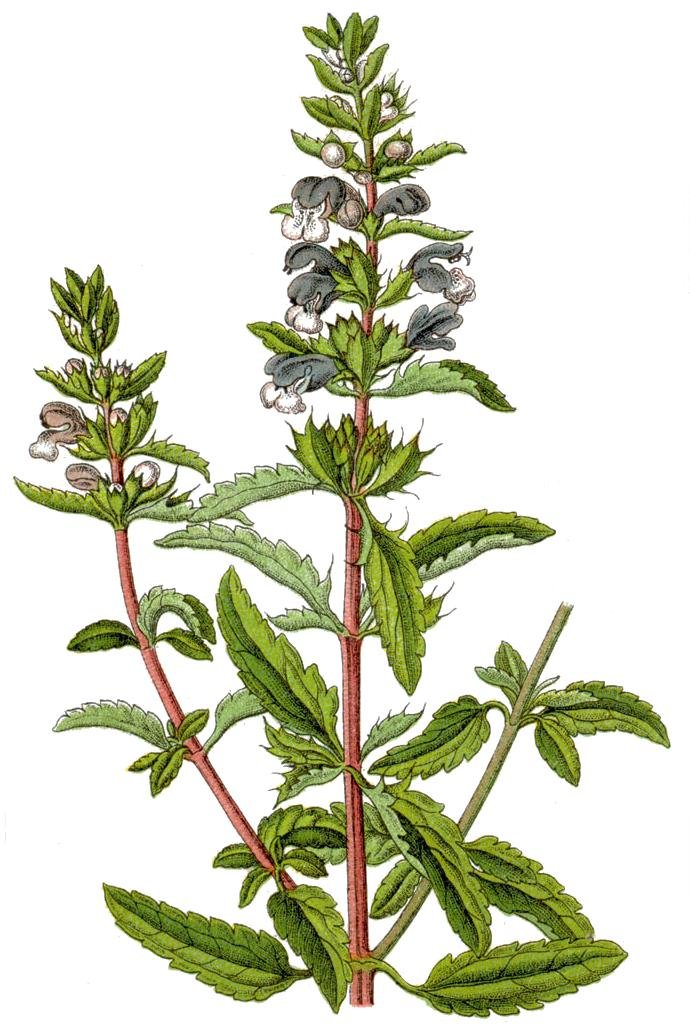
Photo: Johann Georg Sturm (Painter: Jacob Sturm), Public domain · source

Herb · Lamiaceae
Moldavian dragonhead
Dracocephalum moldavica
In other languages: Moldavische drakenkop (Nederlands) · Mélisse de Moldavie (Français)
Moldavian dragonhead is an annual herb in the mint family. It comes from Central Asia and southern Siberia and has long been naturalised in eastern Europe. It grows into an upright little plant of about 50 cm with toothed, lance-shaped leaves that smell strongly of lemon. From July to September, whorls of blue-violet, two-lipped flowers appear, which bees and bumblebees love. There is also a white-flowered form. It is easy to raise from seed, and the leaves can be used fresh or dried in tea.
Light
Full sun
warm and bright
Moisture
Dry to normal
no wet feet
Legal basis
Sand, loam or clay
any pH
Hardiness
down to -2 °C
protect in harsh winters
Size
0.5 m
tall, 0.3 m wide
Flowering
July–September
| Height | 0.5 m |
|---|---|
| Native to Belgium | No, planted |
| Good for bees, butterflies and birds | Yes, for bees |
| Poisonous to people and pets | Not known to be poisonous |
| Flowering | July–September |
Identify
Moldavian dragonhead: how do you recognise it?
- Habit
- Annual, upright and slightly branched, 40–50 cm tall and about 30 cm wide, with square stems.
- Leaves
- Lance-shaped to elongated triangular, 2–4 cm long, with a scalloped edge; fresh green.
- Flowers
- Two-lipped flowers up to 2.5 cm long, in whorls along the upper stems, from July to September; blue-violet, sometimes white.
- Scent
- The whole plant smells strongly of lemon, most of all when you crush the leaves.
- Seed
- Small, dark brown nutlets in the dry calyces; it sometimes self-seeds.
Flowering: July–September · Harvest and fruit: June–September · Sowing: March–May · Plants: May
In your garden
Why grow it?
- A real bee plant: from July to September, bees and bumblebees visit the flowers.
- The leaves smell and taste fresh and lemony, and are lovely in tea or in a cold lemonade.
- Quick results: a few months after sowing it is already in flower.
- The blue-violet flowers bring a cool colour among marigolds and other summer flowers.
- Easy to grow from seed, also in a pot or trough on a sunny patio.
Moldavian dragonhead: where does it grow best?
- Full sun: that is where it flowers most freely and the leaves smell strongest.
- Well-drained soil, sand, loam or clay, acid to chalky; on very rich soil it flops over more easily.
- Dry to normally moist; it dislikes wet feet.
- Space plants 25–30 cm apart; a 25 cm pot holds two or three.
- Light
- Sun
- Soil type
- Sand, loam or clay
- Acidity
- Not fussy
- Moisture
- Dry or normal
- Size
- 0.5 m tall, 0.3 m wide
- Hardiness
- Half hardy (to -2 °C): protect it in harsh winters
Goes well with
- Pot marigold: Orange flowers beside the blue-violet, and another easy annual.
- Phacelia: Another bee magnet; together they make a buzzing strip in the vegetable garden.
- Borage: Blue star-shaped flowers in the same sunny spot, also loved by bumblebees.
- Lemon balm: For a tea corner with two lemon-scented herbs.
- Cornflower: Blue with blue in a cutting garden or a strip of summer flowers.
Maintenance
Moldavian dragonhead: when and how to plant it?
Plant in May.
- Sow indoors in March–April in small pots or a seed tray at 18–20 °C, covering the seed only very thinly.
- Prick out the seedlings into individual pots once they have two true leaves and grow them on in a light spot.
- In early May, harden the plants off outside during the day and plant them out after mid-May, when there is no more risk of night frost.
- Or sow directly where they are to grow in May, in rows, and thin the seedlings to 25–30 cm later.
- Plant at the same depth as in the pot, firm the soil and water straight away.
- Keep the soil weed-free for the first few weeks; do not mulch too thickly, so the soil stays warm.
Care
- Watering
- Regularly after planting until established; after that only in long dry spells. More often in a pot, but never leave it standing in water.
- Feeding
- Not needed in ordinary garden soil. Too much fertiliser gives floppy stems and less scent.
- Pinching out
- Pinch out the tips of young plants at about 15 cm: they branch better and become bushier.
- Support
- In a windy spot or on rich soil, a few twiggy sticks or a length of string stop the plants falling over.
- Harvest and use
- Pick the leaves from June, ideally just before flowering; the flowering tops can be dried too. Use them fresh or dried in tea or lemonade.
Tip: Pick the leaves for tea just before flowering, on a dry morning once the dew has gone: that is when the lemon scent is strongest.
Moldavian dragonhead: when to prune it?
When: No pruning is needed: it is an annual. You can pinch out young plants and cut off faded flower stems.
How:
- In June, pinch out the tips of plants about 15 cm tall for bushier growth.
- Cut faded flower stems back to just above a few leaves: sometimes new side shoots then still flower.
- Towards the end of summer, leave a few stems to finish flowering and ripen if you want to collect seed.
Propagation
- Seed
- Sow indoors in March–April or outdoors in May. Collect your own seed in September: cut off brown flower stems, let them dry further in a paper bag and store the seed somewhere cool and dry until spring.
- Self-sowing
- On light, open soil it sometimes self-seeds. Move the seedlings in May to where you want them.
Moldavian dragonhead: how does it get through the winter?
Hardy to −2 °C: protect in harsh winters.
- Annual: the plant dies after flowering or with the first frost; it does not survive temperatures below about −2 °C.
- Clear away the dead plants in October–November, or leave a few stems standing for seed.
- Store your own seed cool and dry and sow it again the following spring.
- Keep dried leaves in a tightly closed jar, dark and dry, for tea in winter.
Diseases and pests
- Damping off: Seedlings collapse at the base and fall over. Do not sow too thickly, use clean seed compost and do not overwater.
- Slugs: They strip young plants after planting out. Only plant out sturdy plants and check in the evening.
- Flopping: On rich soil or in wind the stems fall over. Do not feed, pinch out the plants and give a little support if needed.
- Root rot: On wet, heavy soil the roots rot and the plant wilts. Choose a well-drained spot or grow it in a pot.
Through the year
- March: Sow indoors at 18–20 °C.
- April: Sow indoors. Prick out seedlings.
- May: Harden off and plant out after mid-May. Sow outdoors in situ.
- June: Pinch out tips. Thin seedlings. First leaves for picking.
- July: Flowering. Harvest leaves and flowering tops for tea.
- August: Full flower, busy with bees. Water in dry weather.
- September: Last flowers. Collect seed.
- October: Clear away dead plants. Store seed dry.
Use
Edible and useful
- Flowers (July–September)
- Pick the blue-violet (or white) lipped flowers from July to September. They taste mild and fresh, of lemon. Scatter them over a salad, a fruit salad or a dessert, add them to a tea, or cut flowering tops for a syrup.
- Leaves (June–September)
- Pick the leaves from June, ideally just before flowering and on a dry morning: that is when they smell most strongly of lemon, like lemon balm. Use them fresh or dried in herbal tea, lemonade or iced tea, and a few shredded leaves in a fruit salad, quark or a green salad. In Eastern Europe it has long been grown for tea.
- Storing
- Dry flowering stems in small bunches, upside down somewhere airy and dark. Strip off the leaves and flowers once crisp and keep them in a closed jar for up to a year. Fresh leaves keep for a few days in a bag in the fridge.
Caution: Moldavian dragonhead is a kitchen herb: use it in normal amounts, like lemon balm, for a few cups of tea a day. If you are pregnant or breastfeeding, keep to the occasional cup: little is known about it. Only pick from a plant you sowed yourself or bought under that name, and do not swallow the essential oil.
Eating and using is at your own risk: see the terms of use.
Recipes
- Dragonhead tea (Tea · 1 cup · 10 min)
- Dragonhead syrup (Syrup · ± 800 ml · 20 min + overnight steeping)
Good for wildlife
- Bees
- Nectar and pollen for honeybees and wild bees.
You and this species
Did you know?
- Dracocephalum literally means ‘dragon head’: the open, two-lipped flower recalls the gaping mouth of a dragon.
- The lemon scent comes from the same kind of aromatic compounds, such as citral, as in lemon balm.
- Beekeepers like to sow it as a forage plant: it flowers for a long time and produces plenty of nectar.