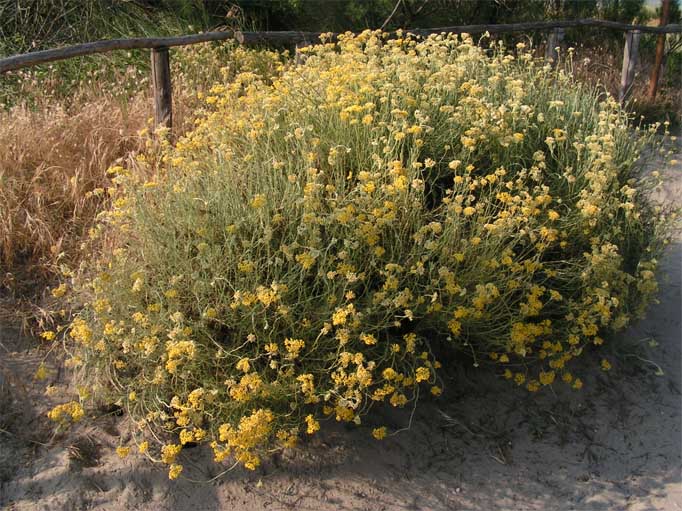
Photo: Ericsteinert at German Wikipedia, CC BY-SA 3.0 · source

Herb · Asteraceae
Curry plant
Helichrysum italicum
In other languages: Kerrieplant (Nederlands) · Immortelle d’Italie (Français)
Curry plant comes from the Mediterranean region, where it grows on dry, sunny slopes and rocky ground. It is a small, evergreen sub-shrub with narrow, silver-grey leaves that smell strongly of curry. From June to August small golden-yellow flowers appear in flat clusters, which attract bees. Despite the scent, the plant is not the source of curry powder: that is a spice blend. It is a lovely, aromatic plant for a dry, sunny border, a gravel garden or a pot.
Light
Full sun
warm and bright
Moisture
Dry
tolerates drought
Legal basis
Sand or loam
any pH
Hardiness
down to -15 °C
protect young plants
Size
0.5 m
tall, 0.6 m wide
Flowering
June–August
| Pruning months | April |
|---|---|
| Height | 0.5 m |
| Native to Belgium | No, planted |
| Good for bees, butterflies and birds | Yes, for bees |
| Poisonous to people and pets | Not known to be poisonous |
| Flowering | June–August |
Identify
Curry plant: how do you recognise it?
- Habit
- Compact, mounded sub-shrub about 50 cm tall and 60 cm wide, evergreen.
- Leaves
- Narrow, needle-like to linear, silver-grey and downy, with a strong curry scent.
- Flowers
- Small golden-yellow buttons in flat clusters from June to August; they keep their colour when dried.
- Scent
- The foliage smells strongly of curry, especially when rubbed or after rain.
- Roots
- Fine roots that do well in poor, dry soil.
Flowering: June–August · Harvest and fruit: May–September · Plants: April–May · Pruning: April
In your garden
Why grow it?
- Silver-grey foliage that looks good all year, even in winter.
- Strong curry-like scent, especially after rain or in warm weather.
- Yellow summer flowers that attract bees and keep their colour when dried.
- Very drought-tolerant and low-maintenance in a sunny spot.
- A mild leaf for the kitchen: a sprig adds flavour to dishes.
Curry plant: where does it grow best?
- Full sun; in a warm spot it keeps its silver-grey colour.
- Poor, well-drained soil: sand or loam, acid to chalky. Add grit or sand on heavy soil.
- Dry; it will not tolerate wet feet, above all in winter.
- Allow 40–50 cm between plants; it does well in a sunny spot against a wall.
- Light
- Sun
- Soil type
- Sand or loam
- Acidity
- Not fussy
- Moisture
- Dry
- Size
- 0.5 m tall, 0.6 m wide
- Hardiness
- Hardy (to -15 °C)
Goes well with
- Lavender: Same sunny, dry spot; purple next to silver-grey and yellow.
- Rosemary: Another evergreen, fragrant Mediterranean shrub.
- Thyme: A low, fragrant ground cover at the base.
- Stonecrop: Combines well in a dry gravel garden.
- Sage: Grey-green leaves and blue flowers as a complement.
Maintenance
Curry plant: when and how to plant it?
Plant in April–May.
- Plant in April–May, when no hard frost is expected any more.
- Dig a hole as deep as the pot and twice as wide; on heavy soil, mix plenty of coarse sand or grit into the soil.
- Set the plant at the same depth as in its pot and firm the soil.
- Leave 40–50 cm between plants.
- Water thoroughly once, then only in dry weather; use a layer of gravel rather than organic mulch.
Care
- Water
- In the first year, water occasionally in dry weather. After that it is very drought-tolerant and rarely needs extra water.
- Feeding
- Unnecessary and even harmful: too much feed gives soft, green growth. Poor soil is better.
- Mulching
- Use a layer of gravel or grit rather than organic mulch, which holds moisture.
- Deadheading
- Cut off the faded flower clusters after flowering to keep the plant compact, or leave them for dried flowers.
- Harvesting
- Snip sprigs for the kitchen during the growing season; use them sparingly.
Tip: Let a sprig simmer in rice, soup or stew and remove it before serving: the flavour is milder than the scent. Put it in a dry, sunny spot and err on the side of too little water.
Curry plant: when to prune it?
Pruning months: April.
When: In April, when the worst frosts are over and new shoots appear.
How:
- Cut all stems back by about a third, just above young, leafy wood.
- Remove dead or frost-damaged stems completely.
- After flowering, cut off the faded flower clusters.
- This keeps the plant compact and stops it becoming bare and woody at the base.
Caution: Do not cut deep into old, leafless wood: it is slow to regrow.
Propagation
- Cuttings
- In July–August, take 8–10 cm tip cuttings from non-flowering shoots, remove the lower leaves and insert them in sandy compost. They root within a few weeks.
- Seed
- Sow in spring in a tray of sandy soil, barely covered, at 18–20 °C. The seed is fine and germinates within a few weeks.
Curry plant: how does it get through the winter?
Hardy to −15 °C: protect young plants.
- Hardy to about −15 °C: in Belgium it usually survives, but wet winters are more dangerous than frost.
- Make sure the soil drains well, preferably in a sheltered, sunny spot against a wall.
- In a pot: keep it dry and sheltered in winter, against a south-facing wall, and water hardly at all.
Diseases and pests
- Winter rot: The plant turns brown and dies after a wet winter. Plant in very well-drained soil, preferably raised or with grit.
- Bare, woody base: Old plants become bare at the bottom. Prune lightly each spring and replace old plants after a few years.
- Frost damage: After a hard winter, stems turn brown. Wait until spring and cut away the dead wood.
- Few flowers: In a spot that is too shady or too rich. Choose full sun and poor soil.
Through the year
- March: You can remove dead wood, but wait until April to prune.
- April: Cut back and plant.
- May: Plant. Water only once.
- June: Flowering begins. Snip sprigs for the kitchen.
- July: Full flower. Take cuttings.
- August: Flowering. Cuttings. Dry the flowers.
- September: Cut off faded flower clusters.
- October: Keep the plant dry.
- November: Do not let it stand wet; keep the pot dry.
- December: Rest.
Use
Edible and useful
- Flowers (July–August)
- Cut the golden flower clusters in July and August, when the first flowers have just opened: that way they keep their colour once dried. They are for drying, not for eating. Dried, they stay pretty for months in a dried bouquet or a wreath; that is why the French call the plant immortelle.
- Leaves (May–September)
- Cut young sprigs of 5 to 10 cm from May to September. The silver-grey leaves smell strongly of curry, but it is not curry: curry powder is a blend of spices, and the curry leaves of Indian cooking come from another plant (Murraya koenigii). In the kitchen, use curry plant like a bay leaf: cook a sprig with rice, soup, a stew or vegetables and remove it before serving. The flavour is milder than the smell. Chopped leaves are bitter: use a pinch at most.
- Storing
- Fresh is best: the plant is evergreen, so you can cut a sprig whenever you need one. Dried leaves lose much of their scent. For dried flowers, tie the stems in small bunches and hang them upside down somewhere dark, dry and airy for two to three weeks.
Caution: Use curry plant as a flavouring, in small amounts: a sprig that cooks with the dish and comes out again, not a handful of leaves. It is neither curry nor curry leaf. Not during pregnancy or breastfeeding: too little is known about it. People allergic to the daisy family (such as chamomile or arnica) may react to it. Never swallow the essential oil (helichrysum oil).
Eating and using is at your own risk: see the terms of use.
Recipes
- Rice with a sprig of curry plant (Dish · 4 people · 25 min)
- Small dried bouquet of curry plant (Other · 1 small bouquet · 15 min + 2 to 3 weeks drying)
Good for wildlife
- Bees
- Nectar and pollen for honeybees and wild bees.
You and this species
Did you know?
- The plant smells of curry, but curry powder is a spice blend and is not made from this plant.
- The name Helichrysum comes from Greek: helios (sun) and chrysos (gold), after the golden flowers.
- The flowers keep their colour when dried; in French the plant is therefore called immortelle.