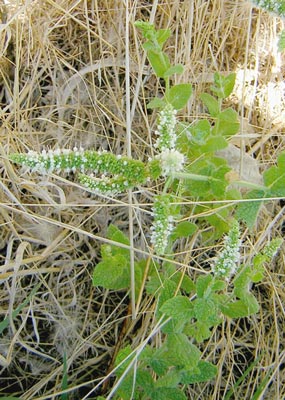
Photo: No machine-readable author provided. Aroche assumed (based on copyright claims)., CC BY 2.5 · source

Herb · Lamiaceae
Apple mint
Mentha suaveolens
In other languages: Appelmunt (Nederlands) · Menthe à feuilles rondes (Français)
Apple mint (Mentha suaveolens) comes from southern and western Europe and North Africa. It is a sturdy mint with round, crinkled, softly hairy leaves that smell mild and fruity, with a hint of apple. It grows to about 80 cm and carries white to pale pink spikes in July–September that attract bees and butterflies. In the kitchen you use the fresh leaves in drinks, fruit salads, yoghurt sauces and with vegetables. It is less rampant than peppermint, but still spreads by runners: plant it in a pot or a contained bed.
Caution: It spreads by runners: keep it in a pot or a contained bed, otherwise it roams through the garden.
Light
Sun or partial shade
preferably some sun
Moisture
Normal to wet
must not dry out
Legal basis
Sand, loam or clay
any pH
Hardiness
Fully hardy
down to -25 °C
Size
0.8 m
tall, 0.8 m wide
Flowering
July–September
| Pruning months | March and July |
|---|---|
| Height | 0.8 m |
| Native to Belgium | No, planted |
| Good for bees, butterflies and birds | Yes, for bees and butterflies |
| Poisonous to people and pets | Not known to be poisonous |
| Flowering | July–September |
Identify
Apple mint: how do you recognise it?
- Habit
- Sturdy perennial about 80 cm tall and wide, with upright, square stems that spread by runners.
- Leaves
- Round to oval, 2–5 cm, crinkled and softly hairy (woolly), grey-green with a toothed edge. A variegated form, ‘Variegata’, also exists.
- Flowers
- Dense spikes of small white to pale pink flowers, from July to September.
- Scent and flavour
- Mild, fruity and sweet, with a hint of apple; less sharp than peppermint.
- Roots
- Creeping rhizomes and runners with which it spreads sideways.
Flowering: July–September · Harvest and fruit: May–September · Plants: March–May and September · Pruning: March and July
In your garden
Why grow it?
- Mild, fruity mint leaves for drinks, fruit salads, yoghurt sauces and tea: less sharp than peppermint.
- The flower spikes in July–September attract bees and butterflies.
- Attractive, softly hairy, grey-green foliage that smells pleasant when you touch it.
- Fully hardy, to about −25 °C, and returns every spring.
- Easy to grow in a pot on the terrace, on the windowsill or in the herb garden.
Apple mint: where does it grow best?
- Sun to part shade; in the sun the scent is strongest, in part shade the leaves stay softer.
- Humus-rich, moisture-retentive soil: sand, loam or clay, acid to chalky.
- Moderately moist to moist; it does not like drying out, but does not like wet roots either.
- Sheltered from strong wind, so the stems do not snap.
- Plant it in a pot, or in a bottomless bucket or root barrier 30–40 cm deep, so it does not roam through the garden.
- Light
- Sun and partial shade
- Soil type
- Sand, loam or clay
- Acidity
- Not fussy
- Moisture
- Normal or wet
- Size
- 0.8 m tall, 0.8 m wide
- Hardiness
- Hardy (to -25 °C)
Goes well with
- Chives: Fits in the same herb container and likes the same moist soil.
- Bergamot: Flowers at the same time, attracts bees and also likes moist soil.
- Lemon balm: A second fragrant herb for tea and drinks; plant the two in separate pots.
Maintenance
Apple mint: when and how to plant it?
Plant in March–May and September.
- Plant in March–May or in September, when the soil is not frozen.
- Dig a hole twice as wide as the pot and mix in a few spadefuls of compost.
- Set the plant at the same depth as in the pot, preferably in a pot or an edged bed so it does not spread.
- Firm the soil and water generously straight away.
- Spread a layer of compost or bark mulch around the plant to keep the soil moist.
Care
- Water
- Regularly in dry spells, especially in a pot; keep the soil lightly moist. Water in the morning at the base, not over the leaves.
- Feeding
- In spring, a layer of compost. In a pot, a little liquid plant feed every 4 weeks from May to August.
- Harvesting
- From May to September pinch out the tips regularly: this keeps it compact and gives new leaves. The leaves taste best before flowering.
- Rejuvenating
- Divide the plant every 3 years and replant a piece with young roots in fresh soil; an old clump gets floppy and bare.
- Runners
- Cut off runners that grow outside the bed or pot and keep an eye on the boundary.
Tip: Plant it in a pot or a bottomless bucket and cut it back to 5–10 cm after flowering, in July, for a fresh crop. The leaves taste best before flowering.
Apple mint: when to prune it?
Pruning months: March and July.
When: In March cut away the old stems; during the growing season pinch out the tips regularly, and after flowering in July–August you can cut everything back to 5–10 cm.
How:
- In March cut last year’s dead stems to just above the ground.
- During the season cut the tips just above a pair of leaves; it then branches and produces new leaves.
- In July–August, after flowering, cut the stems back to 5–10 cm: this gives a fresh new crop.
- Keep runners that grow outside the pot or bed short.
Caution: For a bee-friendly plant, leave a few stems to flower for the insects, but cut the rest back.
Propagation
- Division
- In March–April or in September, split off a piece of the plant with roots and set it in fresh soil. Water until it has taken.
- Cuttings
- During the growing season cut a 10 cm stem below a node, remove the lower leaves and stand it in a glass of water: roots form in 1–2 weeks. Then pot up.
Apple mint: how does it get through the winter?
Hardy to −25 °C.
- Fully hardy, to about −25 °C: the stems die back and it shoots again in spring.
- Cut the stems to just above the ground and spread a thin layer of compost or leaves over the roots.
- In a pot: stand it against the wall and wrap the pot in hessian or bubble wrap so the roots do not freeze.
- Want leaves in winter? In October pot up a piece of plant and put it on a bright, cool windowsill.
Diseases and pests
- Mint rust: Orange, powdery pustules under the leaves in damp summers. Cut off affected stems, put them in the household waste and cut the plant to the ground. Replant it in a new spot.
- Mint beetle: Shiny, metallic-green little beetles and holes in the leaves. Pick them off and cut off badly affected stems.
- Powdery mildew: White powder on the leaves in dry weather or poor air flow. Water, thin out and cut off affected stems.
- Floppy, bare clump: An old clump gets floppy. Divide it and replant young pieces in fresh soil with compost.
Through the year
- March: Cut away dead stems. Divide and plant.
- April: Plant. Apply mulch.
- May: Plant. Start harvesting.
- June: Pinch out tips for a compact plant.
- July: Flowering. After flowering, cut back to 5–10 cm.
- August: Harvest new shoots. Water in dry spells.
- September: Plant or divide. Last harvest.
- October: Pot up a piece for the windowsill.
- November: Cut away stems. Protect the pot.
- December: Rest.
Use
Edible and useful
- Leaves (May–September)
- Pick the soft, downy tips from May to September; they are best before flowering. Apple mint has round, hairy leaves and a mild, fruity mint flavour with a hint of apple. Less sharp than peppermint, it is lovely in lemonade, fruit salad, tabbouleh and tea. Chop it finely, as the hairs feel a little rough when raw.
- Storing
- Fresh, a few days in a glass of water. It dries like other mints, hung upside down in small bunches; the thick, downy leaves take a little longer. Keep the dried leaves whole in a closed jar in the dark, for up to a year.
Caution: Apple mint spreads even more vigorously than other mints: grow it in a large pot. People with heartburn sometimes tolerate a lot of mint poorly. Do not confuse it with pennyroyal (Mentha pulegium), a small mint with a pungent smell, which is poisonous. Never eat anything you have not identified with certainty.
Eating and using is at your own risk: see the terms of use.
Recipes
- Apple mint lemonade (Sap · ± 1.5 litres · 15 min + 2 hrs steeping)
- Tabbouleh with apple mint and parsley (Dish · 4 people · 30 min)
Good for wildlife
- Bees
- Nectar and pollen for honeybees and wild bees.
- Butterflies
- Nectar for butterflies.
You and this species
Did you know?
- The species name suaveolens is Latin for ‘sweet-smelling’.
- The variegated form ‘Variegata’ is called pineapple mint, after its fruity scent.
- All mints have square stems: a feature of the mint family (Lamiaceae).