Photo: Wikimedia Commons, CC BY-SA 3.0 · source

Conifer · Pine family (Pinaceae)
Cedar of Lebanon
Cedrus libani · also: Lebanon cedar
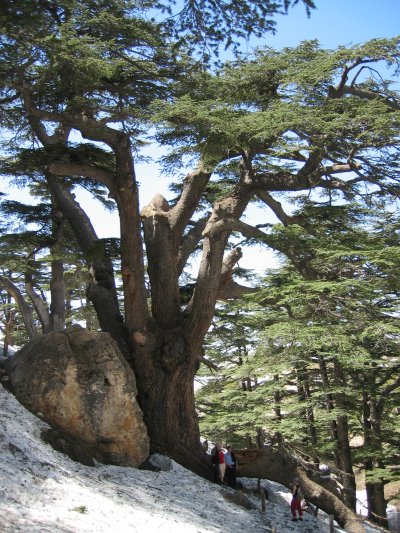
The cedar of Lebanon is the cedar of the ancient stories: an evergreen conifer from the mountains of Lebanon, Syria and Turkey, with a broad, flat-topped crown and long, horizontal branches in flat tiers, like tables stacked one above the other. It only takes on that typical shape after many years; when young it is conical. It grows 20–35 m tall, with a crown about 18 m wide. That makes it far too big for an ordinary garden, but as a specimen tree in a park, a castle garden or on a very large lawn it is monumental.
Light
Full sun
warm and bright
Moisture
Dry
tolerates drought
Legal basis
Any garden soil
any pH
Hardiness
Throughout Belgium
no protection needed
Size
20–35 m
tall
| Pruning months | August–September |
|---|---|
| Height | 20–35 m |
| Native to Belgium | No, planted |
| Poisonous to people and pets | Not known to be poisonous |
Identify
Cedar of Lebanon: how do you recognise it?
- Habit
- Tree of 20–35 m with a crown of about 18 m; conical when young, broad and flat-topped when old, with long, horizontal branches in flat tiers, like tables stacked one above the other.
- Needles
- 2–3 cm, stiff and sharp, dark green to grey-green; in tufts on short shoots and single on young shoots. Evergreen.
- Bark
- Dark grey, cracked into small, scaly plates.
- Cones
- Upright and barrel-shaped, 8–12 cm, with a flattened tip; they break up on the tree.
- Difference from Atlas cedar
- Atlas cedar has obliquely rising branches and leader, shorter needles and smaller cones.
- Difference from deodar
- The deodar has long, soft needles and drooping branch tips.
Pruning: August–September
Identify by feature: Prickly needles · Needles in bundles
Looks like it, but isn’t
- Atlas cedar Cedrus atlantica: obliquely rising branches and leader, shorter needles and smaller cones. Difference from Atlas cedar
- Deodar Cedrus deodara: long, soft needles and drooping branch tips. Difference from deodar
- Cedar Cedrus: the page for the whole genus, with what all cedars have in common.
In your garden
Why grow it?
- A monumental specimen tree with a silhouette like no other: flat tiers like tables stacked one above the other.
- Tolerates drought and poor, chalky or sandy soil, as long as it is free-draining.
- Little work: a cedar looks best unpruned.
- A tree for generations: cedars of Lebanon can live for centuries.
Cedar of Lebanon: where does it grow best?
- Full sun: only then does it develop its broad, flat tiers.
- Any free-draining soil, including chalky, sandy or stony soil; it copes well with drought but not with waterlogging.
- An open spot with space all round: the long, low branches are the finest part of the tree.
- Allow for 20–35 m in height and a crown of about 18 m: only for a park, a castle garden or a very large garden, well away from the house.
- Light
- Full sun
- Legal basis
- Any garden soil
- Moisture
- Dry
- Size
- 30 m tall, 18 m wide
- Hardiness
- Throughout Belgium, no protection needed
Goes well with
- Judas tree: Comes from the same eastern Mediterranean region, flowers pink on bare branches in April and also likes a sunny, dry spot.
- Holm oak: An evergreen oak that tolerates drought just like the cedar; together they give a park structure even in winter.
- English lavender: For the sunny, dry edge outside the crown.
- Crocus: Flowers in spring in the grass at the edge of the crown.
Good and bad companions
Goes well with
- Tolerate the shade under this tree: oregon grape, rhododendron, oleaster, japanese skimmia, garden privet, camellia, laurustinus, box-leaved honeysuckle
Maintenance
Cedar of Lebanon: when and how to plant it?
- Plant in April or in September–October, when the ground is neither frozen nor parched.
- Choose a young pot-grown tree: it establishes better than a large one, and a cedar dislikes having its roots disturbed.
- Tease out circling roots and plant at the same depth as it was in the pot.
- Put a stake on the windward side and remove it after 2–3 years.
- Water after planting and during dry spells in the first year.
Care
- Watering
- In dry spells during the first two years; after that it copes even in dry summers.
- Feeding
- Not needed, even on poor soil.
- Lower branches
- Leave them: the low, spreading tiers are the beauty of a free-standing cedar of Lebanon.
- Ground under the crown
- Leave the fallen needles and don’t drive heavy machinery under the crown: the roots cannot cope with compacted soil.
Tip: Plant it where you still want to see it in fifty years’ time: a cedar of Lebanon cannot be moved, and its broad tiers only come with age. Leave the lower branches right down to the ground.
Cedar of Lebanon: when to prune it?
Pruning months: August–September.
When: Dead, diseased and broken branches can be removed at any time of year. Any formative pruning in late summer.
How:
- Do not prune: a cedar of Lebanon looks best as it grows.
- If a branch really has to go, saw it off completely at the trunk, just outside the branch collar: half-cut branches spoil the tree for good.
- Have old trees with heavy, horizontal branches checked by an arborist every few years.
Caution: The heavy side branches can break under a load of wet snow.
Propagation
- Sowing
- In winter, gather seeds from a cone that is breaking up on the tree and sow them in a pot in spring. Seedlings grow slowly and only develop the typical tiers after many years.
- Grafting
- Special forms, such as dwarf and weeping forms, are grafted; that is a job for the nursery.
Cedar of Lebanon: how does it get through the winter?
Hardy throughout Belgium: no protection needed.
- Hardy in Belgium and the Netherlands.
- Wet snow can break the broad, flat branches: shake young trees and have breaks on old trees sawn off cleanly.
Diseases and pests
- Snow damage: Heavy branches broken after wet snow. Saw the break off cleanly at the trunk or at a healthy side branch; leave large branches to an arborist.
- Aphids: Sticky honeydew and black sooty mould under the tree, sometimes with needle drop in spring. The tree usually recovers on its own.
- Honey fungus: Honey-coloured toadstools at the base and dying branches: root rot. Have an arborist check the tree’s stability.
- Waterlogged soil: Yellow needles and poor growth in soil that stays wet for long periods. Choose a free-draining site.
Through the year
- January: Shake wet snow off young trees; remove broken branches.
- April: Plant young pot-grown trees.
- June: Water young trees in dry spells.
- July: Water during prolonged drought, young trees only.
- August: Any formative pruning; remove dead and broken branches.
- September: Formative pruning still possible; the male cones shed pollen.
- October: Plant young pot-grown trees.
Use
What can you use it for?
- Garden and landscape
- Monumental specimen tree for large parks and castle gardens; the flat tiers only develop on older trees.
- Wood
- Fragrant, rot-resistant wood, in antiquity the building timber for temples, palaces and ships.
You and this species
Did you know?
- It appears on the flag of Lebanon. The Phoenicians and Egyptians built ships and temples with it; according to the Bible, so did King Solomon.
- In Lebanon itself only a few old cedar forests remain; the best known, the Forest of the Cedars of God near Bsharri, is a UNESCO World Heritage Site.
- When young it is simply conical: the flat tiers, like stacked tables, only appear on older trees.