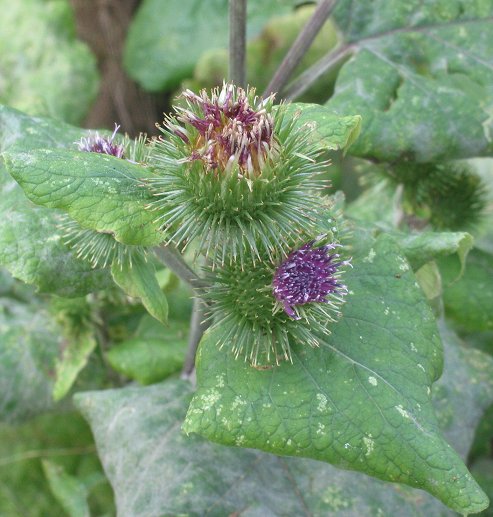
Photo: Rasbak at Dutch Wikipedia, CC BY-SA 3.0 · source

Herbaceous plant · Daisy family (Asteraceae)
Greater burdock
Arctium lappa
In other languages: Grote klit (Nederlands) · Grande bardane (Français)
Grows wild in Belgium.
Greater burdock is a robust biennial of rough ground, verges, riverbanks, woodland edges and neglected places on fertile soil. In Belgium it is less common than its smaller relative, lesser burdock, but you find it scattered across the whole country. In its first year it forms a rosette of huge, heart-shaped leaves; in its second a branched stem grows up to 2 m, with purple flower heads surrounded by hooked bracts. These burs cling to fur and clothing and inspired the invention of the hook-and-loop fastener. Bumblebees, bees and butterflies visit the flowers, and goldfinches eat the seeds in autumn and winter.
Light
Sun or partial shade
preferably some sun
Moisture
Normal
no wet feet
Hardiness
Fully hardy
down to -30 °C
Size
1.5 m
tall, 1 m wide
Flowering
July–September
| Pruning months | March and September |
|---|---|
| Height | 1.5 m |
| Native to Belgium | Yes |
| Flowering | July–September |
Identify
How to recognise it
- Growth habit
- Biennial: in the first year a large leaf rosette, in the second a much-branched flowering stem of 1–2 m.
- Leaf
- Very large, up to 50 cm, heart-shaped with a wavy edge; green above, grey and felted beneath. The stalks of the lower leaves are solid, not hollow.
- Flower
- Globular heads of 3–4 cm with purple tubular florets, on long stalks in a loose, flat-topped cluster, surrounded by green bracts with hooked tips. From July to September.
- Fruit/seed
- Elongated, grey-brown seeds with a short pappus that stay inside the bur: the whole head hooks on and so spreads the seeds.
- Roots
- A long, thick taproot that goes deep into the ground.
- Confusion with
- Lesser burdock (Arctium minus) has smaller heads of 1.5–2.5 cm on short stalks, more in clusters along the stem, and hollow leaf stalks. Butterbur also has huge leaves that are grey beneath, but it grows in wet places and flowers in early spring, before the leaves appear.
Flowering: July–September · Pruning: March and September
In your garden
Why grow it?
- A rich nectar source in July–September for bumblebees, bees, hoverflies and butterflies.
- Goldfinches and other finches pick the seeds from the faded heads in autumn and winter.
- An imposing structural plant for a wild corner, with huge leaves that give shade and shelter to small animals.
- In Japan the root is a cultivated vegetable, gobo, and it was once eaten in Europe too.
- A wonderful example of seed dispersal by animals, to show children.
Greater burdock: where does it grow best?
- In the wild: rough ground, verges, river and ditch banks, woodland edges, farmyards and waste ground.
- Sun to part shade.
- Normal, deep and fertile soil; it likes nitrogen-rich spots.
- Give it room: a plant in flower is soon 1 m across. A wild corner, a rough strip or the edge of an orchard is ideal.
Goes well with
- Wild teasel: Another bold biennial structural plant, whose seeds goldfinches eat.
- Common nettle: For a wild corner, with food plants for peacock and red admiral caterpillars.
- Hemp-agrimony: Pink flower clusters in late summer, on the same rich soil.
- Tansy: Yellow buttons in late summer for a rough strip.
Maintenance
Greater burdock: when and how to plant it?
- Buy seed of wild origin from a native plant nursery or collect a few ripe burs from a garden.
- Sow where it is to grow, as the taproot resents being moved. Sow in September–October or March–April.
- Place the seeds in twos or threes 1 cm deep, 80–100 cm apart, and thin later to one plant.
- Water until the seedlings are growing well; after that it is no longer needed.
- Do not plant it beside a path where dogs walk, as the burs get into their coats.
- Never dig up plants from the wild.
Care
- Water
- Only for young plants; the deep taproot finds its own water.
- Feeding
- Not needed; it already likes rich soil.
- Letting it seed
- Leave a few heads for the goldfinches; cut off the rest if you do not want seedlings.
- Clearing up
- After setting seed the plant dies. Dig out the taproot or let it rot down in the soil.
- Spreading
- Pull up seedlings in spring while the taproot is still small.
Tip: If you want burdock for the birds but not in your dog’s coat, put it at the back of a wild corner, behind a low hedge or a pile of branches, where your animals do not brush past.
Pruning and mowing
Pruning months: March and September.
When: In September, cut off the burs if you do not want them; in March, remove the dead stems.
How:
- Cut off faded heads before they turn brown and clingy if you want neither seedlings nor burs in your dog’s coat.
- Leave a few stems with burs for the birds.
- In March, cut the dead stems off at the base.
- Do not remove the large first-year leaves: the rosette needs them to flower the following year.
Caution: Wear gloves and old clothes: the burs hook into everything.
Propagation
- Seed
- Collect ripe, brown burs in September–October, pick out the seed wearing gloves and sow in place in autumn or spring.
- Self-seeding
- If burs drop nearby, seedlings come up of their own accord.
Greater burdock: how does it get through the winter?
Hardy to −30 °C.
- First-year plants die back; the taproot overwinters and sprouts again in spring.
- Second-year plants die after setting seed, but the dry stems with burs remain standing.
- Goldfinches and other finches come for the seeds in winter.
- Fully hardy, to about −30 °C.
Diseases and pests
- Burs in fur: Dogs, cats and horses come home with burs in their coats. Cut off the heads or plant it away from paths.
- Too many seedlings: On rich soil it self-seeds heavily. Pull up seedlings while young.
- Aphids: Colonies on stems and leaves; ladybirds and hoverfly larvae deal with them.
- Powdery mildew: White powder on the large leaves in late summer; harmless for a plant that dies anyway.
Through the year
- March: Cut off dead stems. Sow in place.
- April: Rosettes sprout again. Thin seedlings.
- May: On second-year plants the flowering stems shoot up.
- July: Flowering begins: bumblebees and butterflies.
- August: Full flower.
- September: Cut off burs if you do not want seedlings. Collect and sow seed.
- October: The burs ripen; goldfinches come for the seeds.
- December: Dry stems with burs stay standing for the birds.
You and this species
Did you know?
- The hook-and-loop fastener was devised in the 1940s by the Swiss engineer George de Mestral, after he examined under a microscope the hooks of burs he had picked up on a walk with his dog.
- In Japan the root is grown as a vegetable called gobo.
- The genus name Arctium probably comes from the Greek arktos, bear, after the rough, bristly heads.