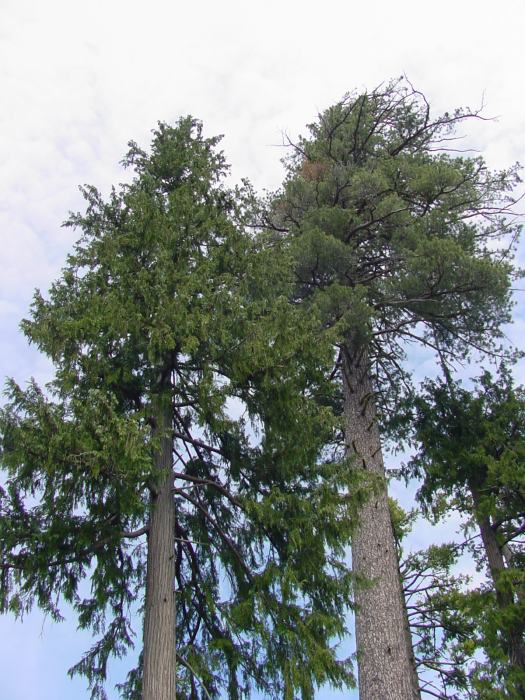
Photo: US Forest Service Dorena Genetic Resource Center, Public domain · source

Conifer · Cypress family (Cupressaceae)
Lawson cypress
Chamaecyparis lawsoniana · also: Port Orford cedar, Chamaecyparis
Lawson cypress comes from the border region of Oregon and California and is one of the best-known ornamental conifers in our gardens. You recognise it by its flat sprays of scale leaves with a white X pattern underneath, its drooping leading shoot and its globular cones. There are hundreds of garden forms: green, blue or golden yellow, columnar or dwarf. The species itself grows 15–30 m tall and as a tree is too big for an ordinary garden, but as a hedge it is easily kept at 1.5–3 m. Do clip it every year, though: it won’t regrow from brown wood.
Light
Sun or partial shade
preferably some sun
Moisture
Normal
no wet feet
Legal basis
Any garden soil
any pH
Hardiness
Throughout Belgium
no protection needed
Size
15–30 m
tall
| Pruning months | May–June and August–September |
|---|---|
| Height | 15–30 m |
| Native to Belgium | No, planted |
| Good for bees, butterflies and birds | Yes, for birds |
| Poisonous to people and pets | Not known to be poisonous |
Identify
Lawson cypress: how do you recognise it?
- Habit
- Evergreen conifer of 15–30 m with a narrow, conical crown and a drooping leading shoot.
- Leaf
- Scale leaves in flat, fern-like sprays; underneath often with white X- or Y-shaped marks. When crushed they smell resinous, a little like parsley.
- Bark
- Red-brown, in plates or strips.
- Cones
- Globular cones of about 8–10 mm with shield-shaped scales (like a football); blue-green and bloomy at first.
- Difference from thuja
- Thuja has oblong cones that open like a little flower, and a leading shoot that points straight up.
- Difference from Leyland cypress
- Leyland cypress, common in hedges, has sprays that don’t lie in a single flat plane and larger cones.
Pruning: May–June and August–September
Identify by feature: Scales instead of needles
Looks like it, but isn’t
- Thuja Thuja: oblong cones that open like a little flower; leading shoot points straight up. Difference from thuja
- Leyland cypress (× Cuprocyparis leylandii): common in hedges; sprays not in a single flat plane, larger cones.
In your garden
Why grow it?
- A dense, evergreen hedge in many colours: green, blue or golden yellow.
- Hundreds of garden forms, from slender columns to dwarfs for the rock garden or a pot.
- Grows on almost any soil, in sun or partial shade.
- In a dense cypress hedge birds find nesting places and shelter in winter.
Lawson cypress: where does it grow best?
- Sun to partial shade; golden forms colour best in sun.
- Well-drained soil that doesn’t dry out; no waterlogging, or the roots will rot.
- As a hedge it suits any garden; as a free-standing tree the species grows 5 m wide and far too tall for a small garden.
- For a small garden or a pot: choose a dwarf or a slender columnar form.
- Light
- Sun or partial shade
- Legal basis
- Any garden soil
- Moisture
- Normal
- Size
- 20 m tall, 5 m wide
- Hardiness
- Throughout Belgium, no protection needed
Goes well with
- Winter heath: Flowers in late winter and early spring among dwarf forms, and tolerates chalky soil too.
- Japanese maple: Fine red or orange foliage and autumn colour next to blue or golden cypresses.
- Rhododendron: Flowers in spring in front of a dark cypress hedge; together on acid soil that doesn’t dry out.
Good and bad companions
Goes well with
- Tolerate the shade under this tree: oregon grape, rhododendron, oleaster, japanese skimmia, garden privet, camellia, laurustinus, box-leaved honeysuckle
Maintenance
Lawson cypress: when and how to plant it?
- Plant root-balled or from a pot in September–October or March–April.
- For a hedge: 2–3 plants per metre, depending on their size.
- Loosen the soil and work in compost; open up heavy clay so that water doesn’t stand.
- Plant at the same depth as before and water generously straight away; keep the soil moist during the first year.
Care
- Watering
- In dry spells during the first two years, and later too in long dry summers.
- Feeding
- In spring, a little compost or organic fertiliser; no more is needed.
- Mulch
- A layer of wood chips at the base keeps the soil moist and the weeds down.
- Height
- Decide in good time how tall the hedge may grow, then cut back the top every year.
Tip: Check the label of a garden form for its size after ten years: some ‘dwarf conifers’ still end up several metres tall over time.
Lawson cypress: when to prune it?
Pruning months: May–June and August–September.
When: Clip hedges in May–June and late August, by mid-September at the latest.
How:
- Never cut into brown wood: it won’t regrow. Clip every year, so you always stay in the green.
- Keep the hedge slightly narrower at the top than at the bottom, so light reaches every part.
- On free-standing trees and garden forms, only remove dead branches and double leaders.
Caution: Check first that no birds are nesting in the hedge, and don’t clip in bright sun or drought.
Propagation
- Cuttings
- In August–September, pull off a side shoot with a heel and root it in cutting compost under glass. This is the only way to propagate garden forms: they don’t come true from seed.
Lawson cypress: how does it get through the winter?
Hardy throughout Belgium: no protection needed.
- Fully hardy.
- Shake wet snow off hedges and columnar forms: otherwise the branches splay apart.
Diseases and pests
- Root rot: Its worst enemy: on wet soil, branches or whole plants turn brown and die (Phytophthora). Plant on well-drained soil and don’t put a new cypress in the same wet spot.
- Drought: Brown patches after a dry summer, especially on young hedges. Water and mulch the soil.
- Red spider mite: Dull, greyish-yellow sprays with fine webbing in hot, dry summers. Hose the hedge down with water.
- Bare patches: After clipping too hard, or with too little light at the base, the hedge goes bare. These patches won’t fill in again: clip less deeply from now on.
Through the year
- March: Plant (March–April); compost at the base.
- April: Water young hedges in a dry spring.
- May: First trim (May–June), once birds have finished nesting.
- June: Clipping still possible.
- July: Water during long dry periods; watch out for red spider mite.
- August: Second trim in late August; take cuttings.
- September: Last trim by mid-September at the latest; planting season starts.
- December: Shake wet snow off hedges and columnar forms.
Use
What can you use it for?
- Garden and landscape
- Hedging plant and ornamental conifer in many colours and shapes.
- Wood
- In its native range (‘Port Orford cedar’) a prized, durable timber.
Good for wildlife
- Birds
- Berries, seeds or insects as food, or a place to nest.
You and this species
Did you know?
- There are hundreds of garden forms, from blue and golden yellow to dwarf.
- In its native range it is called ‘Port Orford cedar’ and is a prized, durable timber.
- The name ‘Lawson cypress’ refers to the Scottish nursery Lawson, which spread the species in Europe in the 19th century.
- The name Lawson cypress honours Charles Lawson, an Edinburgh nurseryman who brought the tree onto the European market from 1854.
- Chamaecyparis means ‘dwarf cypress’, yet in its small native range in Oregon and northern California it grows more than 50 metres tall.