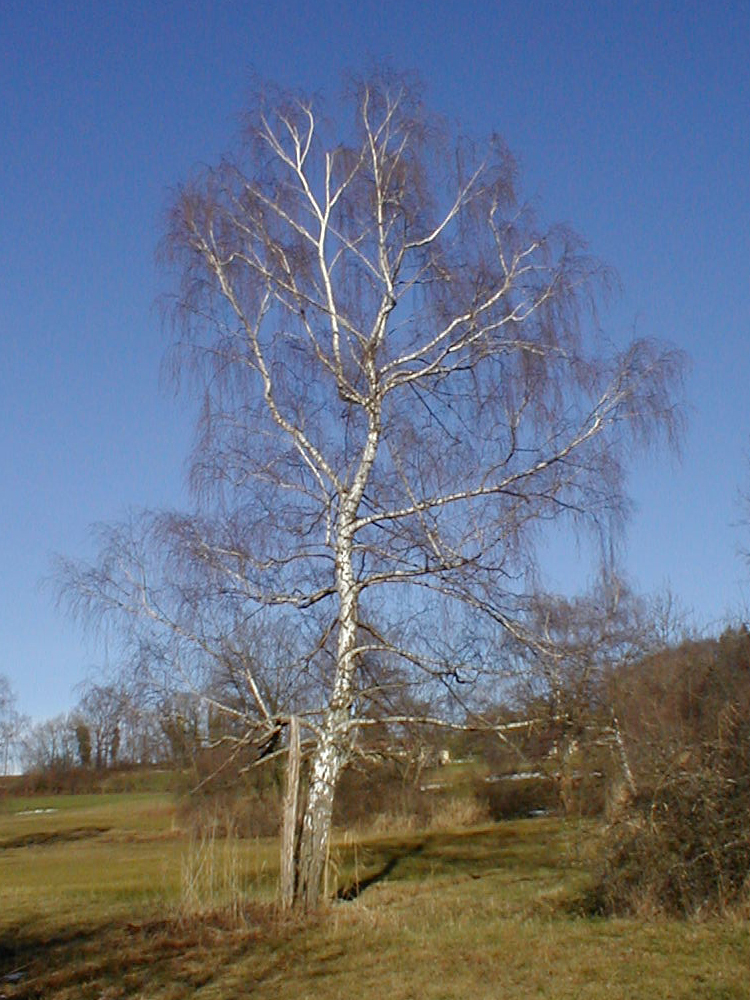
Photo: Maplan, CC BY-SA 3.0 · source

Broadleaf tree · Birch family (Betulaceae)
Silver birch
Betula pendula · also: Birch, Warty birch
The silver birch is the birch with the white trunk and gracefully hanging twigs. Its Dutch name, ‘rough birch’, refers to the small warts on the young twigs. A true pioneer, it is one of the first trees to colonise bare sand, heathland and waste ground. It grows 15–25 m tall, but with a narrow, airy crown of about 8 m that lets plenty of light through. It loves sun and poor, acid, rather dry soil. That is why it fits into a medium-sized garden, especially as a multi-stemmed group. Do bear in mind, though: its roots are shallow and its pollen is a major cause of hay fever in April.
Caution: Its pollen in April is one of the main causes of hay fever: don’t plant it right by a bedroom window if anyone in the household is allergic. The shallow roots dry out the soil beneath it.
Light
Full sun
warm and bright
Moisture
Dry
tolerates drought
Legal basis
Acid soil
acid
Hardiness
Throughout Belgium
no protection needed
Size
15–25 m
tall
Flowering
April
| Pruning months | July–October |
|---|---|
| Height | 15–25 m |
| Native to Belgium | Yes |
| Good for bees, butterflies and birds | Yes, for butterflies and birds |
| Poisonous to people and pets | Not known to be poisonous |
| Flowering | April |
Identify
Silver birch: how do you recognise it?
- Habit
- Tree of 15–25 m with a narrow, airy crown about 8 m across and hanging twigs.
- Leaves
- Alternate, diamond-shaped to triangular, 3–7 cm, with a long pointed tip and double-toothed edge; hairless. Thin stalk.
- Bark
- White with black patches; at the base of the trunk black, deeply fissured, diamond-patterned bark.
- Flowers
- Hanging catkins in April.
- Fruit
- Cylindrical catkins that break up into small winged nutlets.
- Difference from downy birch
- Downy birch has hairy twigs without warts that don’t hang, and a more oval leaf.
Flowering: April · Harvest and fruit: March–May · Pruning: July–October
Identify by feature: Winged seeds · White trunk
Looks like it, but isn’t
- Downy birch Betula pubescens: hairy twigs without warts, not hanging, and a more oval leaf. Difference from downy birch
In your garden
Why grow it?
- A white trunk that lights up the garden all year round, especially in winter.
- An airy crown with light shade, under which other plants can still grow.
- Grows on poor, acid sand where few other trees will.
- Hosts hundreds of insect species, and the seed feeds siskins.
- Golden-yellow autumn colour.
Silver birch: where does it grow best?
- Full sun.
- Poor, acid, free-draining soil such as sand; it copes well with drought.
- The roots are shallow and take up a lot of water: lawn and plants underneath have a hard time.
- With a crown of about 8 m it suits a medium-sized garden, but keep some distance from the house and gutters: catkins, seeds and twigs fall everywhere.
- Light
- Full sun
- Legal basis
- Acid soil
- Moisture
- Dry
- Size
- 25 m tall, 8 m wide
- Hardiness
- Throughout Belgium, no protection needed
Goes well with
- Scots pine: Another light-loving tree of sandy soils: white trunks next to orange bark.
- Heather: Flowers purple in late summer on the same poor, acid soil, in the birch’s light shade.
- Rowan: A small native tree with orange-red berries that also likes poor, acid soil.
- Broom: Flowers golden yellow in May on dry sand, in the sun at the edge.
Good and bad companions
Goes well with
- Tolerate the shade under this tree: oregon grape, rhododendron, oleaster, japanese skimmia, garden privet, camellia, laurustinus, box-leaved honeysuckle
Maintenance
Silver birch: when and how to plant it?
- Plant from November to March when the ground isn’t frozen.
- Young trees establish best; choose a container-grown or root-balled tree.
- For a multi-stemmed group: plant three young birches together in one large planting hole.
- Water after planting and during dry spells in the first two summers.
Care
- Watering
- In dry spells during the first two summers; after that it copes.
- Feeding
- Not needed: it is made for poor soil.
- Underplanting
- Choose plants that tolerate dry shade and root competition, or let heather and bilberry grow there.
- Clearing up
- In summer, catkins and seeds fall into gutters and onto the patio: sweep them up regularly.
Tip: Plant three young birches together in one planting hole: they grow into an airy, multi-stemmed group with three white trunks – more beautiful than a single tree and just as narrow.
Silver birch: when to prune it?
Pruning months: July–October.
When: In summer or early autumn (July–October). In spring a birch bleeds heavily.
How:
- Prune little: large wounds rot quickly.
- Remove dead, crossing and low-hanging branches while they are still thin, and cut just outside the branch collar.
- Never tap sap from a young or sick tree.
Caution: Never prune in late winter or spring: the tree then loses a lot of sap from the wounds.
Propagation
- Sowing
- In August, pick the catkins as they turn brown and sow the tiny seeds straight away or in spring on the surface of moist soil: they need light to germinate, so don’t cover them.
- Self-sown seedlings
- On bare sand it seeds itself readily; move seedlings while they are young.
Silver birch: how does it get through the winter?
Hardy throughout Belgium: no protection needed.
- Fully hardy.
- The white trunks and the fine tracery of hanging twigs are at their best in winter.
Diseases and pests
- Birch polypore: A white, half-moon-shaped bracket on the trunk: a sign that the tree is rotting inside. Have a large tree near a path or the house checked.
- Witches’ brooms: Dense clusters of twigs in the crown, caused by a fungus. Harmless.
- Aphids: Birch aphids secrete honeydew that makes garden furniture and cars sticky. Harmless to the tree.
- Drought in young trees: Brown leaf edges and early leaf fall in hot summers. Water young trees in good time.
Through the year
- February: Plant if the ground isn’t frozen; no pruning.
- March: Tap birch sap, only from older, healthy trees; no pruning: the tree bleeds.
- April: Flowering: catkins and lots of pollen, peak hay fever season.
- July: Pruning possible; water young trees in dry spells.
- August: Pruning; collect seed.
- September: Pruning.
- October: Last month for pruning; golden-yellow autumn colour.
- November: Planting season starts.
Use
What can you use it for?
- Food and drink
- Birch sap, tapped in March, makes a refreshing spring drink.
- Also used for
- The bark burns even when wet and is ideal for lighting fires; twigs for brooms.
- Wood
- Plywood, furniture and firewood that burns brightly.
- For wildlife
- A pioneer that hosts hundreds of insect species; seed for siskins.
Caution: Its pollen in April is one of the main causes of hay fever.
Edible and useful
- Sap (March–April)
- The sap rises from early March to mid-April, in the weeks before the leaves break. It is clear, faintly sweet and refreshing: drink it fresh, ferment it or, with a lot of patience, boil it down to syrup (allow about 100 litres of sap for 1 litre of syrup).
- Leaves (April–May)
- Young leaves in April and May, while they are still slightly sticky and fragrant: for tea, or finely shredded in a salad.
- Storing
- Fresh birch sap spoils quickly: refrigerate it at once and drink it within 2 to 3 days, or freeze it in portions. Dried leaves keep for a year in a closed jar.
- Fermenting
- Birch kvass, sap fermented for a few days with a little sugar and a few raisins, is an old spring drink in Eastern Europe.
Caution: Only tap your own tree, or one you have explicit permission for, never in woods or parks. Choose a healthy tree with a trunk at least 25 cm across, drill a single small hole and tap for no longer than 1 to 2 weeks. Then close the hole with a wooden peg or grafting wax so that no more sap runs out and no disease gets in. Only drink sap that is clear and smells fresh. Pick leaves well away from busy roads and sprayed fields, and never eat or drink anything you have not identified with certainty.
Eating and using is at your own risk: see the terms of use.
Recipes
- Tapping birch sap (Sap · 1–4 litres a day · 15 min + 1–2 weeks tapping)
- Birch kvass (Fermentation · 2 litres · 15 min + 3–5 days)
- Birch-leaf tea (Tea · 1 cup · 10 min)
- Birch sap syrup (Syrup · ± 1 litre · 2 hrs)
- Birch leaf vinegar (Vinegar · ± 500 ml · 20 min + 2 weeks steeping)
Good for wildlife
- Caterpillars
- Host plant: caterpillars of butterflies or moths eat the leaves.
- Birds
- Berries, seeds or insects as food, or a place to nest.
- Ladybirds
- Aphids on the plant are food for ladybirds and their larvae.
You and this species
Did you know?
- A pioneer: one of the first trees on bare sandy ground or heathland.
- The bark burns even when wet and is ideal for lighting fires; its white colour comes from betulin in the bark.
- Birch sap, tapped in March, makes a refreshing spring drink.
- The white colour of the bark comes from betulin, a substance that reflects sunlight.
- As early as the Stone Age, birch bark was heated to make a tar that served as glue. Ötzi, the Alpine iceman, had used it to fix his arrowheads.