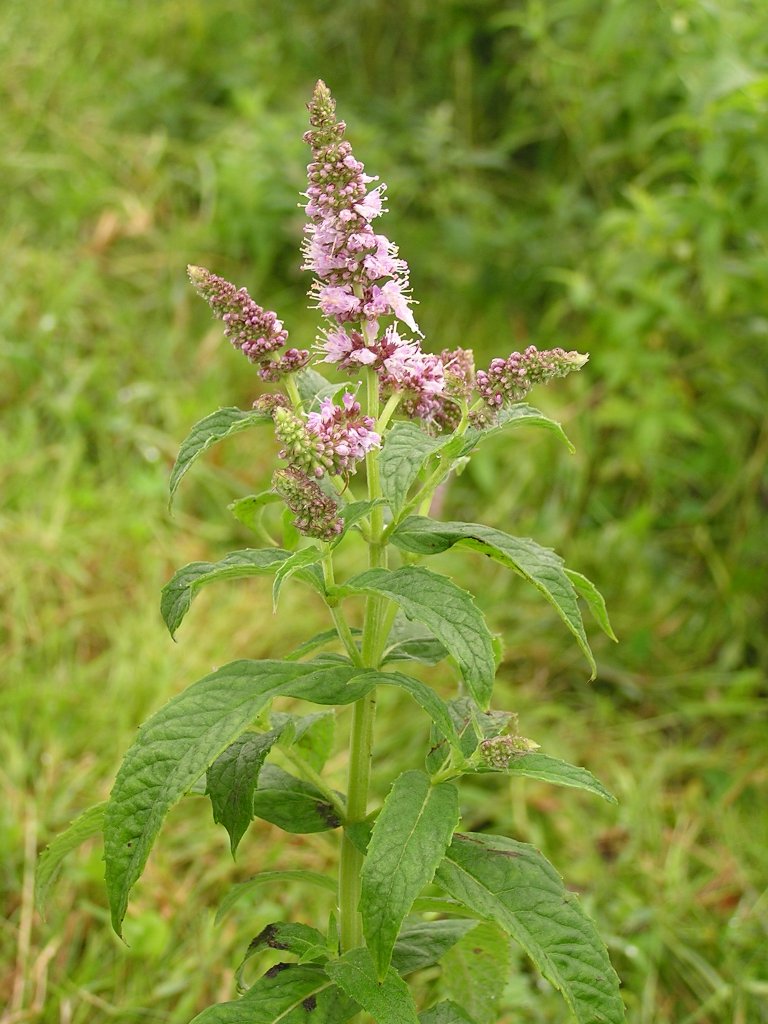
Photo: Michael Becker, CC BY-SA 3.0 · source

Herb · Lamiaceae
Horse mint
Mentha longifolia
In other languages: Hertsmunt (Nederlands) · Menthe à longues feuilles (Français)
Horse mint (Mentha longifolia) is a tall, native mint found across Europe, western Asia and Africa, including Belgium. The upright stems grow 60–100 cm tall and carry silvery-grey, softly hairy leaves with a strong minty scent. From July to September long, slender spikes of small lilac flowers appear, and bees, butterflies and hoverflies swarm over them. The plant spreads by underground runners and forms a dense clump within a few years. That makes it handsome in a naturalistic garden, beside a stream or pond, or on a damp spot where it can roam freely.
Caution: It spreads strongly by underground runners and can swamp weaker plants. Use a root barrier or a bottomless bucket, or plant it where it may spread freely.
Light
Sun or partial shade
preferably some sun
Moisture
Normal to wet
must not dry out
Legal basis
Sand, loam or clay
any pH
Hardiness
Fully hardy
down to -25 °C
Size
1 m
tall, 0.8 m wide
Flowering
July–September
| Pruning months | March |
|---|---|
| Height | 1 m |
| Native to Belgium | Yes |
| Good for bees, butterflies and birds | Yes, for bees and butterflies |
| Poisonous to people and pets | Not known to be poisonous |
| Flowering | July–September |
Identify
Horse mint: how do you recognise it?
- Habit
- Tall perennial 60–100 cm high and up to 80 cm wide, with upright, square stems and underground runners.
- Leaves
- Oblong to lance-shaped, 4–9 cm, stalkless or nearly so, toothed; grey-green and densely, softly hairy.
- Flower
- Long, slender spikes of small lilac to pale pink flowers, from July to September.
- Scent
- The leaves smell strongly of mint, stronger and a little coarser than garden mint.
- Roots
- Creeping, shallow rhizomes and runners that spread quickly.
Flowering: July–September · Harvest and fruit: May–September · Plants: March–May and September · Pruning: March
In your garden
Why grow it?
- Silvery, soft foliage with a strong minty scent, good in the garden and in the kitchen.
- Flowers from July to September, just when many other nectar plants have finished.
- Attracts bees, butterflies and hoverflies.
- A native plant that suits a naturalistic garden and pond margins.
- Grows vigorously and quickly covers a damp spot: a good choice for awkward corners.
Horse mint: where does it grow best?
- Sun or half shade; in full sun it needs moist soil.
- Moist to wet, fertile soil: sand, loam or clay, acid to chalky.
- Tolerates a short dry spell but does best with constant moisture, for example beside a pond or stream.
- Give it room or restrict it: allow at least 80 cm per plant.
- Light
- Sun and partial shade
- Soil type
- Sand, loam or clay
- Acidity
- Not fussy
- Moisture
- Normal or wet
- Size
- 1 m tall, 0.8 m wide
- Hardiness
- Hardy (to -25 °C)
Goes well with
- Hemp agrimony: A native moisture lover with pink flower heads that flowers at the same time as the mint.
- Meadowsweet: Creamy-white plumes on the same damp soil.
- Purple loosestrife: Purple flower spikes and the same wet feet.
- Yellow flag iris: A sturdy marginal plant for the pond edge.
Maintenance
Horse mint: when and how to plant it?
Plant in March–May and September.
- Plant in March–May or in September, when the soil is not frozen.
- Dig a hole as deep as the root ball and twice as wide. Mix in some compost.
- Set the plant at the same depth as in its pot and firm the soil well.
- Space plants 60–80 cm apart, or plant them in a large bottomless bucket or root barrier if they must not spread.
- Water thoroughly straight away and keep the soil moist in the first year.
- Spread a layer of leaf-mould mulch around the plant to keep the soil moist.
Care
- Water
- Keep the soil moist; in dry summers water thoroughly every week, especially in pots or in full sun.
- Feeding
- A spade of compost in spring is enough; too much feed gives soft, floppy growth.
- Mulching
- A layer of leaf mould in April keeps the soil cool and moist.
- Restricting
- Every spring cut off the runners at the edge of the clump and remove them.
- Harvesting
- Pick young tips before flowering. The leaves are strong and are used fresh or dried in tea, sauces and salads.
Tip: Plant it on a damp spot where it can spread, and cut off the runners every spring: that way it stays attractive without taking over.
Horse mint: when to prune it?
Pruning months: March.
When: In March, before the new shoots start to grow.
How:
- Cut the old, brown stems of last year back to just above the ground.
- In summer pick young tips for the kitchen; this keeps the plant compact.
- Cut off spent flower spikes if you want to limit seed and self-seeding.
Caution: Leave the stems standing in winter: insects overwinter in them.
Propagation
- Division or spading off
- In March–April or in September cut a rooted piece off the edge and replant it elsewhere. Water until it has taken.
- Cuttings
- In May–July take tip cuttings of 10 cm and root them in a glass of water or in moist compost; they root within a few weeks.
Horse mint: how does it get through the winter?
Hardy to −25 °C.
- Fully hardy, to about −25 °C: no protection needed.
- The top growth dies back and shoots again in spring.
- In a pot: place it against a wall and keep the compost slightly moist; the roots can freeze more easily than in the open ground.
Diseases and pests
- Mint rust: Orange spots under the leaves, later turning brown and limp. Cut off all affected stems and put them in the household waste, not on the compost heap.
- Powdery mildew: White powder on the leaves in dry, stuffy spots. Water at the base, allow more space and cut off affected parts.
- Spreading: It can swamp its neighbours. Cut off the runners every year or plant it in a root barrier.
- Floppy, bare stems: Too much shade or too little water. Give more light and regular water; cut back to get new shoots.
Through the year
- March: Cut back to just above the ground. Divide and plant. Add compost.
- April: Plant. Cut off runners at the edge.
- May: Plant. Keep an eye on the boundaries.
- June: Harvest young tips before flowering. Take cuttings.
- July: Flowering begins: bees and butterflies. Water in dry spells.
- August: Full flower. Water in dry spells.
- September: Last flowers. Plant or divide.
- November: Rest. The stems can stay for overwintering insects.
Use
Edible and useful
- Leaves (May–September)
- Cut the tips of the stems from May to September on a dry morning, ideally just before flowering, when the flavour is freshest. Always cut just above a pair of leaves so the plant branches again. Spearmint is milder and sweeter than peppermint: ideal for fresh mint tea, tabbouleh, mint sauce, lemonade, or a salad with watermelon or peas.
- Storing
- Fresh sprigs keep for a few days in a glass of water or wrapped in a damp cloth in the fridge. To dry, hang small bunches upside down somewhere airy and shady, or spread the leaves on a rack. Dried, they keep for a year in a closed jar in the dark. Chopped mint with a little water also freezes well in an ice-cube tray.
Caution: Mint spreads by underground runners: grow it in a pot, or in a bottomless container sunk into the ground. Different mints grown side by side cross and lose their flavour. Do not confuse it with pennyroyal (Mentha pulegium), a mint with a sharp, resinous smell that is poisonous in larger amounts. People with heartburn sometimes tolerate a lot of mint poorly. Never eat anything you have not identified with certainty.
Eating and using is at your own risk: see the terms of use.
Recipes
- Fresh mint tea (Tea · 1 teapot (± 1 litre) · 10 min)
- Mint cordial (Syrup · ± 1 litre · 20 min + overnight steeping)
- Classic mint sauce (Dish · 4 people · 10 min + 30 min resting)
Good for wildlife
- Bees
- Nectar and pollen for honeybees and wild bees.
- Butterflies
- Nectar for butterflies.
You and this species
Did you know?
- The species name longifolia means ‘long-leaved’.
- Mints cross easily with each other, which is why many garden mints are hybrids.
- According to Greek myth, Minthe was a nymph turned into a mint plant, which gave the plant its name Mentha.