Side by side
London plane or sycamore? How to tell them apart
Platanus × hispanica · Acer pseudoplatanus
You can tell a London plane by its flaking camouflage bark, its alternate leaves and its hanging seed balls; a sycamore has leaves in opposite pairs, winged fruits and bark that only flakes off in plates on old trees.
The leaves look very alike: large and hand-shaped. Look at how they sit on the twig: alternate on the plane, in opposite pairs on the sycamore. On the plane, the hollow base of the leaf stalk covers the bud.

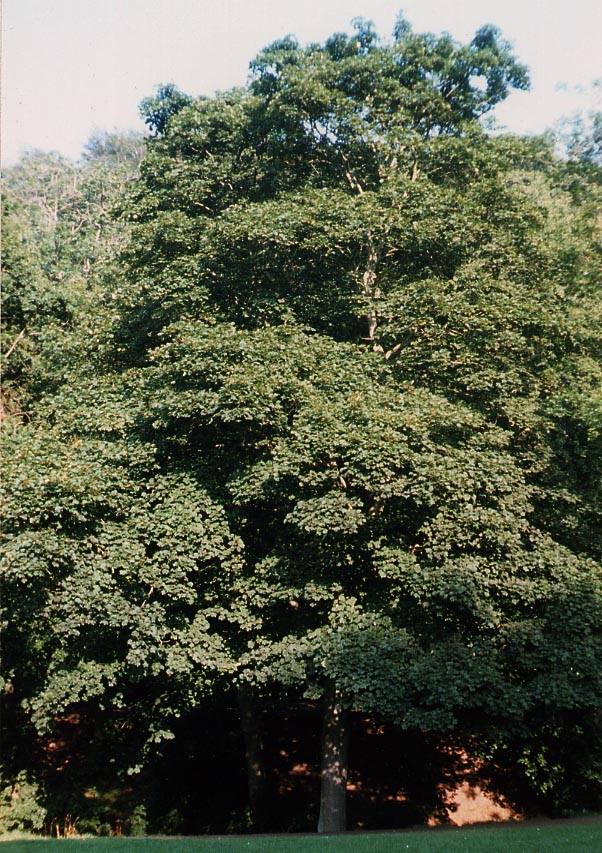


| London plane | Sycamore | |
|---|---|---|
| Leaves | Alternate, palmately lobed with 3–5 lobes, 12–25 cm. The base of the leaf stalk is hollow and encloses the bud. | Opposite, 10–20 cm, with 5 coarsely and irregularly toothed lobes; underside grey-green. Leaf stalk often red, without milky sap. |
| Flowering | May | Yellow-green flowers in hanging clusters, appearing with the leaves (May). |
| Fruit | Hanging balls 2–3 cm across, often in pairs, which break up in winter into fluffy seeds. | Winged fruits with wings at an acute to right angle. |
| Bark | Peels off in large patches, creating a mottled pattern of grey, green and yellow. | Grey, flaking in plates on older trees. Buds green. |
| Shape and height | Broadleaf tree, 25–40 m | Broadleaf tree, 25–35 m |
| Site | Full sun, any garden soil, normal | Sun or partial shade, any garden soil, normal |
| Native to Belgium | No, planted | No, naturalised |
| Good for bees, butterflies and birds | Little | Yes, for bees and birds |
| Poisonous to people and pets | Not known to be poisonous | Not known to be poisonous |
| Pruning months | November–March | July–October |
The best feature in each season
- Spring
- The sycamore flowers in May with hanging spikes of yellow-green flowers; the plane has inconspicuous balls of flowers on long stalks.
- Summer
- The fruits tell you: hanging balls of 2–3 cm on a long stalk on the plane, winged seeds like little helicopters on the sycamore.
- Autumn
- The plane turns yellowish brown and keeps its seed balls into winter; the sycamore already sends its helicopters spinning away in autumn.
- Winter
- Without leaves the bark is unmistakable: large flaking patches in grey, green and yellow on the plane. The sycamore has green buds in opposite pairs, the plane brown buds alternating along the twig.
Where do they grow?
The London plane is a hybrid between the oriental plane and the American plane, and lines streets, squares and avenues: it copes very well with polluted city air. The sycamore comes from the mountains of central and southern Europe and has naturalised everywhere, in woods, hedgerows and gardens.
Which one for your garden?
- Left to grow, both reach 25–40 m: only suitable for a park or an avenue. As a pleached or roof-trained tree, a plane does fit by a terrace, because it tolerates hard pruning.
- For wildlife the sycamore is better: bees take nectar from its flowers. The plane offers little food, and the hairs of young leaves and the fluff of the fruits can irritate the airways. Near a horse paddock, do not plant a sycamore: its seeds and seedlings are poisonous to horses.
Did you know? In the 19th century the London plane was planted all over London because it coped with the soot and smog: by shedding its bark it keeps renewing its skin.
Read on
- Plant profile: London plane
- Plant profile: Sycamore
- London plane: when and how to prune
- Sycamore: when and how to prune
- Identification key: the question that separates them
Also looks like
- Sycamore or Norway maple
- Sycamore or silver maple
- Sweetgum or London plane
- Norway maple or London plane
- London plane or fig
- Sweetgum or sycamore