Side by side
Sycamore or Norway maple? How to tell them apart
Acer pseudoplatanus · Acer platanoides
You can tell a sycamore by its coarsely toothed leaf lobes without long points and a leaf stalk without milky sap; a Norway maple has lobes ending in long, pointed teeth and white milky sap when you snap the leaf stalk.
Snap a leaf stalk: if a drop of white sap appears, it is a Norway maple. Its leaf is glossy and thinner, with long pointed teeth; the sycamore leaf is thicker, coarsely toothed and greyish green underneath.
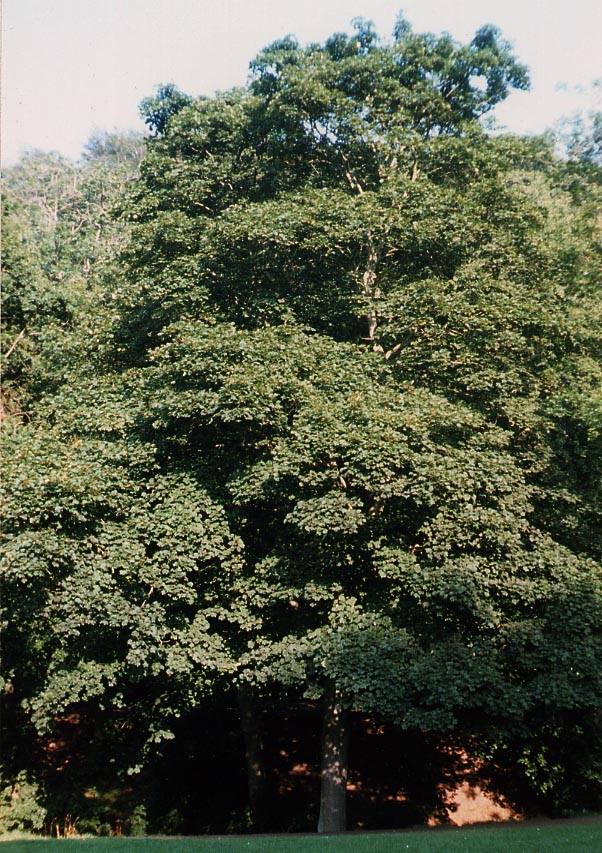


| Sycamore | Norway maple | |
|---|---|---|
| Leaves | Opposite, 10–20 cm, with 5 coarsely and irregularly toothed lobes; underside grey-green. Leaf stalk often red, without milky sap. | Opposite, 10–18 cm, with 5–7 lobes ending in long, pointed teeth; glossy. Snap the leaf stalk and white milky sap comes out. |
| Flowering | Yellow-green flowers in hanging clusters, appearing with the leaves (May). | Yellow-green flower clusters before the leaves open (April) (April). |
| Fruit | Winged fruits with wings at an acute to right angle. | Winged fruits with wings at a wide, obtuse angle. |
| Bark | Grey, flaking in plates on older trees. Buds green. | Grey, finely and regularly fissured, does not flake. |
| Shape and height | Broadleaf tree, 25–35 m | Broadleaf tree, 20–30 m |
| Site | Sun or partial shade, any garden soil, normal | Sun or partial shade, any garden soil, normal |
| Native to Belgium | No, naturalised | Yes, long naturalised |
| Good for bees, butterflies and birds | Yes, for bees and birds | Yes, for bees |
| Poisonous to people and pets | Not known to be poisonous | Not known to be poisonous |
| Pruning months | July–October | July–October |
The best feature in each season
- Spring
- The Norway maple flowers as early as April, with conspicuous yellow-green clusters on bare branches; the sycamore only flowers in May, in hanging spikes, together with the leaves.
- Summer
- Look at the wings of the fruits: on the sycamore they meet at an acute to right angle, on the Norway maple they spread wide apart, at an obtuse angle.
- Autumn
- The Norway maple turns a bright yellow to orange; the sycamore turns a duller yellowish brown and often has black tar spots on its leaves.
- Winter
- The buds help: green on the sycamore, reddish brown on the Norway maple. Older sycamores have bark that flakes off in plates; the Norway maple has finely, regularly ridged bark that does not flake.
Where do they grow?
The sycamore comes from the mountains of central and southern Europe and has naturalised everywhere: in woods, hedgerows, parks and as a seedling in almost every garden. The Norway maple comes from central, eastern and northern Europe and grows mainly in streets and parks, although it self-seeds too.
Which one for your garden?
- Both reach 20–35 m and are too big for an ordinary garden. In a small garden, choose the round-headed form of the Norway maple (‘Globosum’) or a smaller, native maple such as the field maple.
- If you live next to a horse paddock, do not plant a sycamore: its seeds and seedlings are poisonous to horses. Bees get a lot from the early flowers of the Norway maple in April.
Did you know? In French the sycamore is called érable sycomore, yet it is no relation of the true sycamore of the Bible, a fig tree from the Middle East.
Read on
- Plant profile: Sycamore
- Plant profile: Norway maple
- Sycamore: when and how to prune
- Norway maple: when and how to prune
- Identification key: the question that separates them
Also looks like
- Sycamore or silver maple
- London plane or sycamore
- Sweetgum or sycamore
- Norway maple or London plane
- Norway maple or field maple