Side by side
Sycamore or silver maple? How to tell them apart
Acer pseudoplatanus · Acer saccharinum
You can tell a sycamore by its five-lobed leaf that is less deeply cut and coarsely toothed, with a grey-green underside; a silver maple has very deeply cut, finely toothed leaves with a silvery-white underside, and flowers as early as February–March.
Turn a leaf over: silvery white on the silver maple, grey-green on the sycamore. On the silver maple the cuts between the lobes reach deep into the leaf, on the sycamore far less. Both have opposite leaves without milky sap and winged seeds. The silver maple has an open crown with often drooping shoots.
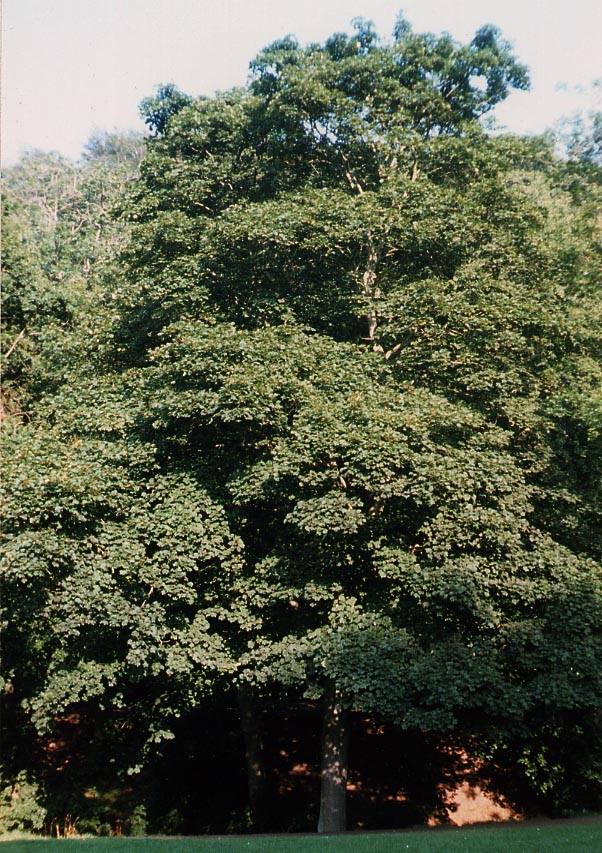


| Sycamore | Silver maple | |
|---|---|---|
| Leaves | Opposite, 10–20 cm, with 5 coarsely and irregularly toothed lobes; underside grey-green. Leaf stalk often red, without milky sap. | Opposite, 10–15 cm, with 5 very deeply cut, finely toothed lobes; underside silvery white. No milky sap. |
| Flowering | Yellow-green flowers in hanging clusters, appearing with the leaves (May). | Small red flowers, as early as February–March (February–March). |
| Fruit | Winged fruits with wings at an acute to right angle. | Large winged fruits that ripen as early as late spring. |
| Bark | Grey, flaking in plates on older trees. Buds green. | Silver-grey, later in long, loose flakes. |
| Shape and height | Broadleaf tree, 25–35 m | Broadleaf tree, 20–30 m |
| Site | Sun or partial shade, any garden soil, normal | Full sun, any garden soil, moist to wet |
| Native to Belgium | No, naturalised | No, planted |
| Good for bees, butterflies and birds | Yes, for bees and birds | Yes, for bees |
| Poisonous to people and pets | Not known to be poisonous | Not known to be poisonous |
| Pruning months | July–October | July–October |
The best feature in each season
- Spring
- The silver maple flowers as early as February–March, with small red flowers on bare branches; the sycamore only flowers with its leaves, in hanging clusters of yellowish-green flowers.
- Summer
- When the wind blows through the crown, the silver maple shimmers white from the pale undersides of its leaves. Its large winged seeds ripen as early as late spring, those of the sycamore only in autumn.
- Autumn
- The sycamore drops its ‘helicopters’, with wings at an acute to right angle, and seeds itself everywhere. The leaves of the silver maple turn yellow.
- Winter
- Look at the buds and bark: green buds and grey bark that flakes off in plates on older sycamores; reddish buds and silvery-grey bark that later peels in long, loose strips on the silver maple.
Where do they grow?
The sycamore originally comes from the mountains of central and southern Europe, but is naturalised everywhere here, in woods, parks, shelterbelts and along roads. The silver maple comes from eastern North America, where it grows along rivers; here it is found in parks and avenues, often near water.
Which one for your garden?
- Both grow too big for an ordinary garden: the sycamore reaches 25–35 m, the silver maple 20–30 m. The silver maple grows very fast, but has brittle wood and invasive roots: do not plant it close to houses or driveways.
- The seeds and seedlings of the sycamore are poisonous to horses: they cause atypical myopathy, a muscle disease that is often fatal. Do not plant it near a horse paddock.
Did you know? You can boil maple syrup from the sap of the silver maple, just as from that of the sugar maple, although you need more sap for it.
Read on
- Plant profile: Sycamore
- Plant profile: Silver maple
- Sycamore: when and how to prune
- Silver maple: when and how to prune
- Identification key: the question that separates them
Also looks like
- Sycamore or Norway maple
- London plane or sycamore
- Sweetgum or sycamore
- Japanese maple or silver maple
- Red maple or silver maple