Side by side
Small-leaved lime or Caucasian lime? How to tell them apart
Tilia cordata · Tilia × euchlora
You recognise small-leaved lime by its small, matt leaf with a blue-green underside and rusty-brown tufts of hair; Caucasian lime has a larger, very glossy dark green leaf with a paler underside and brown tufts, drooping lower branches and a trunk without shoots.
Look at the gloss and the underside: Caucasian lime has a strikingly glossy, dark green leaf of 5–10 cm, small-leaved lime a matt leaf of 3–8 cm with a blue-green underside. Both have brown tufts of hair in the vein axils, rusty brown on small-leaved lime. From a distance you recognise Caucasian lime by its gracefully drooping lower branches.
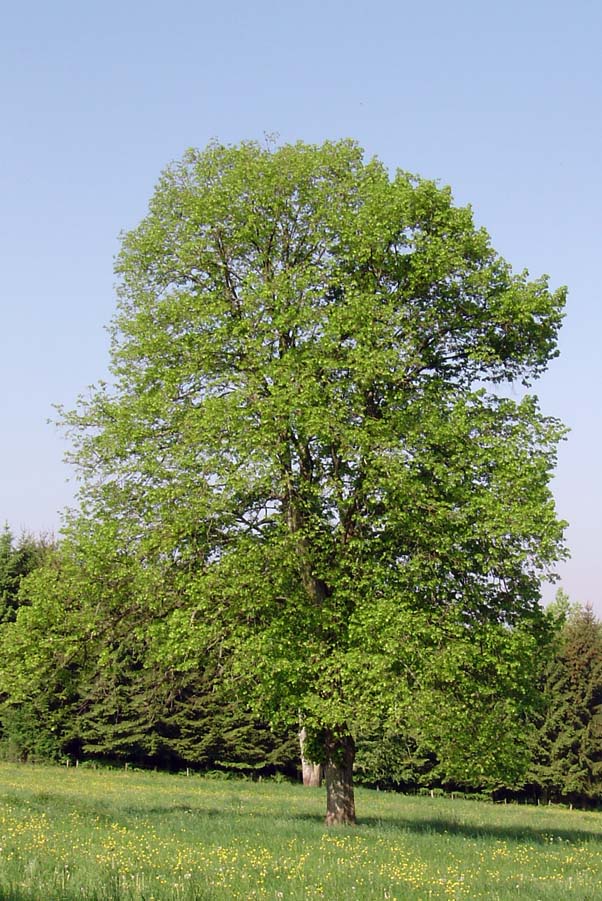


| Small-leaved lime | Caucasian lime | |
|---|---|---|
| Leaves | Alternate, lopsided heart-shaped, 3–8 cm, finely toothed. Underside blue-green and hairless, with rusty-brown tufts of hair in the vein axils. | Alternate, 5–10 cm, lopsided heart-shaped, finely and sharply toothed; glossy dark green above, paler below with brown tufts of hair in the vein axils. |
| Flowering | Clusters of 5–10 flowers on a tongue-shaped bract, in early July (July). | Clusters of 3–7 fragrant, yellowish-white flowers, in mid-July (July). |
| Fruit | Thin-walled nutlets without distinct ribs, easily crushed between your fingers. | Egg-shaped, felted nutlets with a pointed tip. |
| Bark | Grey and finely fissured. | Grey, smooth, later shallowly fissured; young twigs hairless and yellowish green. |
| Shape and height | Broadleaf tree, 20–30 m | Broadleaf tree, 15–20 m |
| Site | Sun or partial shade, any garden soil, normal | Sun or partial shade, any garden soil, normal |
| Native to Belgium | Yes | No, planted |
| Good for bees, butterflies and birds | Yes, for bees and butterflies | – |
| Poisonous to people and pets | Not known to be poisonous | Not known to be poisonous |
| Pruning months | November–March | November–March |
The best feature in each season
- Spring
- The young twigs of Caucasian lime are hairless and yellowish green, those of small-leaved lime hairless and often reddish brown on the sunny side.
- Summer
- Small-leaved lime flowers in early July with clusters of 5–10 flowers pointing in all directions; Caucasian lime in mid-July with 3–7 fragrant, yellowish-white flowers per cluster. Under Caucasian lime the ground stays dry: it hardly gets any aphids.
- Autumn
- The nutlets of small-leaved lime are thin-walled, without clear ribs, and can be cracked between your fingers; those of Caucasian lime are egg-shaped, felted and have a pointed tip.
- Winter
- Look at the trunk and crown: smooth and grey with drooping lower branches on Caucasian lime, finely fissured on small-leaved lime. Yellowish-green twigs also point to Caucasian lime.
Where do they grow?
Small-leaved lime is native and grows wild in ancient woodland and wooded banks, although it has become rare there. Caucasian lime is probably a cross between small-leaved lime and a lime from the Caucasus, and is only found planted here, mainly as a street tree.
Which one for your garden?
- Small-leaved lime grows 20–30 m tall and suits a large garden, a wooded bank or a pollard; for wildlife it is the best choice: its flowers are a top plant for bees.
- Caucasian lime stays smaller at 15–20 m and is hardly troubled by aphids, so there is no sticky honeydew: a good choice over a driveway or in a street, but less rich for wildlife.
Did you know? A small-leaved lime that keeps sprouting again as coppice can live for more than a thousand years: the stool then grows into a ring of stems around a heart that has long gone.
Read on
- Plant profile: Small-leaved lime
- Plant profile: Caucasian lime
- Small-leaved lime: when and how to prune
- Caucasian lime: when and how to prune
- Identification key
Also looks like
- Large-leaved lime or small-leaved lime
- Common lime or small-leaved lime
- Katsura tree or small-leaved lime
- Common lime or Caucasian lime