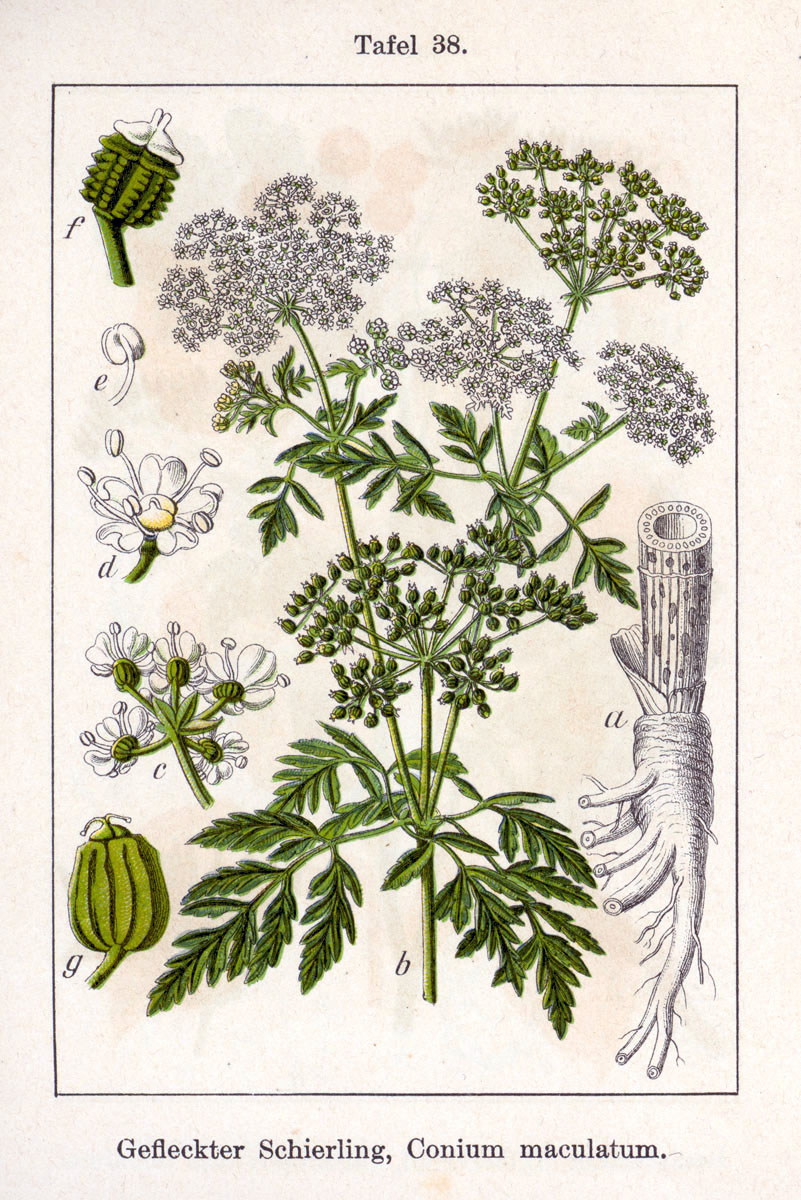
Photo: Johann Georg Sturm (Painter: Jacob Sturm), Public domain · source

Herbaceous plant · Carrot family (Apiaceae)
Hemlock
Conium maculatum
In other languages: Gevlekte scheerling (Nederlands) · Grande ciguë (Français)
Grows wild in Belgium.
Hemlock is a tall biennial of the carrot family and one of the most poisonous plants in Europe. In Belgium it is fairly common in fertile, disturbed places: roadside verges, rough ground, riverbanks, rubble, field edges and around manure heaps. You can recognise it by the smooth, hairless, bluish-grey bloomed stem with purple blotches, the finely divided, glossy leaves and the unpleasant mousy smell when the leaves are crushed. In June–August it carries many white umbels that attract flies and beetles. Above all it is important to recognise, because it resembles edible umbellifers such as wild carrot and parsley.
Caution: Highly poisonous to people and animals: all parts, including the root, which can resemble a parsnip. Small amounts can be fatal. A danger to children (hollow stems used as whistles), dogs, cats, horses, cattle and other grazing animals. Confusion with edible umbellifers is the biggest pitfall: never pick wild umbellifers to eat unless you are 100% sure. Wear gloves. If any is swallowed, call a doctor or the Poison Centre immediately.
Light
Sun or partial shade
preferably some sun
Moisture
Normal to wet
must not dry out
Hardiness
Fully hardy
down to -25 °C
Size
1.8 m
tall, 0.8 m wide
Flowering
June–August
| Pruning months | July and September |
|---|---|
| Height | 1.8 m |
| Native to Belgium | Yes |
| Flowering | June–August |
Identify
How to recognise it
- Growth habit
- Biennial: in the first year a rosette of fine leaves, in the second year a branched stem of 1–2.5 m.
- Leaves
- Two to four times pinnate, finely divided like a fern, glossy dark green and hairless; when crushed they smell of mice.
- Flowers
- Small white flowers in many umbels of 2–5 cm across; June to August.
- Stem
- Smooth, hollow, hairless and bluish-grey bloomed, with purple blotches and streaks, especially lower down.
- Fruit
- Small, roundish, 2–3 mm, with wavy ridges.
- Look-alikes
- Wild carrot has a hairy stem without blotches, divided bracts beneath the umbel and smells of carrot. Cow parsley flowers earlier (April–June) and has a hairy, grooved stem. Fool’s parsley has long, drooping bracteoles on the outer side of the small umbels. If in doubt, do not pick or eat anything.
Flowering: June–August · Pruning: July and September
In your garden
Why grow it?
- The white umbels are a nectar source for flies, hoverflies, beetles and parasitic wasps.
- Food plant of a small moth whose caterpillars live only on hemlock.
- An important plant to learn to recognise: anyone who forages must know the difference from edible umbellifers.
- Tall, elegant structure in a large, wild patch of rough ground, far from the house and play areas.
- A plant with a long history, from ancient Greece to chemistry.
Hemlock: where does it grow best?
- In the wild: verges, rough ground, banks of ditches and rivers, rubble, field edges and manure heaps, on fertile soil.
- Sun to half shade.
- Moist to moderately dry, nitrogen-rich soil.
- In a garden it belongs at most in a large, remote wild area, far from the vegetable plot, chicken run, paddock and play area.
Goes well with
- Hemp-agrimony: Pink flower heads in the same damp rough ground; popular with butterflies.
- Common nettle: Food plant of the peacock and small tortoiseshell in the same fertile corner.
- Wild teasel: Another tall structural plant for a wild area, with seed for goldfinches.
- Tansy: Yellow button flowers in late summer, after the hemlock has finished.
Maintenance
Hemlock: when and how to plant it?
- It is better not to plant hemlock: in an ordinary garden, with children, pets or a vegetable plot, the risk is too great.
- If you have a large wildlife garden without those risks, leave a self-sown plant in a remote spot; buying or sowing is rarely needed. Never dig up plants from the wild.
- Never let it grow near edible herbs such as parsley, chervil or dill: the seedlings look very similar.
- Mark the spot clearly so that nobody picks the plant by mistake.
- If your garden borders a pasture, do not let it grow by the fence: grazing animals may eat it.
- Always wear gloves when handling the plant and wash your hands afterwards.
Care
- Watering
- Not needed.
- Feeding
- Not needed; it likes rich soil and finds enough by itself.
- Preventing self-seeding
- Cut off the umbels in July before the seed ripens if you do not want it to spread.
- Removing
- Dig out unwanted plants wearing gloves, ideally as rosettes in the first year, taproot and all.
- Disposal
- Never leave remains in a pasture or near animal feed; use the green waste bin or a remote compost heap.
Tip: Learn to recognise hemlock by the combination of a hairless, blotched stem and the mousy smell: that is the best protection if you forage for wild plants.
Pruning and mowing
Pruning months: July and September.
When: In July, before the seed ripens; clear dead plants in September.
How:
- Cut off the umbels when most flowers have faded, before the fruits turn brown.
- After setting seed the plant dies by itself; pull up or cut the dry stem in September, wearing gloves.
- Do not leave any pieces on a lawn, in a pasture or where children play.
Caution: Never let children use hollow hemlock stems as whistles or peashooters.
Propagation
- Seed
- Spreads only by seed, which stays viable in the soil for a few years. One plant produces thousands of seeds, so it is better not to let it seed.
Hemlock: how does it get through the winter?
Hardy to −25 °C.
- First-year rosettes often stay green in winter and are then easily confused with other umbellifers.
- After flowering in the second year the plant dies; the dry stems stay standing for a long time.
- Hardy to about −25 °C.
Diseases and pests
- Poisoning: The greatest risk: confusion with edible plants, or children and animals nibbling it. Remove the plant wherever that risk exists.
- Self-seeding: Cut off the umbels before the seed ripens and dig out young rosettes.
- Aphids: Often aphids on the umbels; ladybirds and hoverflies clear them up.
- Skin and hands: Always work with gloves and wash your hands after contact.
Through the year
- March: Learn to spot the rosettes and dig them out where they are not wanted.
- April: Rapid growth; stems with purple blotches.
- May: Flower stems up to 2 m tall.
- June: First white umbels.
- July: Flowering; cut off umbels before the seed ripens.
- August: Last flowers.
- September: Clear dead plants wearing gloves.
- October: New rosettes appear.
- November: Rosettes stay green.
You and this species
Did you know?
- According to tradition, the Greek philosopher Socrates died in 399 BC after drinking a potion made with hemlock.
- Its poison, coniine, was the first alkaloid to be made in a laboratory, in 1886.
- The species name maculatum means ‘spotted’ and refers to the purple blotches on the stem.