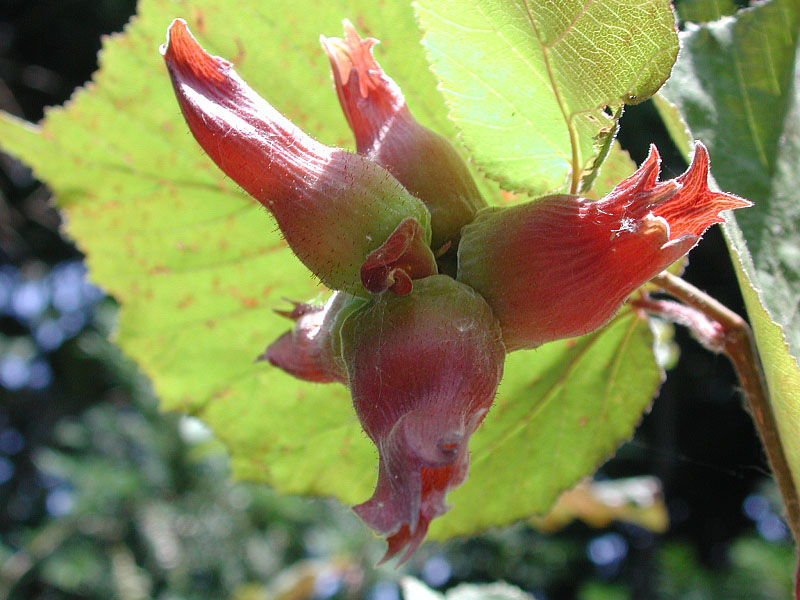
Photo: Fritz Geller-Grimm, CC BY-SA 2.5 · source

Shrub · Birch family (Betulaceae)
Filbert
Corylus maxima · also: Lambert’s filbert, Purple hazel
Filbert is a multi-stemmed shrub of 4–6 m from south-eastern Europe and western Asia, a close relative of our native hazel. You recognise it by its nuts, which are completely enclosed in a long, tubular husk. Many cultivated hazelnut varieties descend from this species. In gardens the best-known form is the purple-leaved ‘Purpurea’, the ‘purple hazel’. In February–March yellow catkins hang from the branches, and in September the nuts ripen. Plant a common hazel or another variety nearby: they pollinate each other.
Caution: The pollen of the catkins causes early hay fever: don’t plant it right next to a window or patio if someone in the household suffers from it.
Light
Sun or partial shade
preferably some sun
Moisture
Normal
no wet feet
Legal basis
Any garden soil
any pH
Hardiness
Throughout Belgium
no protection needed
Size
4–6 m, multi-stemmed shrub
tall
Flowering
February–March
| Pruning months | November–March |
|---|---|
| Height | 4–6 m, multi-stemmed shrub |
| Native to Belgium | No, planted |
| Poisonous to people and pets | Not known to be poisonous |
| Flowering | February–March |
Identify
Filbert: how do you recognise it?
- Habit
- Multi-stemmed shrub of 4–6 m, spreading broadly from the base.
- Leaf
- Alternate, round with a short pointed tip, 8–12 cm, double-toothed and softly hairy; dark reddish-purple in ‘Purpurea’.
- Bark
- Smooth, greyish-brown with pale lenticels.
- Flower
- Yellow, hanging male catkins in February–March; tiny red stigmas of the female flowers.
- Fruit
- Elongated nuts (2–2.5 cm), completely enclosed in a tubular husk that is constricted at the tip and extends well beyond the nut, September.
- Difference from hazel
- Hazel has a short, ragged husk that does not fully enclose the nut, and rounder nuts.
- Difference from Turkish hazel
- Turkish hazel is a tree with a straight trunk and husks with long, curly fringes.
Flowering: February–March · Harvest and fruit: September–October · Pruning: November–March
Identify by feature: Winter flowers · Nuts, acorns and chestnuts
Looks like it, but isn’t
- Hazel Corylus avellana: a short, ragged husk that does not fully enclose the nut, and rounder nuts. Difference from hazel
- Turkish hazel (Corylus colurna): a tree with a straight trunk and husks with long, curly fringes.
In your garden
Why grow it?
- Large, elongated hazelnuts in September.
- The purple-leaved ‘Purpurea’ is a striking ornamental shrub.
- Pollen in late winter for the first bees; nuts for squirrels, jays and mice.
- Can be coppiced, which keeps it a manageable size.
Filbert: where does it grow best?
- Sun to partial shade; the purple form colours best in the sun.
- Almost any soil, preferably fertile and slightly moist; no waterlogging.
- Allow about 4 m width: suitable for a large garden, a border or a hedgerow.
- For a good crop: a common hazel or another variety nearby, for wind pollination.
- Light
- Sun or partial shade
- Legal basis
- Any garden soil
- Moisture
- Normal
- Size
- 5 m tall, 4 m wide
- Hardiness
- Throughout Belgium, no protection needed
Goes well with
- Hazel: Pollinates the filbert and vice versa: together more nuts.
- Cornelian cherry: Flowers yellow in February–March, at the same time as the catkins.
- Hawthorn: Together a mixed hedge or hedgerow full of blossom, nuts and berries.
Maintenance
Filbert: when and how to plant it?
- Plant from November to March, bare-root or root-balled.
- As a single shrub, 4 m from other shrubs; in a hedgerow or hedge, one plant every 1–1.5 m.
- Plant at the same depth as before and firm the soil well.
- After planting, cut the branches back by a third: it will then shoot better from the base.
Care
- Watering
- In dry spells during the first year; rarely needed after that.
- Feeding
- A little compost in spring; too much feed gives long shoots and few nuts.
- Suckers
- Dig out suckers or use them to make new plants.
- Harvest
- In September, pick the nuts husk and all when the husk starts to turn brown, and let them dry in an airy place; they then come out easily.
Tip: Want a purple hazel and nuts too? Plant a ‘Purpurea’ with a common hazel nearby: they pollinate each other.
Filbert: when to prune it?
Pruning months: November–March.
When: In winter (November–March), preferably after the catkins have flowered.
How:
- Every year, saw a few of the oldest branches off at ground level: the shrub stays young and productive.
- Every 7–10 years you can coppice the whole shrub; it regrows from the base, but then gives few or no nuts for a few years.
- Remove thin, weak and crossing shoots to let light into the shrub.
Caution: Don’t prune during the nesting season (mid-March to mid-August) if birds are nesting in the shrub.
Propagation
- Layering
- In autumn, bend a long, supple branch to the ground, nick it lightly and cover it with soil; after a year it will have roots.
- Suckers
- In winter, separate a rooted sucker from the parent plant and plant it elsewhere. That way the purple form stays purple; seedlings don’t always resemble the parent.
Filbert: how does it get through the winter?
Hardy throughout Belgium: no protection needed.
- Fully hardy; the catkins tolerate frost.
- Prune preferably after the catkins have flowered, so the first bees can still make use of them.
Diseases and pests
- Nut weevil: Nuts with a small round hole and a grub inside. Gather affected nuts and shake the shrub over a sheet in May to catch the weevils.
- Empty nuts: Nuts without a kernel: often poor pollination. Plant a common hazel or another variety nearby.
- Squirrels and birds: They often take the nuts before they are ripe. Plant several shrubs, or harvest a little earlier and let them finish ripening.
- Big bud mite: Swollen, round buds that don’t open. Cut them off in winter and put them in the household waste.
Through the year
- January: Winter pruning still possible; the catkins swell.
- February: Catkins in flower; then prune or coppice.
- March: Last month for pruning and planting.
- May: Shake the shrub against nut weevils.
- August: Nuts are growing; watch out for squirrels.
- September: Harvest the nuts, husk and all.
- October: Dry the nuts.
- November: Planting and layering; winter pruning can begin.
- December: Winter pruning.
Use
What can you use it for?
- Food and drink
- Hazelnuts in September; many cultivated hazelnut varieties descend from this species.
- Garden and landscape
- The purple-leaved form ‘Purpurea’ is a popular ornamental shrub.
- For wildlife
- Pollen in late winter for the first bees; nuts for squirrels, jays and mice.
Caution: The pollen causes early hay fever.
Edible and useful
- Nuts (September–October)
- Gather the nuts from late September to mid-October, when the husk turns brown and the nuts start falling by themselves. Pick them up from the ground on a dry day, or shake the branches gently. In the filbert the nut is completely hidden in a long, tubular husk: remove that first. Throw away nuts with a small round hole (nut weevil) and any that feel light or float in water. Leave a share for squirrels, jays and mice.
- Storing
- Let the nuts dry in their shells for 2–3 weeks in a dry, airy place, then keep them in a net or paper bag somewhere cool and dark: they keep for several months. Shelled nuts keep in a closed jar, preferably in the fridge, for 2–3 months at most. In the freezer they last a year. Roasted nuts go rancid faster than raw ones.
Caution: Hazelnuts are a common allergen: always tell guests when a dish contains hazelnut. Do not eat nuts that taste bitter or rancid, or that are mouldy or black inside: throw them away. Dry the nuts thoroughly before storing them, because damp nuts quickly go mouldy. Do not gather in nature reserves, on sprayed fields or beside busy roads, and ask permission on private land. Do not give whole nuts to small children: they can choke. Never eat anything you have not identified with certainty.
Eating and using is at your own risk: see the terms of use.
Recipes
- Drying and roasting hazelnuts (Dried · ± 500 g shelled nuts · 30 min + 2–3 weeks drying)
- Chocolate hazelnut spread (Other · ± 400 ml (2 small jars) · 30 min)
- Hazelnut macaroons (Dish · ± 20 biscuits · 40 min)
- Hazelnut liqueur (Liqueur · ± 800 ml · 30 min + 4 weeks steeping)
You and this species
Did you know?
- The purple hazel in gardens is usually not a common hazel but a filbert, the cultivar ‘Purpurea’.
- Its Dutch name, ‘lambertsnoot’, is said by one explanation to refer to St Lambert, whose feast day (17 September) falls around harvest time, and by another to ‘Lombardy nut’.
- Many cultivated hazelnut varieties descend from the filbert or are hybrids with it.