Photo: Wikimedia Commons, CC BY-SA 3.0 · source

Shrub · Honeysuckle family (Caprifoliaceae)
Fly honeysuckle
Lonicera xylosteum
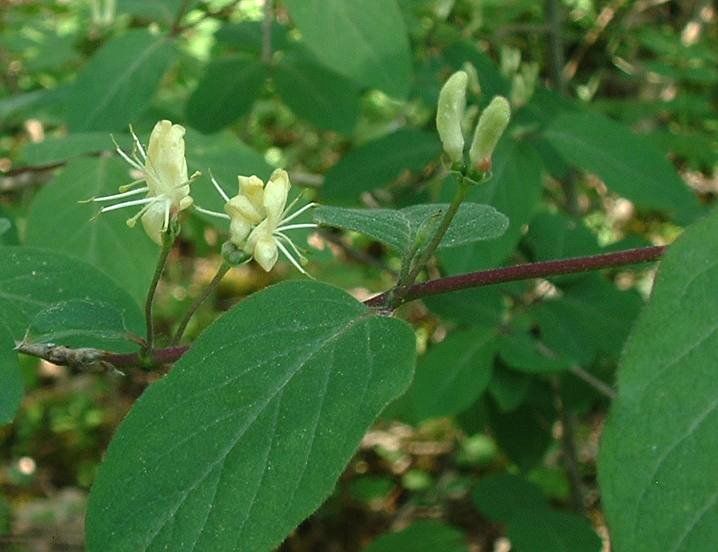
The fly honeysuckle is a honeysuckle that does not climb: an upright shrub of 1–3 m with softly hairy, opposite leaves. In May–June it bears small yellowish-white flowers in pairs, followed in July–August by glossy red berries that hang in pairs from a single stalk. The berries are poisonous to people, but birds love them. It grows in sun and shade, preferably on chalky soil, and fits into a mixed hedge or woodland edge. In the wild it is rare in our region.
Caution: The red berries are poisonous: they cause vomiting, stomach ache and diarrhoea. Keep them away from small children and pets, and don’t plant it next to a play area. Birds eat the berries without any problem.
Light
Sun to shade
not fussy
Moisture
Normal
no wet feet
Legal basis
Any garden soil
neutral to chalky
Hardiness
Throughout Belgium
no protection needed
Size
1–3 m
tall
Flowering
May–June
| Pruning months | November–March |
|---|---|
| Height | 1–3 m |
| Native to Belgium | Yes |
| Poisonous to people and pets | Yes, take care with children and pets |
| Flowering | May–June |
Identify
Fly honeysuckle: how do you recognise it?
- Habit
- Upright, densely branched shrub of 1–3 m and about 2 m across; does not climb.
- Leaf
- Opposite, 3–6 cm, broadly oval, untoothed, greyish-green and softly hairy on both sides.
- Bark
- Greyish-brown, peeling in long strips.
- Flower
- Small, two-lipped, yellowish-white flowers in pairs on a hairy stalk, in May–June.
- Fruit
- Glossy red berries, in pairs and slightly joined at the base, in July–August; poisonous.
- Difference from common honeysuckle
- Common honeysuckle is a twining climber with large flowers in whorls, fragrant in the evening; fly honeysuckle is a shrub with small flowers in pairs.
- Difference from snowberry
- Snowberry has small, hairless, blue-green leaves and white berries.
Flowering: May–June · Pruning: November–March
Identify by feature: Red berries
Looks like it, but isn’t
- Snowberry Symphoricarpos albus: small, hairless, blue-green leaves and white berries. Difference from snowberry
- Tartarian honeysuckle (Lonicera tatarica): hairless leaves and pink flowers.
In your garden
Why grow it?
- A native shrub for a mixed hedge or woodland edge, even in shade.
- Flowers in May–June for bumblebees and bees.
- Red berries for birds in summer.
- Needs little pruning.
Fly honeysuckle: where does it grow best?
- Sun, partial shade or shade; it flowers best in sun.
- Chalky or loamy soil that stays reasonably moist; it also grows on other ordinary garden soils, but not on wet ground.
- Allow 1–3 m height and about 2 m width: a spot in a mixed hedge, hedgerow or woodland edge.
- Light
- Sun to shade
- Legal basis
- Any garden soil
- Moisture
- Normal
- Size
- 2.5 m tall, 2 m wide
- Hardiness
- Throughout Belgium, no protection needed
Goes well with
- Wayfaring-tree: A native shrub for the same chalky woodland edge, with white flower heads and red to black berries.
- Common dogwood: White flower heads in June and red stems in winter, in the same mixed hedge.
- Hazel: The backbone of a native hedge or hedgerow, even in partial shade.
- Wild privet: A native shrub for chalky soil, with fragrant white flowers and black berries.
Good and bad companions
Goes well with
- Tolerates shade and suits planting under large trees such as: ginkgo, box elder, ash, honey locust, field maple, silver maple
Maintenance
Fly honeysuckle: when and how to plant it?
- Plant from November to March, when the ground is not frozen.
- Buy it from a nursery that sells native planting stock, and never take plants from the wild: it is rare there.
- In a mixed hedge: put it among hazel, common dogwood and wayfaring-tree.
- Water after planting and during dry spells in the first year.
Care
- Watering
- Only in dry spells during the first year.
- Feeding
- Not needed; a little leaf mould in autumn is enough.
- Berries
- Leave them for the birds, but keep an eye on small children.
- Position
- Don’t plant it right next to a play area or sandpit.
Tip: Plant it in a mixed hedge with other shrubs of chalky soil: you will have flowers and berries for insects and birds from May into autumn.
Fly honeysuckle: when to prune it?
Pruning months: November–March.
When: Dead, diseased and broken branches can be removed at any time of year. If pruning is needed, do it during winter dormancy (November–March).
How:
- Needs little pruning: in winter, thin out a few old branches at the base.
- Rejuvenate an old, bare shrub by coppicing it in winter; it will regrow.
Caution: It flowers on last year’s wood: a shrub that is cut back hard flowers less the following year.
Propagation
- Cuttings
- In winter, push 20 cm lengths of one-year-old wood into the ground, or in summer take cuttings from young shoots under plastic.
- Sowing
- In summer, take the seeds from ripe berries (wear gloves), rinse them clean and sow them outdoors in a pot; they germinate after a winter.
Fly honeysuckle: how does it get through the winter?
Hardy throughout Belgium: no protection needed.
- Fully hardy.
- Winter is pruning season; it is also when the peeling bark stands out best.
Diseases and pests
- Aphids: Aphids on the young shoots in spring. Ladybirds and tits clear them up.
- Powdery mildew: White coating on the leaves in a dry spot in late summer. Water during dry spells; it is not serious.
- Bare shrub: An old shrub goes bare at the base. In winter, cut a few old branches off at ground level.
Through the year
- January: Thinning: remove a few old branches.
- February: Pruning and planting in mild weather.
- March: Last month for pruning and planting.
- May: Flowering: small yellowish-white flowers for bumblebees and bees.
- July: Red berries: for the birds, not for children.
- August: Last berries; water young plants in dry spells.
- November: Planting season begins.
- December: Pruning and planting in mild weather.
Use
What can you use it for?
- Garden and landscape
- Native shrub for a mixed hedge or woodland edge, even in shade.
- For wildlife
- Flowers for bumblebees and bees, berries for birds.
Caution: The berries are poisonous.
You and this species
Did you know?
- The scientific name xylosteum means ‘bone wood’: the wood is as hard as bone.
- Unlike common honeysuckle it does not climb: it is a true shrub.
- The berries hang in pairs from a single stalk and are slightly joined at the base.