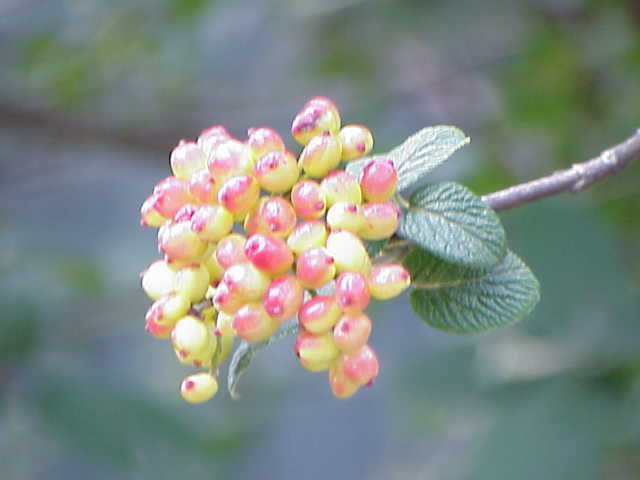
Photo: Kurt Stüber [1], CC BY-SA 3.0 · source

Shrub · Moschatel family (Adoxaceae)
Wayfaring-tree
Viburnum lantana
The wayfaring-tree is a native shrub of 2–4 m for dry, chalky soil. Its thick, wrinkled leaves are grey-felted underneath, just like the young twigs and the buds. In May–June it bears flat, creamy white flower heads, without the large outer florets of the guelder rose. The berries then turn from green through red to glossy black, often all colours at once in a single head. In Belgium it grows wild but is rare, mainly in the south on chalky soil. The berries are mildly poisonous.
Caution: The berries are mildly poisonous: eating a lot of them causes stomach ache, vomiting and diarrhoea. Keep young children and pets away from them. Birds eat them without any problem.
Light
Sun or partial shade
preferably some sun
Moisture
Dry
tolerates drought
Legal basis
Any garden soil
neutral to chalky
Hardiness
Throughout Belgium
no protection needed
Size
2–4 m
tall
Flowering
April–May
| Pruning months | June–July |
|---|---|
| Height | 2–4 m |
| Native to Belgium | Yes |
| Poisonous to people and pets | Yes, take care with children and pets |
| Flowering | April–May |
Identify
Wayfaring-tree: how do you recognise it?
- Habit
- Broad, dense shrub of 2–4 m with upright branches.
- Leaf
- Opposite, 5–10 cm, oval, finely toothed, thick and wrinkled; underside grey-felted with star-shaped hairs.
- Twigs
- Young twigs and buds grey-felted; older branches greyish-brown.
- Flower
- Flat heads (6–10 cm) of small, creamy white flowers, without large outer florets, in May–June.
- Fruit
- Flattened, oval berries that turn from green through red to glossy black, often all colours at once in a single head (August–September); mildly poisonous.
- Difference from guelder rose
- Guelder rose has lobed leaves, large white outer florets and translucent red berries.
- Difference from leatherleaf viburnum
- That one is evergreen, with much longer, narrow and deeply wrinkled leaves.
Flowering: April–May · Pruning: June–July
Identify by feature: White or silver underside · Red berries · Black berries
Looks like it, but isn’t
- Guelder rose Viburnum opulus: lobed leaves, large white outer florets and translucent red berries. Difference from guelder rose
- Leatherleaf viburnum Viburnum rhytidophyllum: evergreen, with much longer, narrow and deeply wrinkled leaves. Difference from leatherleaf viburnum
In your garden
Why grow it?
- One of the few native shrubs for dry, chalky soil.
- White flower heads in May–June and berries in three colours at once in late summer.
- Native: flowers for insects, berries for birds in late summer.
- Once established, it copes well with drought and wind.
Wayfaring-tree: where does it grow best?
- Sun to partial shade; in sun it flowers best and bears the most berries.
- Preferably dry, chalky, free-draining soil; ordinary garden soil will do, but not wet feet.
- On a sunny bank or a dry border, where other shrubs struggle.
- Allow 3 m width.
- Light
- Sun or partial shade
- Legal basis
- Any garden soil
- Moisture
- Dry
- Size
- 4 m tall, 3 m wide
- Hardiness
- Throughout Belgium, no protection needed
Goes well with
- Field maple: A small native tree for the same dry, chalky hedge.
- Wild privet: Black berries and scented flowers, on the same chalky soil.
- Spindle: Pink fruits and red autumn colour next to the red and black berries.
- Hawthorn: White blossom in May and red berries: together a dense, bird-rich hedge.
Good and bad companions
Goes well with
- Suits the woodland edge or the light shade of: ginkgo, box elder, ash, honey locust, field maple, silver maple
Maintenance
Wayfaring-tree: when and how to plant it?
- Plant from November to March, bare-root or root-balled.
- In a mixed hedge: one plant every 1–1.5 m, together with other native shrubs.
- Plant at the same depth as before, firm the soil and water generously.
- Mulch with leaves or wood chips and water in dry spells during the first year.
Care
- Watering
- Only in dry spells during the first year; after that it copes well with dry summers.
- Feeding
- Not needed; it grows and flowers well even on poor soil.
- Checks
- In April–May, look out for viburnum beetle larvae (see problems).
- Berries
- Leave them for the birds; they don’t all ripen at once, so there is food for weeks.
Tip: Is your soil too dry and chalky for guelder rose? Choose the wayfaring-tree instead: it too has white flower heads and berries for the birds, but it likes dry feet.
Wayfaring-tree: when to prune it?
Pruning months: June–July.
When: After flowering (June–July).
How:
- Needs little pruning: thin out old branches at the base.
- Every few years, remove one or two of the oldest branches so that young shoots can come through.
- Don’t cut everything back: whatever you remove after flowering will bear no berries.
Caution: June–July falls in the nesting season: check for nesting birds in the shrub before you prune.
Propagation
- Softwood cuttings
- In June, take 10–15 cm cuttings of young, still soft shoots and root them under glass or plastic.
- Layering
- Bend a low branch to the ground and cover it with soil; after a year it will have roots.
- Sowing
- Sow the seeds from ripe, black berries outdoors in autumn; they often take a year and a half to germinate.
Wayfaring-tree: how does it get through the winter?
Hardy throughout Belgium: no protection needed.
- Fully hardy.
- In winter you can recognise it by its grey, felted twigs and buds.
Diseases and pests
- Viburnum beetle: In April–May, small yellow larvae eat the leaves down to lace; later in summer the adult beetles do the same. In winter, cut off the shoot tips with eggs and put them in the general waste.
- Aphids: Aphids on the young shoot tips in spring. Ladybirds and tits usually clear them up; otherwise hose them off with water.
- Wet soil: On heavy, wet soil it grows poorly and branches die back. Plant it in a dry, free-draining spot.
Through the year
- January: Cut off shoot tips with viburnum beetle eggs.
- March: Last month to plant bare-root shrubs.
- April: Watch for viburnum beetle larvae and aphids.
- May: Flowering: creamy white heads full of insects.
- June: Prune after flowering; check for nests first.
- July: Last pruning month; the berries turn red.
- August: Red and black berries in one head: food for birds.
- November: Plant bare-root shrubs.
Use
What can you use it for?
- Garden and landscape
- Native shrub for dry, chalky soil; attractive in a mixed hedge or woodland edge.
- For wildlife
- Flowers for insects, berries for birds in late summer.
Caution: The berries are mildly poisonous.
You and this species
Did you know?
- In winter its buds are ‘naked’, without bud scales: only a thick layer of felt protects them from the cold.
- The name wayfaring-tree refers to the shrub growing along the old tracks over the chalk hills of southern England.