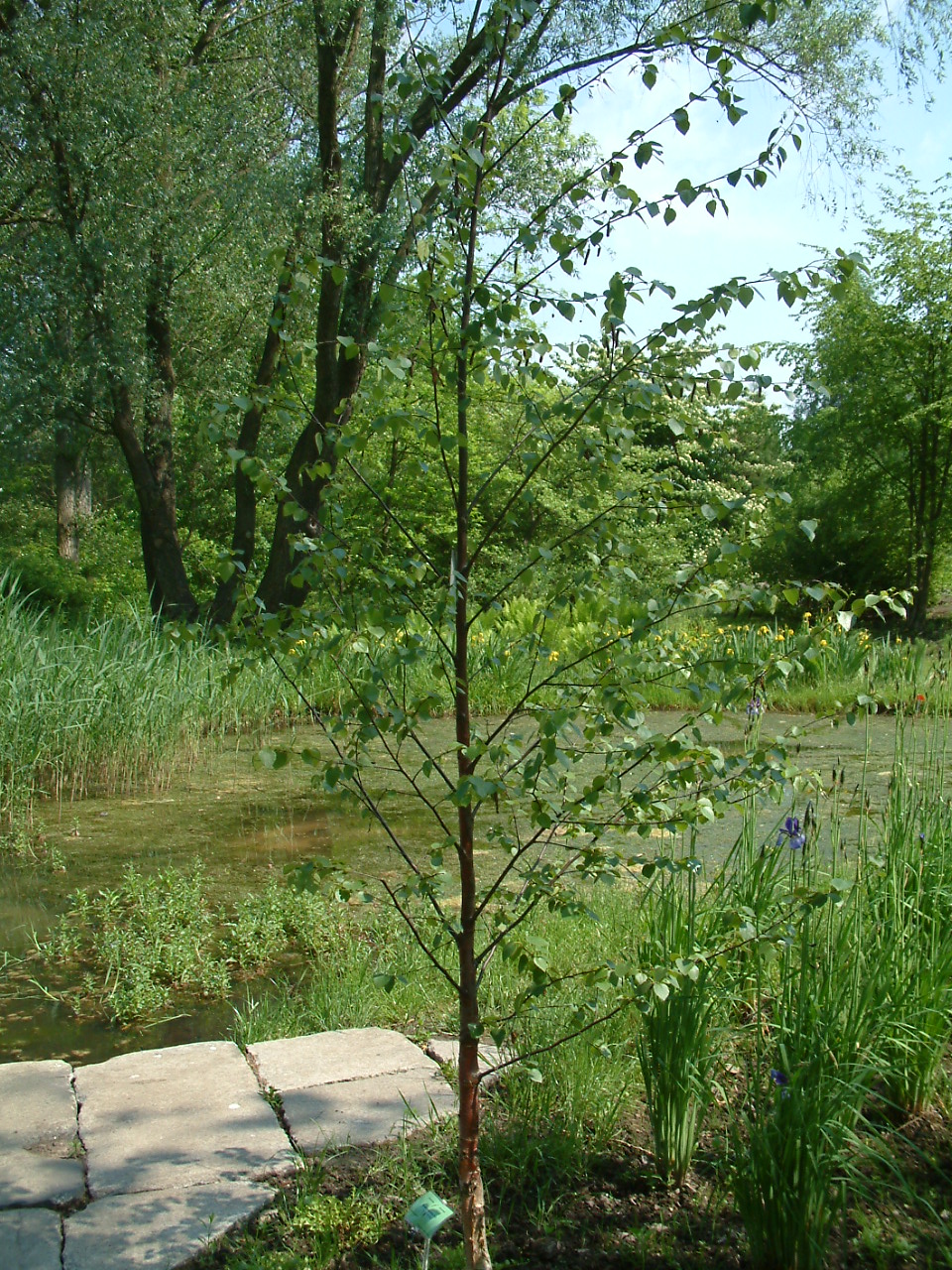
Photo: Wikimedia Commons, CC BY-SA 3.0 · source

Broadleaf tree · Birch family (Betulaceae)
Downy birch
Betula pubescens
The downy birch is the birch of wet ground: of peat bogs, wet heath, wet woodland and ditch banks. It looks very like the silver birch, with the same white trunk, but its twigs are finely hairy and without warts, they don’t hang down, and the leaf is oval rather than diamond-shaped. It grows 10–20 m tall with a light crown about 7 m wide. As a true pioneer it grows fast, loves sun and tolerates acid, wet and poor soil where few other trees will grow. For a wet garden on acid soil it is a light, native tree with white trunks all year round.
Caution: Like silver birch pollen, its pollen causes hay fever: bear that in mind if anyone in the household is allergic to birch.
Light
Full sun
warm and bright
Moisture
Moist to wet
must not dry out
Legal basis
Acid soil
acid
Hardiness
Throughout Belgium
no protection needed
Size
10–20 m
tall
Flowering
April–May
| Pruning months | July–October |
|---|---|
| Height | 10–20 m |
| Native to Belgium | Yes |
| Good for bees, butterflies and birds | Yes, for butterflies and birds |
| Poisonous to people and pets | Not known to be poisonous |
| Flowering | April–May |
Identify
Downy birch: how do you recognise it?
- Habit
- Tree of 10–20 m with a light crown about 7 m wide; the twigs angle upwards and don’t hang down as in silver birch.
- Twigs
- Finely hairy when young, without the white warts of silver birch.
- Leaves
- Alternate, oval, 3–5 cm, with a shorter tip than in silver birch; singly or irregularly toothed, hairy underneath (when young).
- Bark
- White to greyish-white, without the black, deeply fissured diamonds at the base.
- Flowers
- Catkins in April–May, with the leaves: long, hanging male catkins and smaller female ones.
- Fruit
- Catkins that break up into winged nutlets.
- Difference from silver birch
- Silver birch has hanging, hairless twigs with warts, a diamond-shaped leaf and black, deeply fissured diamonds at the base of the trunk.
Flowering: April–May · Harvest and fruit: March–May · Pruning: July–October
Identify by feature: Winged seeds · White trunk
Looks like it, but isn’t
- Silver birch Betula pendula: hanging, hairless twigs with warts and a diamond-shaped leaf. Difference from silver birch
In your garden
Why grow it?
- A native tree for wet, acid soil, where many other trees struggle.
- White trunks and a light crown: graceful in every season, winter included.
- Grows fast: within a few years you have a proper tree.
- Good for wildlife: many insects live on birches, and siskins and redpolls eat the seeds in winter.
- Little work: it needs hardly any pruning.
Downy birch: where does it grow best?
- Full sun: as a true light-demanding tree it cannot stand the shade of other trees.
- Acid, moist to wet soil such as peat, wet sand or a ditch bank; it copes with waterlogging better than silver birch.
- Its roots are shallow and dense: right under the crown a border or lawn will struggle.
- Allow for 10–20 m in height and a crown of about 7 m: suitable for a medium to large garden, a wet corner or a copse.
- Light
- Full sun
- Legal basis
- Acid soil
- Moisture
- Moist to wet
- Size
- 20 m tall, 7 m wide
- Hardiness
- Throughout Belgium, no protection needed
Goes well with
- Alder: Another native tree of wet ground: together a small wet woodland along a ditch or pond.
- Bog-myrtle: A low, aromatic shrub of wet, acid heath, lovely at the edge of a group of birches.
- Cross-leaved heath: Flowers pink in summer on wet, acid soil, in the sun at the edge of the birches.
- Alder buckthorn: A native shrub for wet, acid soil, with flowers for bees and berries for birds; food plant of the brimstone butterfly.
Good and bad companions
Goes well with
- Tolerate the shade under this tree: oregon grape, rhododendron, oleaster, japanese skimmia, garden privet, camellia, laurustinus, box-leaved honeysuckle
Maintenance
Downy birch: when and how to plant it?
- Plant from November to March when the ground isn’t frozen; container plants can go in later, but not during a dry spell.
- Choose a young plant (forestry transplant or small tree): birches establish far better young than as large trees.
- Never let the fine roots of bare-root plants dry out: keep them in a bucket of water until planting.
- Don’t add lime to the planting hole: it wants acid soil.
- Water after planting and during dry spells in the first year.
Care
- Watering
- In dry spells during the first year; after that only in very dry summers, in a spot that isn’t naturally wet.
- Feeding
- Not needed: it grows on poor soil.
- Self-sown seedlings
- It seeds itself freely, even in gutters and borders: pull up unwanted seedlings while they are small.
- Fallen leaves
- Leave the fallen leaves under the tree: they break down quickly and feed the soil life.
Tip: Want a birch on wet ground? Choose the downy birch rather than the silver birch: it copes better with wet feet. Plant three young birches close together for a lovely cluster of white trunks.
Downy birch: when to prune it?
Pruning months: July–October.
When: In summer or early autumn.
How:
- Needs little pruning: only remove dead or awkward branches.
- Cut a branch just outside the branch collar, without leaving a stub; take large branches off in two stages so the bark doesn’t tear.
- Never top a birch: the crown becomes ugly and the tree goes into decline.
Caution: Don’t prune from late winter until the leaves open: the wounds then lose a lot of sap.
Propagation
- Sowing
- Pick ripe catkins in August–September and scatter the seeds in spring on a tray of moist, acid compost. Don’t cover them: they need light to germinate.
- Self-sown seedlings
- You often find seedlings around a downy birch; dig them up while young, with as much root as possible, and move them in winter.
Downy birch: how does it get through the winter?
Hardy throughout Belgium: no protection needed.
- Fully hardy: the downy birch grows far into the far north.
- In winter the white trunks and the witches’ brooms in the bare crown stand out best.
Diseases and pests
- Witches’ brooms: Dense nests of fine twigs in the crown, caused by a fungus. Very common and harmless on downy birch; cut them out in summer if they bother you.
- Birch rust: Small orange pustules on the leaves in late summer, after which the leaves drop early. Harmless to a healthy tree; it is mainly young trees that suffer.
- Birch polypore: A white, rounded bracket fungus on the trunk of weakened or dead birches; the wood is then rotting. Have an affected tree near a path or house checked.
- Aphids: Aphids produce sticky honeydew that drips onto cars and patios. Birds and ladybirds usually deal with them.
Through the year
- March: Last month for planting bare-root trees; the sap is rising: don’t prune.
- April: The catkins flower and the leaves open; the pollen causes hay fever.
- July: Pruning season starts: remove dead and awkward branches.
- August: Pick ripe catkins for seed; pruning is possible.
- September: Pruning still possible; watch for birch rust on the leaves.
- October: Last month for pruning; the leaves turn yellow.
- November: Planting season starts.
- December: Plant in mild weather; the witches’ brooms are easy to see in the bare crown.
Use
What can you use it for?
- Also used for
- As for silver birch: sap, bark for lighting fires, and firewood.
- For wildlife
- Characteristic of wet heath and bogs.
Caution: This pollen causes hay fever too.
Edible and useful
- Sap (March–April)
- The sap rises from early March to mid-April, in the weeks before the leaves break. It is clear, faintly sweet and refreshing: drink it fresh, ferment it or, with a lot of patience, boil it down to syrup (allow about 100 litres of sap for 1 litre of syrup).
- Leaves (April–May)
- Young leaves in April and May, while they are still slightly sticky and fragrant: for tea, or finely shredded in a salad.
- Storing
- Fresh birch sap spoils quickly: refrigerate it at once and drink it within 2 to 3 days, or freeze it in portions. Dried leaves keep for a year in a closed jar.
- Fermenting
- Birch kvass, sap fermented for a few days with a little sugar and a few raisins, is an old spring drink in Eastern Europe.
Caution: Only tap your own tree, or one you have explicit permission for, never in woods or parks. Choose a healthy tree with a trunk at least 25 cm across, drill a single small hole and tap for no longer than 1 to 2 weeks. Then close the hole with a wooden peg or grafting wax so that no more sap runs out and no disease gets in. Only drink sap that is clear and smells fresh. Pick leaves well away from busy roads and sprayed fields, and never eat or drink anything you have not identified with certainty.
Eating and using is at your own risk: see the terms of use.
Recipes
- Tapping birch sap (Sap · 1–4 litres a day · 15 min + 1–2 weeks tapping)
- Birch kvass (Fermentation · 2 litres · 15 min + 3–5 days)
- Birch-leaf tea (Tea · 1 cup · 10 min)
- Birch sap and lemon granita (Dish · serves 4 · 15 min + 3–4 hrs freezing)
- Birch leaf bath sachets (Skin and body care · 4 bath sachets · 30 min + 1 week drying)
Good for wildlife
- Caterpillars
- Host plant: caterpillars of butterflies or moths eat the leaves.
- Birds
- Berries, seeds or insects as food, or a place to nest.
- Ladybirds
- Aphids on the plant are food for ladybirds and their larvae.
You and this species
Did you know?
- Likes wet, peaty soil; hybrids with silver birch occur.
- The downy birch reaches further north than the silver birch; in Iceland it is the only native tree that forms woodland.
- As with silver birch, you can tap birch sap in March, and the bark burns even when damp: ideal for lighting a fire.
- Fly agarics and brown birch boletes are often found under birches: these fungi live in symbiosis with the tree’s roots, exchanging nutrients with it.
- Downy birch grows further north than most trees: in Lapland a subspecies with crooked trunks forms the treeline, where the tundra begins.