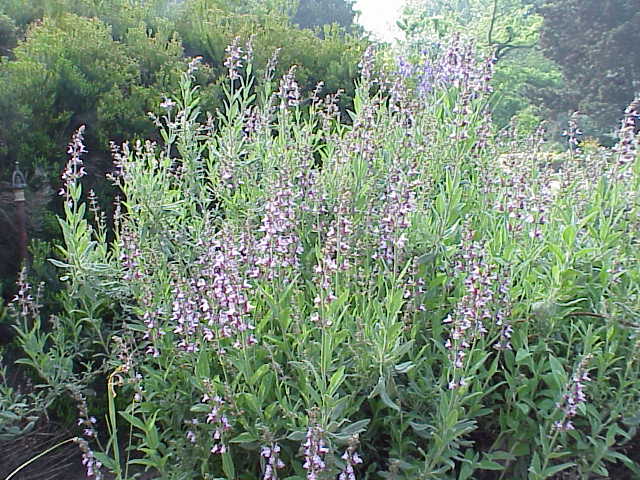
Photo: Kurt Stüber [1], CC BY-SA 3.0 · source

Dwarf shrub · Mint family (Lamiaceae)
Common sage
Salvia officinalis · also: Sage, Garden sage
Common sage is a greyish-green subshrub of 40–70 cm from the Mediterranean, with felted, finely wrinkled, strongly aromatic leaves and, in June–July, bluish-purple two-lipped flowers that draw bumblebees and bees. It is a classic kitchen herb, delicious in butter with pasta, in saltimbocca and with poultry. Sage wants full sun and dry, well-drained soil. Pruned in April and lightly again after flowering, it stays compact; after 4–5 years it becomes woody and is best replaced.
Caution: Sage contains thujone: don’t drink it in large amounts every day, or during pregnancy.
Light
Full sun
warm and bright
Moisture
Dry
tolerates drought
Legal basis
Any garden soil
any pH
Hardiness
Throughout Belgium
no protection needed
Size
0.4–0.7 m
tall
Flowering
June–July
| Pruning months | April and July |
|---|---|
| Height | 0.4–0.7 m |
| Native to Belgium | No, planted |
| Poisonous to people and pets | Not known to be poisonous |
| Flowering | June–July |
Identify
Common sage: how do you recognise it?
- Habit
- Bushy subshrub 0.4–0.7 m tall and about 0.6 m across.
- Leaf
- Opposite, oblong, 3–8 cm, finely scalloped, greyish-green and felted, with a finely wrinkled surface; strongly aromatic.
- Stems
- Square, felted stems that become woody at the base.
- Flower
- Bluish-purple two-lipped flowers (2–3 cm) in whorls on upright spikes, June–July.
- Fruit
- Small nutlets.
- Difference from English lavender
- Lavender has narrow, linear leaves and flower spikes on long, bare stalks.
- Difference from meadow clary
- Meadow clary (Salvia pratensis) is a herb with a leaf rosette and bright blue flowers; wild on chalk grassland.
Flowering: June–July · Harvest and fruit: May–September · Pruning: April and July
Identify by feature: Purple or blue flowers
Looks like it, but isn’t
- English lavender Lavandula angustifolia: narrow, linear leaves and flower spikes on long, bare stalks. Difference from English lavender
- Meadow clary (Salvia pratensis): a herb with a leaf rosette and bright blue flowers; wild on chalk grassland.
In your garden
Why grow it?
- A kitchen herb you can pick almost all year round.
- Bluish-purple flowers in June–July, loved by bumblebees and bees.
- Greyish-green, aromatic leaves that look good next to lavender, thyme and rosemary.
- Needs little water and no feeding: ideal for a dry, sunny spot or a pot.
Common sage: where does it grow best?
- Full sun: the more sun, the more fragrant the leaves.
- Dry, well-drained soil, chalky or not; it dislikes wet roots in winter.
- On heavy clay: plant on a raised bed or work coarse sand or gravel into the soil.
- At home in a herb garden, a gravel garden, along a path or in a large pot by the kitchen door.
- Light
- Full sun
- Legal basis
- Any garden soil
- Moisture
- Dry
- Size
- 0.6 m tall, 0.6 m wide
- Hardiness
- Throughout Belgium, no protection needed
Goes well with
- English lavender: Also Mediterranean and greyish-green, for the same dry, sunny spot; together they draw bees all summer.
- Garden thyme: A low, fragrant cushion for the edge of the herb garden.
- Rosemary: An evergreen kitchen herb with needle-like leaves, for the same sunny, dry soil.
Good and bad companions
Best kept away from
- Do not plant under the dense crown of these trees: norway spruce, european silver fir, nordmann fir, douglas fir, yew, horse chestnut, norway maple, sycamore
Maintenance
Common sage: when and how to plant it?
- Plant in April–May, so it is well rooted before winter.
- Allow 50–60 cm per plant.
- Besides ordinary greyish-green sage there are forms with purple leaves (‘Purpurascens’) and yellow-variegated leaves (‘Icterina’); the three-coloured ‘Tricolor’ is less hardy.
- Don’t plant it deeper than it was growing and water for the first few weeks. In a pot, use compost mixed with some sand or grit, and a pot with a drainage hole.
Care
- Watering
- Only for the first few weeks after planting and in a pot; after that it copes on its own, even in dry summers.
- Feeding
- Not needed: on rich soil it grows floppy and less fragrant.
- Harvest
- Pick single leaves or shoot tips as you need them; for drying, harvest just before flowering, when the leaves are most aromatic.
- Renewal
- After 4–5 years sage becomes woody and sparse: replace it with a young plant or a cutting of your own.
Tip: Keep a sage in a pot by the kitchen door: you can quickly pick a few leaves even when it rains, and in a pot with a drainage hole the roots stay dry in winter.
Common sage: when to prune it?
Pruning months: April and July.
When: In April, and lightly after flowering in July.
How:
- In April, cut last year’s growth back by a third to a half, just above new leaves.
- After flowering, in July, remove the flower stems and lightly reshape the plant.
- Start young: a plant pruned every year stays dense and bushy.
Caution: Don’t prune into bare wood. After 4–5 years sage becomes woody and sparse: replace it with a new plant or a cutting.
Propagation
- Cuttings
- In May–June, take cuttings of 8–10 cm from non-flowering shoots and root them in a sandy mix.
- Layering
- Peg a low branch down onto the soil and cover it with earth; once it has rooted, cut it free.
- Sowing
- Ordinary sage can be sown in spring; forms with coloured leaves are propagated from cuttings.
Common sage: how does it get through the winter?
Hardy throughout Belgium: no protection needed.
- Hardy in Belgium and the Netherlands, but sensitive to wet soil: in winter it dies more often from waterlogging than from frost.
- Don’t prune in autumn: let the plant go into winter with its leaves and wait until April.
- In winter, stand pots in a sheltered spot against a wall, raised on pot feet so the water can drain away.
Diseases and pests
- Root rot: The plant wilts and dies, often after a wet winter. Replant in a drier, better-drained spot.
- Bare and woody: Bare at the base and falling open. Prune every spring; replace an old plant with a cutting.
- Powdery mildew: White coating on the leaves, especially in late summer. Cut off affected shoots; a sunny, airy spot helps.
- Rosemary beetle: Small, shiny beetles striped metallic green and purple, and their larvae, eat the leaves. Shake them off over a bucket.
Through the year
- April: Pruning: cut last year’s growth back by a third to a half; planting.
- May: Planting and potting up; taking cuttings.
- June: Flowering begins: bumblebees and bees. Harvest leaves for drying just before.
- July: Light pruning after flowering: remove the flower stems.
- August: Harvest leaves; water pots in dry spells.
- November: Move pots to a sheltered, dry spot.
Use
What can you use it for?
- Food and drink
- Kitchen herb: in butter with pasta, in saltimbocca and with poultry; also as a tea.
- For wildlife
- The flowers are loved by bumblebees and bees.
Caution: Contains thujone: don’t drink it in large amounts every day, or during pregnancy.
Edible and useful
- Flowers (June–July)
- Pick the blue-purple flowers in June and July, on a dry morning, when they have just opened. Snip off the flowering tops and strip the flowers out with your fingers. They taste mildly of sage and look lovely as a garnish on salad, pasta or cheese. Leave plenty of flowers, because bumblebees and bees love them.
- Leaves (May–September)
- Pick the leaves from May to September, on a dry morning once the dew has gone. Choose young, fully grown leaves from the tips; they are grey-green and velvety. The flavour is strongest just before flowering. Never take more than a third of the plant at once, so it can regrow, and do not prune late in autumn. Use the leaves fresh or dry them.
- Storing
- Fresh sage keeps for a week in the fridge, with the stalks in a glass of water or wrapped in damp kitchen paper. You can also freeze the leaves loose in a bag; they keep for six months. Dried sage keeps for up to a year in a closed jar, dry and dark. The jelly keeps for a year in sterilised jars.
Caution: Sage contains thujone: do not eat or drink it every day in large amounts, and avoid it during pregnancy and breastfeeding. Never swallow sage essential oil. As a culinary herb in small amounts sage is no problem; if you have doubts, for example if you take medication, ask your doctor or pharmacist. Use only true sage (Salvia officinalis): grey-green, slightly wrinkled, velvety leaves with a strong, aromatic smell. If a leaf does not clearly smell of sage when you rub it between your fingers, do not use it. For ornamental sages it is not always known whether they are fit to eat. People who are allergic to the mint family (such as mint, thyme and lavender) may react to sage too. Wild sages such as meadow clary are rare: do not pick them in nature areas, you do not need them in the kitchen. Bought plants may have been treated: let them grow for a few weeks and wash the leaves well. Do not pick beside busy roads, and never eat anything you have not identified with certainty.
Eating and using is at your own risk: see the terms of use.
Recipes
- Pasta with sage butter and Parmesan (Dish · serves 4 · 20 min)
- Apple and sage jelly (Jelly · ± 4 jars of 250 ml · 1 hr + 2 hrs draining)
- Sage leaves in batter (Dish · ± 20 pieces · 25 min)
- Dried sage (Dried · ± 25 g dried leaves · 15 min + 5–10 days drying)
You and this species
Did you know?
- Sage flowers have a little lever: when a bumblebee pushes its head inside, the stamens swing down and stamp pollen onto its back.
- The name Salvia comes from the Latin salvere, ‘to be healthy’: for centuries sage was a medicinal herb.