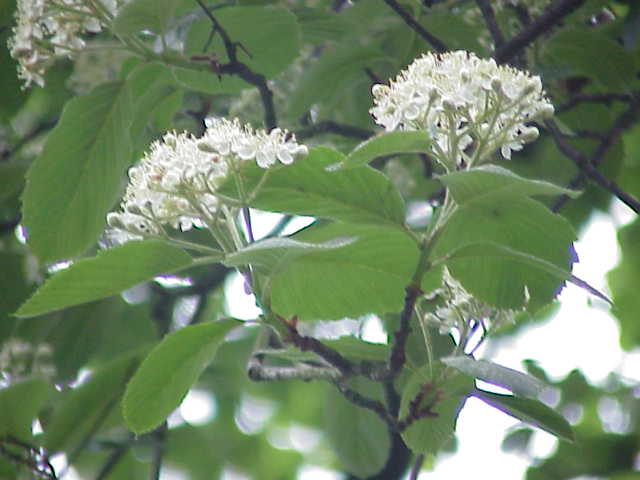
Photo: Kurt Stüber [1], CC BY-SA 3.0 · source

Broadleaf tree · Rose family (Rosaceae)
Whitebeam
Sorbus aria · also: Common whitebeam
Whitebeam is a native tree of 8–15 m, recognisable by its oval, double-toothed leaves with a brilliant white, felted underside: when the wind blows through it, the whole tree looks silvery. In May it bears white flower heads for bees and hoverflies, and in autumn orange-red berries for thrushes and starlings. In the wild it is rare, on dry, chalky soils. It tolerates wind, chalk and drought and stays fairly compact: a tough street tree and an excellent tree for an ordinary garden.
Caution: Whitebeam can pass fireblight to apple, pear and quince: don’t plant it right next to fruit trees.
Light
Full sun
warm and bright
Moisture
Dry
tolerates drought
Legal basis
Any garden soil
neutral to chalky
Hardiness
Throughout Belgium
no protection needed
Size
8–15 m
tall
Flowering
May
| Pruning months | July–August and December–February |
|---|---|
| Height | 8–15 m |
| Native to Belgium | Yes |
| Good for bees, butterflies and birds | Yes, for bees and birds |
| Poisonous to people and pets | Not known to be poisonous |
| Flowering | May |
Identify
Whitebeam: how do you recognise it?
- Habit
- Tree of 8–15 m with an egg-shaped to rounded, fairly compact crown; often narrow and upright when young.
- Leaf
- Alternate, 6–12 cm, oval, irregularly double-toothed, with 10–14 pairs of parallel veins. Dark green above, white-felted below: in the wind the tree looks silvery.
- Bark
- Smooth and grey, later finely cracked.
- Flower
- White flower heads in May.
- Fruit
- Orange-red to scarlet berries (1–1.5 cm) with small pale speckles, in autumn.
- Difference from Swedish whitebeam
- Swedish whitebeam has leaves that are lobed towards the base and grey-felted, not brilliant white.
Flowering: May · Harvest and fruit: September–October · Pruning: July–August and December–February
Identify by feature: White or silver underside · White blossom · Orange berries
Looks like it, but isn’t
- Swedish whitebeam Sorbus intermedia: the leaves are lobed towards the base and grey-felted, not brilliant white. Difference from Swedish whitebeam
- Goat willow Salix caprea: wavy leaf margin, catkins in March and no berries. Difference from goat willow
In your garden
Why grow it?
- A native tree that fits an ordinary garden: 8–15 m tall and about 6 m across.
- Silvery foliage, white flowers in May and orange-red berries in autumn.
- Tolerates wind, chalk, drought and urban soil: also for an exposed or dry spot.
- Flowers for bees and hoverflies, berries for thrushes and starlings.
Whitebeam: where does it grow best?
- Full sun; in shade it flowers less and the crown stays thin.
- Dry to normal, well-drained soil. It loves chalk, but also grows on other soils, as long as they are not wet.
- Tolerates wind, even on the coast, and urban soil: a good street tree.
- Allow for a crown about 6 m across: it fits an average garden.
- Light
- Full sun
- Legal basis
- Any garden soil
- Moisture
- Dry
- Size
- 12 m tall, 6 m wide
- Hardiness
- Throughout Belgium, no protection needed
Goes well with
- Field maple: A native tree that, like whitebeam, tolerates chalk, drought and wind; together a sturdy woodland edge or hedgerow.
- Wayfaring-tree: A native shrub of dry, chalky soils, with white flower heads in May and berries that turn from red to black.
- Wild privet: A native, semi-evergreen shrub for chalky soil; flowers in June for butterflies and bees.
Good and bad companions
Goes well with
- Tolerate the shade under this tree: oregon grape, rhododendron, oleaster, japanese skimmia, garden privet, camellia, laurustinus, box-leaved honeysuckle
Best kept away from
- Fruit trees that can catch fireblight from this plant: apple, pear, nashi pear
Maintenance
Whitebeam: when and how to plant it?
- Plant from November to March, in frost-free weather, bare-root or root-balled.
- Dig a generous planting hole, loosen the bottom and set the tree at the same depth as before.
- Put in a stake on the windward side and tie the tree loosely.
- Don’t plant it right next to apple, pear or quince trees: they can pass fireblight to each other.
- Water during dry spells in the first year.
Care
- Watering
- During dry spells in the first year; after that it copes well with drought.
- Feeding
- Not needed; on poor soil, a little compost in spring.
- Water shoots
- Remove water shoots on the trunk as soon as you see them.
- Fireblight
- In summer, check for twigs that suddenly blacken and wilt, as if scorched. Cut them out generously and disinfect your secateurs.
Tip: Got a small garden? Choose the variety ‘Lutescens’: it stays more compact, and in spring its young leaves are covered in creamy-white down on both sides.
Whitebeam: when to prune it?
Pruning months: July–August and December–February.
When: Dead, diseased and broken branches can be removed at any time of year. Formative pruning in winter or after flowering.
How:
- Little needed: remove crossing branches and water shoots.
- Train a young tree with a single leader and a clear stem tall enough for the spot, e.g. 2 m above a path.
- Cut out branches with fireblight at least 30 cm below the visibly affected part, in dry weather.
Caution: Can carry fireblight.
Propagation
- Sowing
- In autumn, take the seeds from ripe berries and sow them straight away outdoors in a pot or seedbed. They need a winter’s cold and germinate in spring, sometimes only a year later.
- Grafting
- Varieties such as ‘Lutescens’ are grafted onto a rootstock; best left to a nursery.
Whitebeam: how does it get through the winter?
Hardy throughout Belgium: no protection needed.
- Fully hardy.
- The berries sometimes hang on into winter, until thrushes, fieldfares and starlings eat them.
- In the bare crown you can easily see which branches cross: a good time for formative pruning.
Diseases and pests
- Fireblight: Flowers, twigs and leaves suddenly wilt and turn brown to black, as if scorched; young shoot tips bend over like a shepherd’s crook. Cut out diseased branches generously in dry weather and disinfect your tools.
- Aphids: Curled leaves in spring, with sticky honeydew. Ladybirds and birds usually deal with them; don’t spray.
- Wet soil: On wet, poorly drained soil it declines and branches die back. Choose a dry to normal spot.
Through the year
- January: Formative pruning in frost-free weather; plant bare-root trees.
- February: Finish formative pruning; plant.
- May: Flowering: white flower heads for bees and hoverflies; the young leaves are silvery white.
- June: Check for aphids and fireblight.
- July: Summer pruning after flowering; cut out diseased twigs.
- August: Finish summer pruning.
- September: The berries turn orange-red: food for thrushes.
- October: Take the seeds from ripe berries and sow them outdoors.
- December: Formative pruning can start again; plant bare-root trees.
Use
What can you use it for?
- Garden and landscape
- Tough street and garden tree that copes well with wind, chalk and drought.
- For wildlife
- Flowers for bees and hoverflies; the berries for thrushes and starlings.
- Food and drink
- The berries are ripe and edible after frost, in jelly, but rather mealy.
Edible and useful
- Berries (September–October)
- The orange-red berries in September and October. They are only good after the first frost, or once they have become slightly overripe and soft (bletted); they then taste sweet and mealy. Use them cooked, for jelly or purée, preferably with apple.
- Storing
- The berries can be frozen on their clusters. Jelly keeps for a year in sterilised jars.
Caution: As with all rowans: do not eat them raw in large amounts, and sieve out the seeds. Do not confuse whitebeam with poisonous red berries such as those of yew, holly or honeysuckle; whitebeam is easy to recognise by its leaves with brilliant white, felty undersides. Whitebeam is often planted along busy roads: pick away from traffic instead, and never eat anything you have not identified with certainty.
Eating and using is at your own risk: see the terms of use.
Recipes
- Whitebeam and apple jelly (Jelly · ± 3 jars of 250 ml · 1 hr 30 + overnight dripping)
- Whitebeam and apple sauce (Compote · ± 3 jars of 250 ml · 45 min)
- Whitebeam and pear chutney (Other · ± 3 jars of 250 ml · 1½ hrs + 2 weeks maturing)
Good for wildlife
- Birds
- Berries, seeds or insects as food, or a place to nest.
- Bees
- Nectar and pollen for honeybees and wild bees.
- Hoverflies
- Open flowers for hoverflies; many of their larvae eat aphids.
You and this species
Did you know?
- Its Dutch name, meelbes (‘mealy berry’), refers to the mealy flesh of the fruit. Whitebeam tolerates wind, chalk and drought, which makes it a good street tree.
- In spring the buds open like little white candles: the young leaves are white-hairy on both sides and only turn green on top later on.
- The berries are ripe and edible after frost, in jelly, but rather mealy.
- Whitebeam hybridises with rowan and wild service tree. Such crosses gave rise to species like the Swedish whitebeam, which set seed without fertilisation and so became stable species.
- In Belgium, whitebeam grows wild mainly on limestone rocks and slopes in Wallonia, for example in the Meuse valley.