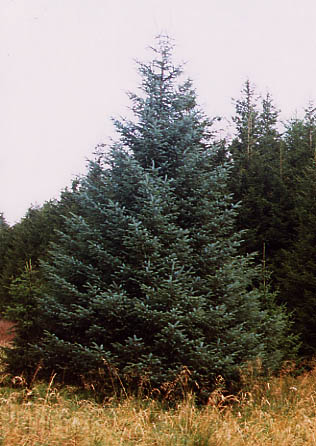
Photo: MPF at English Wikipedia, CC BY-SA 3.0 · source

Conifer · Pine family (Pinaceae)
Sitka spruce
Picea sitchensis
The Sitka spruce is a forest giant from the misty coastal strip of western North America, from Alaska to California. You can recognise it by its very sharp, flattened needles with blue-white undersides and by its pale brown cones with papery scales. Here it grows 30–50 m tall, with a crown about 8 m wide. In Britain and Ireland it is the most important forestry tree, and it also grows in some forests in Belgium and the Netherlands. It is far too big and too prickly for a garden: it belongs in a forest, a large park or an estate.
Caution: The needles are so prickly that you need sturdy gloves to work on it: don’t plant it along paths or where children play. It is also susceptible to the green spruce aphid.
Light
Sun or partial shade
preferably some sun
Moisture
Moist to wet
must not dry out
Legal basis
Acid soil
acid
Hardiness
Throughout Belgium
no protection needed
Size
30–50 m
tall
| Pruning months | August–September |
|---|---|
| Height | 30–50 m |
| Native to Belgium | No, planted |
| Poisonous to people and pets | Not known to be poisonous |
Identify
Sitka spruce: how do you recognise it?
- Habit
- Tree of 30–50 m with a conical crown about 8 m wide and a straight trunk.
- Needles
- 1.5–3 cm, stiff, flattened and very sharply pointed; green above, with two broad blue-white bands below. They grow all round the twig on small woody pegs.
- Bark
- Grey to purplish grey, thin and flaking in rounded scales.
- Cones
- Hanging and pale brown, 6–10 cm, with thin, papery, crinkled scales.
- Difference from Norway spruce
- Norway spruce has square needles that are green all over and less prickly, and longer, reddish-brown cones.
- Difference from Serbian spruce
- Serbian spruce has a very narrow crown, blunt needles and small, purplish-brown cones.
Pruning: August–September
Identify by feature: Prickly needles
Looks like it, but isn’t
- Norway spruce Picea abies: square needles that are green all over and less prickly, and longer, reddish-brown cones. Difference from Norway spruce
- Serbian spruce Picea omorika: very narrow crown, blunt needles and small, purplish-brown cones. Difference from Serbian spruce
In your garden
Why grow it?
- An impressive, fast-growing tree for a large park or forest on moist, acid soil.
- Tolerates wind and sea wind: in its homeland it grows right by the coast.
- The dense, prickly crown is a safe place for birds to shelter and nest.
- The cones provide seed for squirrels and crossbills.
Sitka spruce: where does it grow best?
- Sun to partial shade.
- Acid, moist soil; it likes a cool, damp climate with plenty of rain and suffers in dry summers.
- Shallow roots: on wet or shallow soil it can be blown over in a storm.
- Allow for 30–50 m in height and a crown of about 8 m: only for a forest, a large park or an estate, not for a garden.
- Light
- Sun or partial shade
- Legal basis
- Acid soil
- Moisture
- Moist to wet
- Size
- 35 m tall, 8 m wide
- Hardiness
- Throughout Belgium, no protection needed
Goes well with
- Downy birch: A native birch for the same wet, acid soil, with pale trunks against the dark needles.
- Rowan: Flowers white and bears orange berries at the sunny woodland edge.
- Bog-myrtle: A fragrant native shrub for wet, acid soil at the edge of a spruce wood.
Good and bad companions
Goes well with
- Like the acid soil under this tree: heather, rhododendron, japanese skimmia, raspberry, highbush blueberry, witch hazel, broom, gorse
- Tolerate the shade under this tree: oregon grape, rhododendron, oleaster, japanese skimmia, garden privet, camellia, laurustinus, box-leaved honeysuckle
Best kept away from
- Sun-loving plants get too little light under the dense crown: english lavender, heather, butterfly bush, blackthorn, highbush blueberry, sea buckthorn, japanese rose, broom
Maintenance
Sitka spruce: when and how to plant it?
- Plant from October to April, when the ground is not frozen.
- Choose young forestry transplants: small plants establish much better than large ones.
- Plant shallowly, with the top of the roots level with the soil.
- Wear sturdy gloves and long sleeves: the needles are viciously sharp.
- Water after planting and during dry spells in the first year.
Care
- Watering
- Young trees in dry summers; with its shallow roots a spruce quickly suffers from drought.
- Feeding
- Not needed; leave the needles where they fall.
- Mulch
- A layer of wood chips or needles keeps the soil cool and moist.
- Checking
- In late winter, look for yellow needles caused by the green spruce aphid, and after dry summers for bore holes and brown boring dust from bark beetles.
Tip: Looking for a spruce for an ordinary garden? Choose the Serbian spruce: it stays narrow, is barely prickly and grows in almost any soil.
Sitka spruce: when to prune it?
Pruning months: August–September.
When: Dead, diseased and broken branches can be removed at any time of year. If pruning is needed, do it in August–September.
How:
- A forest tree: do not prune.
- Dead lower branches can be sawn off at the trunk, just outside the branch collar.
- Never remove the leader and never cut back into bare wood.
Caution: A spruce will not sprout from old, bare wood: a bare patch stays bare.
Propagation
- Sowing
- In autumn, pick closed cones and let them open in a warm place. Sow the seeds in a tray in spring; they germinate easily.
Sitka spruce: how does it get through the winter?
Hardy throughout Belgium: no protection needed.
- Fully hardy.
- In a storm it can blow over on wet or shallow soil; wet snow can break branches or the leader.
Diseases and pests
- Green spruce aphid: A green aphid that sucks the older needles in late winter: they turn yellow to brown and drop, especially after mild winters. Sitka spruce is particularly susceptible; it usually recovers.
- Bark beetles: Bore holes, brown boring dust and a crown that quickly changes colour, especially on trees weakened by drought. Fell affected trees quickly and remove the wood.
- Late frost: Brown, limp young shoots after a cold night in April–May. The tree sprouts again; don’t plant it in a frost hollow.
- Drought and storms: It turns brown in dry summers and blows over in storms. Choose a sheltered spot with moisture-retentive soil.
Through the year
- February: Look for yellow needles caused by the green spruce aphid, especially after a mild winter.
- March: Planting season.
- May: Young shoots can be damaged by late frost.
- July: Water young trees in dry spells; look out for bark beetles.
- August: Saw off dead lower branches.
- September: Last month for pruning; the cones ripen.
- October: Planting season begins; pick cones for sowing.
Use
What can you use it for?
- Wood
- Light, strong timber for building, paper and soundboards; once also used for aircraft.
Caution: So prickly that you need gloves to work on it; susceptible to the green spruce aphid.
You and this species
Did you know?
- In its homeland, the west coast of North America, it can grow over 90 m tall. In Britain and Ireland it is the most important forestry tree.
- Its light, strong timber is used for soundboards and paper; it was once also used to build aircraft.
- In Dutch the green spruce aphid is called ‘sitkaluis’, after this spruce, which is particularly susceptible to it.