Photo: US FWS, Public domain · source

Conifer · Pine family (Pinaceae)
Weymouth pine
Pinus strobus · also: Eastern white pine
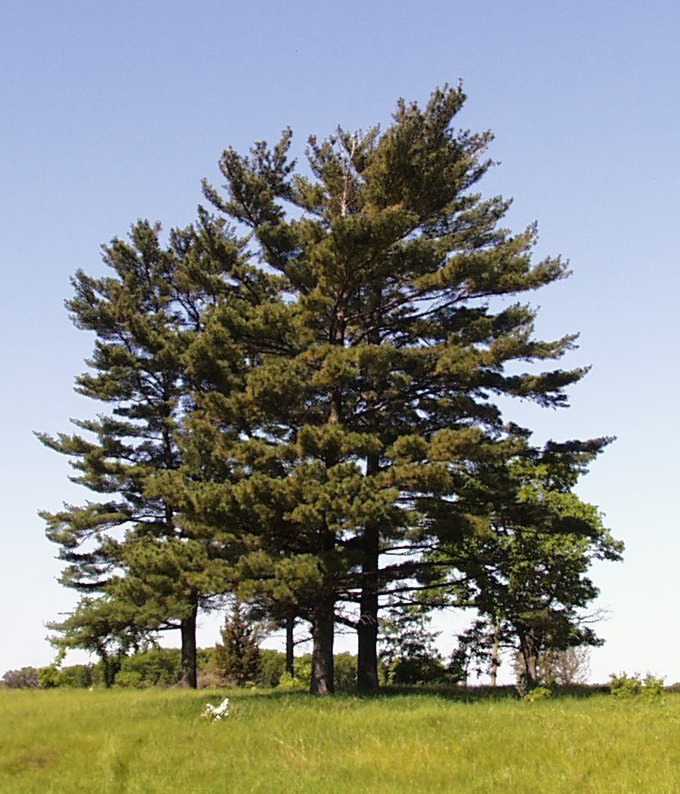
The Weymouth pine comes from eastern North America and is the only common pine in our region with needles in fives: thin, soft and blue-green, with fine white lines on the inner face. Young trees grow quickly into an elegant, open tree; later it reaches 25–35 m with a crown about 10 m wide. It likes sun or partial shade and acid soil that isn’t too dry. The narrow, hanging cones are often dotted with drops of resin. Its great weakness is blister rust, a fungus that also lives on blackcurrant and gooseberry. Too big for an ordinary garden, it brings softness and elegance to a park or large garden.
Caution: Susceptible to blister rust, a fungus that also lives on blackcurrant and gooseberry: don’t plant those shrubs nearby.
Light
Sun or partial shade
preferably some sun
Moisture
Normal
no wet feet
Legal basis
Acid soil
acid
Hardiness
Throughout Belgium
no protection needed
Size
25–35 m
tall
| Pruning months | May–June |
|---|---|
| Height | 25–35 m |
| Native to Belgium | No, naturalised |
| Good for bees, butterflies and birds | Yes, for birds |
| Poisonous to people and pets | Not known to be poisonous |
Identify
Weymouth pine: how do you recognise it?
- Habit
- Tree of 25–35 m; regularly conical with tiered branches when young, later with a broad, irregular crown of about 10 m.
- Needles
- In 5s, 6–12 cm, thin and soft, with white lines on the inner face.
- Bark
- Smooth and grey-green for a long time, later dark and fissured into narrow ridges.
- Cones
- Narrow, slightly curved and hanging, 8–15 cm, often with drops of resin.
- Difference from other five-needled pines
- Himalayan pine has even longer, limply drooping needles.
Harvest and fruit: January–December · Pruning: May–June
Identify by feature: Soft needles · Needles in bundles
Looks like it, but isn’t
- Other five-needled pines (e.g. Himalayan pine): Himalayan pine has even longer, limply drooping needles.
In your garden
Why grow it?
- Soft, blue-green needles that move beautifully in the wind: one of the most graceful pines for a park.
- Grows quickly when young and tolerates more shade than most pines.
- Decorative hanging cones with white drops of resin.
- Light, soft wood that is easy to work.
Weymouth pine: where does it grow best?
- Sun to partial shade; it tolerates more shade than other pines.
- Acid, moisture-retentive but free-draining soil; it does poorly on chalk and on very dry soil.
- Not by the sea or along gritted roads: it can’t tolerate salt. Shelter it from strong winds, as the branches break easily.
- Don’t plant blackcurrants or gooseberries nearby: blister rust spreads by way of those shrubs.
- Allow for 25–35 m in height and a crown of about 10 m: only for a large garden or a park.
- Light
- Sun or partial shade
- Legal basis
- Acid soil
- Moisture
- Normal
- Size
- 30 m tall, 10 m wide
- Hardiness
- Throughout Belgium, no protection needed
Goes well with
- Rhododendron: Likes the same acid soil and partial shade, and flowers in May under the light crown.
- Holly: Evergreen with red berries, for the shady edge beneath the pine.
- Heather: A low, purple edging for the sunny side on acid soil.
- Silver birch: Light, white trunks against the soft, blue-green needles.
Good and bad companions
Goes well with
- Like the acid soil under this tree: heather, rhododendron, japanese skimmia, raspberry, highbush blueberry, witch hazel, broom, gorse
- Tolerate the shade under this tree: oregon grape, rhododendron, oleaster, japanese skimmia, garden privet, camellia, laurustinus, box-leaved honeysuckle
Best kept away from
- Alternate host of white pine blister rust: gooseberry, blackcurrant, redcurrant, flowering currant
Maintenance
Weymouth pine: when and how to plant it?
- Plant in October–November or in March–April, when the ground isn’t frozen.
- Choose a young pot-grown or root-balled plant; it establishes best when young.
- Check first that there are no blackcurrants or gooseberries nearby, including in neighbouring gardens.
- Plant at the same depth as before and cover the soil with a layer of needles or leaf mould.
- Water after planting and during dry spells in the first year.
Care
- Watering
- In dry spells during the first few years; it copes less well with drought than Scots or black pine.
- Feeding
- Not needed; a layer of needles or leaf mould under the crown keeps the soil acid and moist.
- Checking
- Every spring, look for orange blisters or oozing resin on branches and trunk: the sign of blister rust.
- Wind and snow
- After a storm or heavy snow, neatly remove broken branches.
Tip: Never plant it near blackcurrants or gooseberries, and look over the fence too: blister rust needs both plants to complete its cycle.
Weymouth pine: when to prune it?
Pruning months: May–June.
When: Dead, diseased and broken branches can be removed at any time of year. If pruning is needed, do it in May–June.
How:
- Prune as little as possible: a Weymouth pine looks best in its natural, open shape.
- Remove branches with blister rust (orange blisters on the bark) well below the infected part.
- If the trunk is infected, everything above it dies; felling is then often the best option.
Caution: Susceptible to blister rust, a fungus that also lives on blackcurrant and gooseberry.
Propagation
- Sowing
- Collect the seeds from ripe cones in September. Sow them outdoors in autumn, or in spring after 1–2 months cold and moist in the fridge.
- Grafting
- Dwarf and weeping forms are grafted; that is a job for the nursery.
Weymouth pine: how does it get through the winter?
Hardy throughout Belgium: no protection needed.
- Fully hardy.
- Wet snow and ice easily break the brittle branches: shake young trees.
Diseases and pests
- Blister rust: Orange blisters and oozing resin on branches and trunk in spring; the bark dies and everything above withers. The fungus alternates between pine and blackcurrant or gooseberry. Cut out affected branches generously and keep those shrubs away.
- Woolly aphid: White, woolly tufts on the bark of the trunk and branches. Usually harmless; if you like, blast them off with a strong jet of water.
- Salt: Brown needle tips on the coast or along gritted roads. Choose a black pine there instead.
- Drought: On dry sand the needles turn brown in hot summers. Mulch the soil and water young trees.
Through the year
- March: Planting season; look for the orange blisters of blister rust.
- April: Cut out branches with blister rust generously.
- May: If needed, pinch the candles to keep a young tree compact.
- June: Last month for shortening the candles.
- July: Water young trees in dry spells.
- September: The cones ripen: collect seed for sowing.
- October: Planting season starts.
- December: Remove branches broken by snow or storms.
Use
What can you use it for?
- Wood
- Light, soft, even-grained wood that is easy to work, for mouldings and carving.
- Garden and landscape
- Graceful park tree with soft, blue-green needles.
Edible and useful
- Needles (January–December)
- The soft, slender needles make the mildest pine tea, fresh and slightly citrusy. In North America, tea from this pine is an old tradition. Pick all year round, preferably young needles.
- Young shoots (May)
- The young shoots in May can be used like those of other pines, for syrup or flavoured sugar.
- Storing
- Snip the needles into small pieces, dry them in the shade somewhere airy and keep them in a closed jar; they keep for a few months.
Caution: You can recognise Weymouth pine by its soft needles in bundles of five. Never confuse it with yew (flat needles set singly, red berries, deadly poisonous). Drink pine-needle tea in moderation and not during pregnancy. Pick well away from busy roads and sprayed fields, and never eat anything you have not identified with certainty.
Eating and using is at your own risk: see the terms of use.
Recipes
- White-pine tea (Tea · 1 litre · 20 min)
- Pine needle ice cream (Dish · ± 750 ml · 1 hr + 6 hrs freezing)
- Honey with pine shoots (Syrup · ± 1 jar of 400 ml · 15 min + 2–3 weeks infusing)
Good for wildlife
- Birds
- Berries, seeds or insects as food, or a place to nest.
You and this species
Did you know?
- Native to eastern North America, where it once supplied the masts for the British navy.
- In the British colonies the finest Weymouth pines were marked with an arrow: they were reserved for the masts of the Royal Navy.
- It is named after Lord Weymouth, who planted it in England in the early 18th century.
- It is highly susceptible to white pine blister rust, a fungus that alternates between five-needled pines and currant bushes such as blackcurrant.
- In the United States it is the state tree of Maine, ‘the Pine Tree State’, and of Michigan.