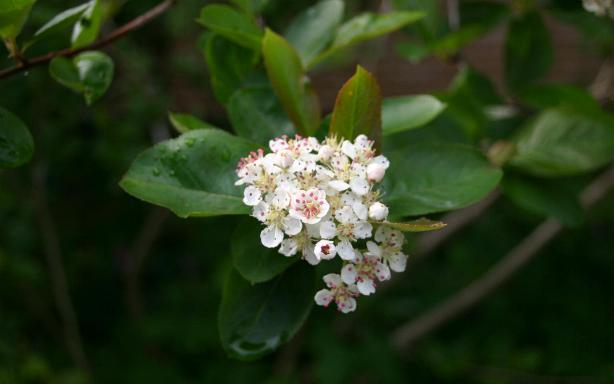
Photo: Sten Porse, CC BY-SA 3.0 · source

Shrub · Rose family (Rosaceae)
Black chokeberry
Aronia melanocarpa · also: Aronia, Chokeberry
Black chokeberry, or aronia, is a shrub of 1–2 m from eastern North America. In May it carries small clusters of white flowers with pink anthers, in August–September glossy black berries in bunches, and in autumn its leaves turn fiery red. It is tough and easy: wet or dry soil, sun or partial shade, and rarely ill. Raw, the berries are very astringent, but cooked and sweetened they are delicious in juice, syrup and jam. Do keep an eye on its suckers, though.
Light
Sun or partial shade
preferably some sun
Moisture
Dry to wet
not fussy
Legal basis
Any garden soil
any pH
Hardiness
Throughout Belgium
no protection needed
Size
1–2 m
tall
Flowering
May
| Pruning months | November–March |
|---|---|
| Height | 1–2 m |
| Native to Belgium | No, planted |
| Poisonous to people and pets | Not known to be poisonous |
| Flowering | May |
Identify
Black chokeberry: how do you recognise it?
- Habit
- Shrub of 1–2 m with many stems from the base; produces suckers.
- Leaf
- Alternate, obovate, 4–7 cm, finely toothed, glossy dark green, with dark glands along the midrib; brilliant red in autumn.
- Bark
- Greyish-brown and smooth.
- Flower
- White flowers (1 cm) with pink anthers in small clusters, May.
- Fruit
- Glossy black berries (6–10 mm) in clusters, August–September; astringent when raw.
- Difference from snowy mespilus
- Snowy mespilus is a large shrub with white star-shaped flowers in clusters in April and sweet, purple berries in June.
- Difference from red chokeberry
- Red chokeberry has a felted underside to the leaves and red berries.
Flowering: May · Harvest and fruit: August–September · Pruning: November–March
Identify by feature: Red autumn colour · Black berries
Looks like it, but isn’t
- Snowy mespilus Amelanchier lamarckii: a large shrub with white star-shaped flowers in clusters in April and sweet, purple berries in June. Difference from snowy mespilus
- Red chokeberry (Aronia arbutifolia): felted underside to the leaves and red berries.
In your garden
Why grow it?
- Berries in August–September for juice, syrup, jam or drying.
- White flowers in May for bees; birds eat the berries.
- Fiery red autumn colour.
- Tough and easy: tolerates wet and dry soil, sun and partial shade.
- Self-fertile: a single bush already gives a crop.
Black chokeberry: where does it grow best?
- Sun to partial shade; in the sun you get the most berries and the best autumn colour.
- Almost any soil, from wet clay to dry sand.
- Allow about 1.5 m width, plus some room for the suckers.
- Also suitable for an informal hedge or a damp corner of the garden.
- Light
- Sun or partial shade
- Legal basis
- Any garden soil
- Moisture
- Dry to wet
- Size
- 2 m tall, 1.5 m wide
- Hardiness
- Throughout Belgium, no protection needed
Goes well with
- Snowy mespilus: Also from North America: white flowers in spring, berries and red autumn colour.
- Guelder rose: Also likes a damp spot; white flower heads in May and red berries in autumn.
- Common dogwood: After the red autumn colour of the chokeberry, its reddish twigs bring colour in winter.
Good and bad companions
Goes well with
- Suits the woodland edge or the light shade of: ginkgo, box elder, ash, honey locust, field maple, silver maple
Maintenance
Black chokeberry: when and how to plant it?
- Plant from November to March, bare-root or from a pot.
- Space the bushes 1–1.5 m apart; in an informal hedge 80 cm–1 m.
- Plant at the same depth as before and mix some compost into the soil.
- To keep the suckers in check, plant it in a lawn (mowing keeps them short) or put in a root barrier.
Care
- Watering
- In dry spells during the first year; rarely needed after that.
- Feeding
- A little compost in spring is enough.
- Suckers
- Dig out unwanted suckers with a spade, or use them to make new plants.
- Harvest
- Cut off the bunches when the berries are completely black and slightly soft, from late August; fully ripe berries are less astringent.
Tip: Mix the berries with apples or pears in compote or jam: the chokeberry adds a deep colour, the apple the sweetness.
Black chokeberry: when to prune it?
Pruning months: November–March.
When: In winter (November–March).
How:
- Little needed: every year, saw a few of the oldest branches off at the base, so the shrub stays young and open.
- Always keep enough strong young shoots from the base to replace the old branches.
- Dig out unwanted suckers.
Caution: Don’t clip the shrub short like a hedge: you would lose many of the flower buds and berries.
Propagation
- Suckers
- In winter, separate a rooted sucker from the parent plant and plant it elsewhere.
- Summer cuttings
- In June–July, take semi-ripe cuttings of 10–15 cm and let them root in cutting compost under plastic.
Black chokeberry: how does it get through the winter?
Hardy throughout Belgium: no protection needed.
- Fully hardy.
- Berries you leave on the bush are eaten by birds in autumn and winter.
Diseases and pests
- Astringent berries: Raw, they make your mouth pucker. Let them ripen fully and use them cooked and sweetened, or mix the juice with apple juice.
- Suckers: On loose soil the shrub spreads by suckers. Dig them out every year.
- Birds: Blackbirds and starlings eat the berries. A net helps if you want a big harvest.
- Aphids: Curled leaves at the shoot tips in spring; usually harmless. Let ladybirds do their work.
Through the year
- January: Winter pruning: remove the oldest branches at the base.
- February: Winter pruning; dig out suckers.
- March: Last pruning; add compost.
- May: Flowering for bees.
- August: Berries turn black; harvest starts in late August.
- September: Harvest: make juice, syrup and jam.
- October: Fiery red autumn colour.
- November: Planting; winter pruning can begin.
- December: Winter pruning.
Use
What can you use it for?
- Food and drink
- Berries for juice, syrup, jam or drying; astringent raw, delicious cooked and sweetened.
- Garden and landscape
- Easy shrub with white flowers, glossy leaves and fiery autumn colour; tolerates both wet and dry soil.
- For wildlife
- Flowers for bees; birds eat the berries.
Edible and useful
- Berries (August–September)
- Pick the clusters from mid-August through September, when the berries are deep black and give slightly under your fingers. They hang on the bush for a long time and mellow a little the longer they stay, but the birds love them too. Cut whole clusters and only strip the berries from the stalks at home. Raw, they are very astringent: use them cooked, dried or mixed with sweeter fruit.
- Storing
- Fresh berries keep for two weeks in the fridge. You can simply freeze them in a bag: frozen berries release their juice more easily. Keep dried berries in a closed jar. Syrup keeps for six months and jam for a year in sterilised bottles and jars.
- Fermenting
- Chokeberry juice can be fermented into wine. It turns out dark and dry because of the many tannins, and needs some extra sugar and patience.
Caution: Only eat the berries of the black chokeberry itself (Aronia melanocarpa). Do not confuse them with other black berries, such as those of wild privet (Ligustrum vulgare), alder buckthorn (Frangula alnus), black nightshade or deadly nightshade (Atropa belladonna): these are poisonous or laxative. Chokeberry has clusters of glossy, round berries with a small crown (the remains of the calyx), dark purple juice and glossy, finely toothed leaves. Raw, the berries are very astringent and large amounts can upset the stomach: start with small portions. Do not pick beside busy roads or from sprayed shrubs, and never eat anything you have not identified with certainty.
Eating and using is at your own risk: see the terms of use.
Recipes
- Chokeberry syrup (Syrup · ± 700 ml · 40 min + 1 hr draining)
- Chokeberry and apple jam (Jam · ± 5 jars of 250 ml · 50 min)
- Dried chokeberries (Dried · ± 250 g dried · 15 min + 8–12 hrs drying)
- Chokeberry liqueur (Liqueur · ± 700 ml · 20 min + 6–8 weeks steeping)
You and this species
Did you know?
- Raw, the berries are so astringent that they make you want to choke: hence the name chokeberry.
- In Poland, aronia is grown on a large scale, mainly for juice.
- Its juice is such a deep purplish-red that it is also used as a natural colouring.