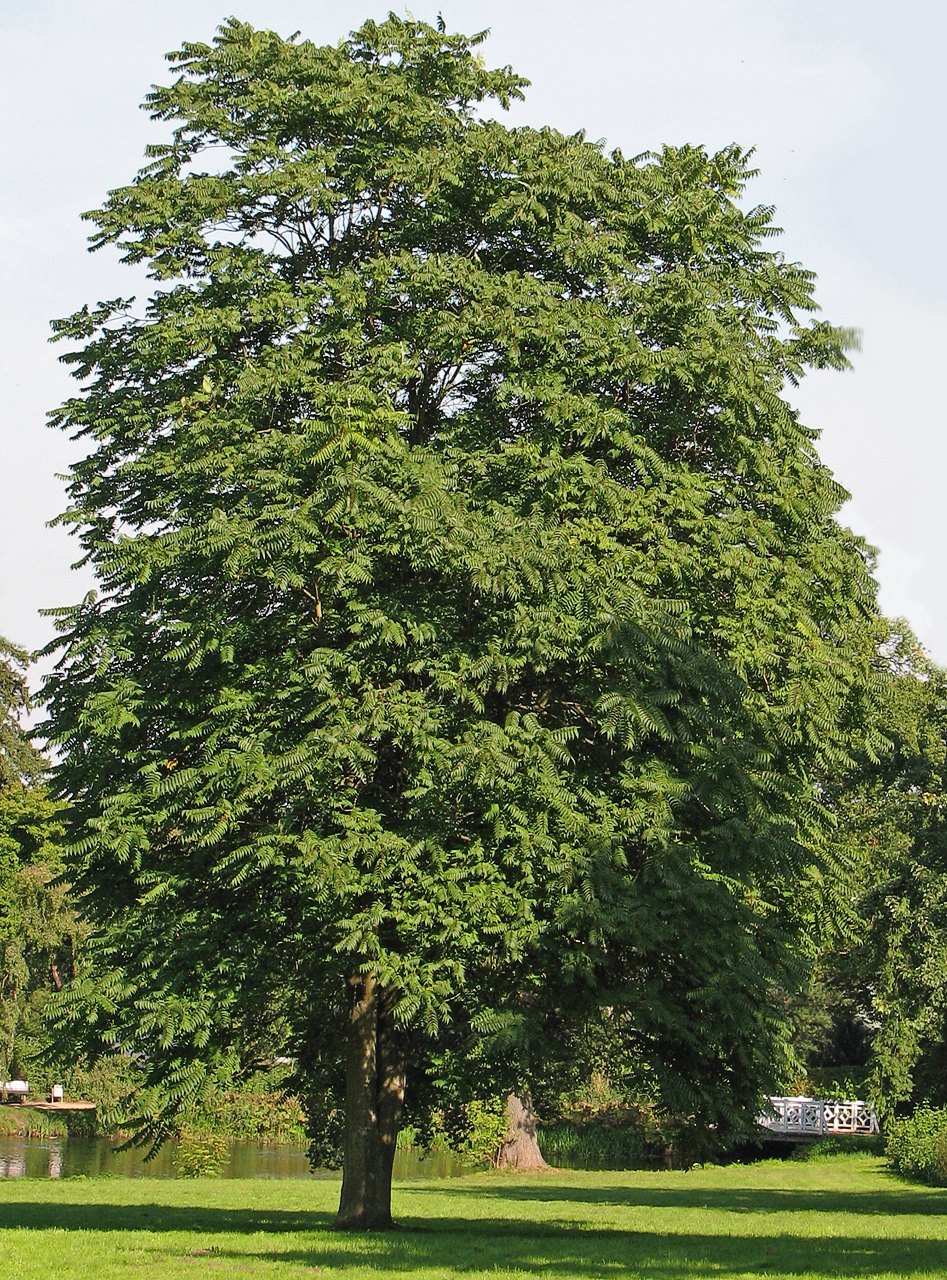
Photo: Darkone (talk · contribs), CC BY-SA 2.5 · source

Broadleaf tree · Quassia family (Simaroubaceae)
Tree of heaven
Ailanthus altissima · also: Ailanthus
Tree of heaven comes from China and was brought to Europe as an ornamental tree in the 18th century. It grows at breakneck speed to 15–25 m, has huge pinnate leaves that stink when crushed, and forms dense stands through root suckers and thousands of winged seeds. In this way it crowds out native plants and pops up in joints, walls, railway banks and gardens. Since 2019 it has been on the EU list of invasive alien species: planting, growing and selling it is banned. This profile helps you recognise it, keep it in check and remove it.
Caution: Invasive non-native species on the EU list: planting, growing and selling it is banned. The sap can irritate the skin.
Light
Full sun
warm and bright
Moisture
Dry
tolerates drought
Legal basis
Any garden soil
any pH
Hardiness
Throughout Belgium
no protection needed
Size
15–25 m
tall
Flowering
June–July
| Height | 15–25 m |
|---|---|
| Native to Belgium | No, naturalised |
| Good for bees, butterflies and birds | Little |
| Poisonous to people and pets | Not known to be poisonous |
| Flowering | June–July |
Identify
Tree of heaven: how do you recognise it?
- Habit
- Fast-growing tree of 15–25 m with an open crown and thick, sparsely branched twigs; forms stands through root suckers.
- Leaf
- Alternate, pinnate, 40–90 cm long with 13–41 leaflets. These are untoothed apart from 1–3 coarse teeth near the base, with a small gland beneath. Stinks when crushed.
- Bark
- Smooth, grey with pale vertical stripes.
- Flower
- Large panicles of small yellow-green flowers in June–July, mostly on separate male and female trees; the male flowers smell unpleasant.
- Fruit
- Clusters of twisted winged fruits that turn red to brown.
- Difference from walnut
- Walnut has fewer (5–9), larger leaflets without teeth, and a pleasant smell.
- Difference from ash
- Ash has opposite leaves with toothed leaflets.
Flowering: June–July
Identify by feature: Pinnate leaves · Winged seeds
Looks like it, but isn’t
- Walnut Juglans regia: fewer (5–9), larger leaflets without teeth, and a pleasant smell. Difference from walnut
- Ash Fraxinus excelsior: opposite leaves with toothed leaflets. Difference from ash
In your garden
Why grow it?
- Why not to plant it: it is on the EU list of invasive species; planting, growing, selling and giving it away are banned.
- It spreads through root suckers and thousands of seeds and crowds out native plants.
- Its roots and seedlings force their way into joints, walls and paving and damage them.
- Recognise it early: a seedling is still easy to pull up, while a large tree is costly to deal with.
Tree of heaven: where does it grow best?
- Grows in full sun on any soil, even on rubble, gravel and between paving.
- Tolerates drought, heat and air pollution: that is why it thrives so well in towns and cities.
- You find it mainly in towns and along railways and roads; from there it spreads into gardens, verges and woodland edges.
- Light
- Full sun
- Legal basis
- Any garden soil
- Moisture
- Dry
- Size
- 25 m tall, 12 m wide
- Hardiness
- Throughout Belgium, no protection needed
Goes well with
- Rowan: A native tree with equally graceful pinnate leaves, but small and a feast for birds.
- Silver birch: Grows just as fast and easily on poor soil, but is native.
- Field maple: A native tree that tolerates drought and urban soil.
- Small-leaved lime: A native shade tree that also flowers for bees.
Good and bad companions
Goes well with
- Tolerate the shade under this tree: oregon grape, rhododendron, oleaster, japanese skimmia, garden privet, camellia, laurustinus, box-leaved honeysuckle
Maintenance
Tree of heaven: when and how to plant it?
- Don’t plant it: it is banned, even if someone gives you one. Don’t let seedlings grow on in your garden either.
- Looking for a tree with graceful pinnate leaves? Choose rowan. For a fast, airy tree on poor soil: silver birch. For shade: field maple or small-leaved lime.
- Pull up seedlings as soon as you see them, roots and all, preferably after rain when the soil is soft.
- Is there a large tree of heaven in or next to your garden? Don’t fell it yourself; have it dealt with by a specialist contractor.
Care
- Seedlings
- Pull them up in their first year with the whole root; broken-off roots sprout again.
- Root suckers
- Cut or mow suckers again and again, several times a year and for years on end, until the roots are exhausted.
- Female trees
- Trees with red fruit clusters seed themselves most: deal with those first.
- Reporting
- Report trees of heaven to your local council or on waarnemingen.be: that way control can be targeted.
Tip: Not sure whether it is tree of heaven or walnut? Crush a leaflet: tree of heaven stinks, walnut smells spicy. Also look for the 1–3 coarse teeth at the base of each leaflet.
Tree of heaven: when to prune it?
When: Don’t prune; have it removed.
How:
- Felling or pruning triggers dozens of root suckers.
- Pull up young seedlings, roots and all; have large trees dealt with by a specialist: usually the tree is first killed off (ring-barking or a trunk treatment) and only felled afterwards.
- Report the species to your local council or on waarnemingen.be.
Caution: Wear gloves and long sleeves: the sap can irritate the skin.
Propagation
- Don’t propagate
- Propagating, growing and giving it away are banned: it is on the EU list of invasive species.
- How it spreads
- Every year female trees produce large numbers of winged seeds that blow a long way; it also suckers far from the trunk, especially after felling or pruning.
Tree of heaven: how does it get through the winter?
Hardy throughout Belgium: no protection needed.
- Fully hardy.
- In winter you recognise it by its thick, bare twigs with large, heart-shaped leaf scars, and by fruit clusters that often hang on until spring.
Diseases and pests
- Suckers after felling: A felled tree of heaven sprouts dozens of shoots all around. Kill it off before felling, and keep cutting new suckers for years.
- Seedlings in joints and walls: Within a few years seedlings grow into trees that damage masonry and paving. Pull them up young, with the whole root.
- Skin irritation: The sap and crushed leaves can irritate the skin. Wear gloves and long sleeves.
- Smell: Crushed leaves and male flowers smell unpleasant. At least it helps with identification.
Through the year
- May: Leaves open: look for seedlings and suckers with the pinnate, smelly leaves and pull them up.
- June: Flowering: male trees smell unpleasant, female trees set seed.
- July: Cut or mow suckers again.
- August: Fruit clusters turn red: these are female trees, deal with them first.
- September: Pull up this year’s seedlings before they root firmly.
- October: Seeds blow away; report trees to your local council or on waarnemingen.be.
You and this species
Did you know?
- An invasive non-native species from China, on the EU list of invasive alien species.
- Young trees and root suckers often grow more than a metre a year.
- The name Ailanthus comes from a Moluccan tree name that is thought to mean ‘tree of heaven’.
- The name Ailanthus comes from ailanto, a word from the Moluccan island of Ambon thought to mean ‘tree of heaven’; altissima means ‘very tall’.
- In the 19th century it was planted in Europe to rear the ailanthus silkmoth, a silkworm that feeds on its leaves, in the hope of producing silk.