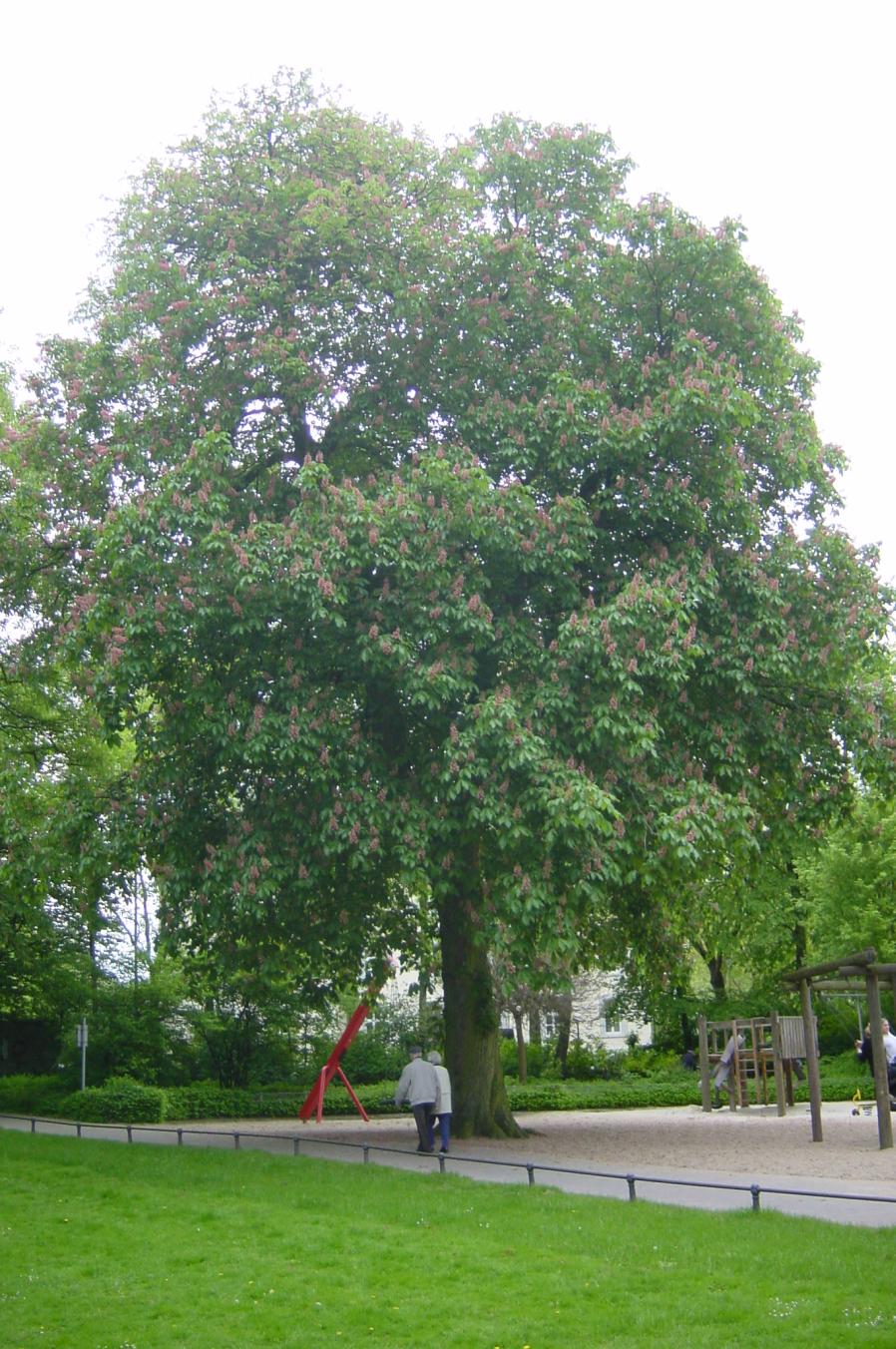
Photo: de:Benutzer:Christian Arntzen, CC BY-SA 3.0 · source

Broadleaf tree · Soapberry family (Sapindaceae)
Red horse chestnut
Aesculus × carnea
Red horse chestnut is a compact horse chestnut of 10–20 m with dark green, hand-shaped leaves and, in May, upright candles of pink to red flowers. A cross between horse chestnut and the American red buckeye, it stays smaller than horse chestnut and is far less troubled by the horse chestnut leaf miner. On squares, in streets and in larger gardens it is a magnificent flowering tree. It is too big for a small garden. As with horse chestnut, the conkers are poisonous to people and animals.
Caution: The conkers are poisonous to people, and the leaves and bark also contain toxic substances. Children who eat conkers can get stomach ache and vomit; don’t confuse them with edible sweet chestnuts. They are dangerous for dogs and horses too.
Light
Sun or partial shade
preferably some sun
Moisture
Normal
no wet feet
Legal basis
Any garden soil
any pH
Hardiness
Throughout Belgium
no protection needed
Size
10–20 m
tall
Flowering
May
| Pruning months | July–August and November–February |
|---|---|
| Height | 10–20 m |
| Native to Belgium | No, planted |
| Poisonous to people and pets | Yes, take care with children and pets |
| Flowering | May |
Identify
Red horse chestnut: how do you recognise it?
- Habit
- Tree of 10–20 m with a rounded, dense crown about 10 m across.
- Leaf
- Opposite, palmately compound with 5 (sometimes 7) dark green, slightly puckered leaflets 8–15 cm long; smaller and darker than in horse chestnut.
- Bark
- Grey-brown, smooth to finely scaly. Buds less sticky than in horse chestnut.
- Flower
- Upright candles of pink to deep red flowers, in May.
- Fruit
- Small, round husks with few or no spines, containing 1–3 brown conkers; often only a few fruits.
- Difference from horse chestnut
- Horse chestnut has white flowers, larger and paler leaflets, very sticky buds and very spiny husks.
Flowering: May · Pruning: July–August and November–February
Identify by feature: Opposite leaves · Pink blossom · Nuts, acorns and chestnuts
Looks like it, but isn’t
- Horse chestnut Aesculus hippocastanum: white flowers, larger and paler leaflets, very sticky buds and very spiny husks. Difference from horse chestnut
In your garden
Why grow it?
- Pink to red flower candles in May, loved by bumblebees and bees.
- Stays smaller than horse chestnut, with a crown about 10 m across.
- Far less troubled by the horse chestnut leaf miner: the leaves stay green for longer.
- Few fruits and husks with few or no spines: less mess than under a horse chestnut.
Red horse chestnut: where does it grow best?
- Sun to partial shade; it flowers best in sun.
- Almost any soil that isn’t too dry; deep and fertile is ideal.
- Allow for a crown about 10 m across: for a larger garden, a square or a street, well away from buildings.
- Little grows under the dense crown; plant shade-tolerant ground cover there.
- Light
- Sun or partial shade
- Legal basis
- Any garden soil
- Moisture
- Normal
- Size
- 15 m tall, 10 m wide
- Hardiness
- Throughout Belgium, no protection needed
Goes well with
- Lesser periwinkle: Evergreen ground cover that tolerates the shade under the crown.
- Holly: An evergreen shrub for the shady edge under the crown.
- Horse chestnut: In a large park or a long avenue: together, white and red candles in May.
- Wood anemone: Flowers in March–April under the crown, before the leaves unfold.
Good and bad companions
Goes well with
- Tolerate the shade under this tree: oregon grape, rhododendron, oleaster, japanese skimmia, garden privet, camellia, laurustinus, box-leaved honeysuckle
Best kept away from
- Sun-loving plants get too little light under the dense crown: english lavender, heather, butterfly bush, blackthorn, highbush blueberry, sea buckthorn, japanese rose, broom
Maintenance
Red horse chestnut: when and how to plant it?
- Plant from November to March when the ground isn’t frozen.
- Cultivars such as ‘Briotii’, with deep red flowers, are grafted: choose a tree with a straight trunk and a healthy graft union.
- Put a stake on the windward side and tie the trunk loosely; remove stake and tie after 2–3 years.
- Water generously after planting and during dry spells in the first year.
Care
- Watering
- In dry spells during the first two years; after that it copes.
- Feeding
- Not needed.
- Fallen leaves
- Rake up the fallen leaves in autumn if they had leaf miner damage: the pupae overwinter in them.
- Checks
- Have an older tree near a path or play area checked by an arborist every few years.
Tip: Not enough room for a horse chestnut? The red one stays smaller and suffers far less from the leaf miner. Choose ‘Briotii’ for the darkest flowers.
Red horse chestnut: when to prune it?
Pruning months: July–August and November–February.
When: Dead, diseased and broken branches can be removed at any time of year. Formative pruning in winter or summer.
How:
- Avoid large saw cuts: they rot easily. So prune mainly young trees, on small branches.
- Train a young tree on a single trunk and gradually remove branches that hang too low.
- On a grafted tree, remove shoots from the rootstock.
Caution: Have trees with bleeding canker (rust-brown sap stains on the trunk) checked by an arborist.
Propagation
- Sowing
- Unusually for a hybrid it comes true from seed: in October, sow fresh conkers straight away, 3–5 cm deep, in a pot or where they are to grow, and don’t let them dry out. Cultivars such as ‘Briotii’ are grafted.
Red horse chestnut: how does it get through the winter?
Hardy throughout Belgium: no protection needed.
- Fully hardy.
- In winter you recognise it by its buds, which are less sticky than those of horse chestnut.
Diseases and pests
- Bleeding canker: Rust-brown to black, sticky sap stains on the trunk and dying bark, caused by a bacterium; red horse chestnut can get it too. There is no cure; have the tree checked by an arborist.
- Horse chestnut leaf miner: Brown blotches in the leaves caused by tiny caterpillars feeding inside them; red horse chestnut is far less affected than horse chestnut. Rake up the fallen leaves.
- Rot: Large saw cuts rot easily. So prune mainly when the tree is young and keep the wounds small.
Through the year
- January: Remove dead branches; winter formative pruning.
- February: Formative pruning still possible; plant in mild weather.
- March: Last month for planting.
- April: Leaves unfold.
- May: Flowering: pink to red candles full of bumblebees and bees.
- July: Summer pruning of young trees.
- August: Summer pruning still possible.
- September: The few conkers fall.
- October: Gather conkers for sowing; keep them away from children and dogs.
- November: Clear up fallen leaves; planting season and winter pruning begin.
- December: Remove dead branches; winter formative pruning.
Use
What can you use it for?
- Garden and landscape
- Compact flowering tree for streets, squares and larger gardens.
- For wildlife
- The red flower candles attract bumblebees and bees.
- Also used for
- Far less troubled by the horse chestnut leaf miner than horse chestnut.
Caution: The conkers are poisonous to people.
You and this species
Did you know?
- A cross between horse chestnut and the American red buckeye. Unusually for a hybrid, a doubling of its chromosomes makes it fertile, and it comes true from seed.
- Its American parent, the red buckeye, is a shrub from the south-eastern United States with red flowers that are pollinated by hummingbirds.
- The cultivar ‘Briotii’, with deep red flowers, is named after the French gardener Briot, who raised it in the 19th century.